

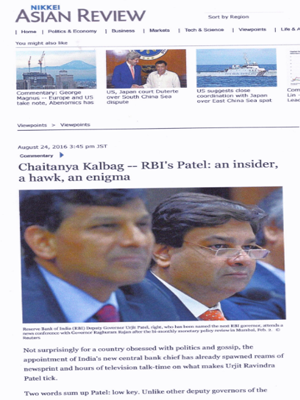
RBI’s Patel – an insider, a hawk, an enigma
Published date: 24th Aug 2016, Nikkei Asian Review
View PDFChaitanya Kalbag, Contributing writer
Not surprisingly for a country obsessed with politics and gossip, the appointment of India’s new central bank chief has already spawned reams of newsprint and hours of television talk-time on what makes Urjit Ravindra Patel tick.
Two words sum up Patel: low key. Unlike other deputy governors of the Reserve Bank of India he has hardly made any speeches, only occasionally intervening in interactions with the press or analysts at the request of his boss, outgoing Governor Raghuram Rajan. Unlike the loquacious and frequently passionate Rajan, who relished the limelight, made dozens of speeches and gave innumerable interviews during his three-year term, Patel looks likely to keep his own counsel.
The RBI website carries only one short speech by Patel from 2015, and a newspaper interview from 2014. In his speech to management students, Patel made a point of praising several economic programs of Prime Minister Narendra Modi. In his interview, he strongly criticized the International Monetary Fund’s prescription of more public spending on infrastructure just as interest rates began to rise. “Increasing fiscal spending in infrastructure is the big bazooka that people are talking about to end secular stagnation in large parts of the developed world. However, starting a publicly driven infrastructure cycle when interest rates are going up does not sound terribly responsible,” he said.
These examples shine some light on the philosophy Patel, 52, brings to his role. At a time when India’s gross domestic product is likely to average 7.5% annual growth for the next few years, Patel faces a few unique challenges.
In his role overseeing monetary policy, Patel was the most important of Rajan’s four deputies. His promotion to the top RBI post is seen as a textbook rise by an insider. But the politics surrounding his elevation are not so straightforward.
Although he initially looked set for an academic career, his trajectory over the past quarter-century spans five years with the IMF, and two decades in India: a two-year deputation with the RBI, a stretch as a consultant to India’s ministry of finance, a brief stint with the country’s biggest private conglomerate, the Reliance Group, and spells as a visiting fellow with the Brookings Institution and an advisor to the Boston Consulting Group.
Patel is well liked by both the ruling Bhartiya Janata Party (BJP), which appointed him to several blue-ribbon panels during the 1998-2004 tenure of Prime Minister Atal Behari Vajpayee, and by the opposition Congress party. During Modi’s long term as chief minister of Gujarat state, Patel also briefly served on the board of the Gujarat State Petroleum Corporation. Although the government, was insistent in its announcement that Patel was rigorously vetted by a search committee of senior officials, it is widely believed that the final decision was taken by Modi, Finance Minister Arun Jaitley, Modi’s principal secretary Nripendra Misra and BJP president Amit Shah.
Markets underwhelmed
The RBI post is politically sensitive, especially after it became clear that Rajan’s decision not to seek a second term was linked to attacks on him by BJP politicians and Modi’s perceived reluctance to ride to his defense. Investors and markets did not take kindly to Rajan’s strained exit, nor were they overjoyed at Patel’s appointment.
This is because, officials say, the nature of Rajan’s departure had forced Modi and Jaitley to opt for continuity. “They have no option but to bring in an inflation hawk like Patel because high inflation could queer the pitch for Modi ahead of the 2019 general elections,” one economist said. Little wonder that both bond markets and the rupee fell on the Monday after his appointment was announced Aug. 20.
Indeed, a committee headed by Patel himself in January 2014 made three far-reaching recommendations that seem certain to haunt him. First, it suggested a shift to the consumer price index as the base metric, instead of the outdated and misleading wholesale price index. Second, it called for inflation targeting, and Rajan and Modi agreed to a range of 4% CPI plus or minus two percentage points. Third, it took away the RBI governor’s sole discretion on interest-rate changes, paving the way for a new six-member Monetary Policy Committee, with three members from the RBI and three nominated by the government.
Patel walks into office after CPI inflation crossed the RBI’s danger line to 6.07% in July, fueled by high food prices that may be mitigated by a bountiful monsoon. To add to his challenges, the MPC will likely be finalized in September, meaning he will not have the autonomy Rajan enjoyed at the next planned policy review on Oct. 4.
The other big challenge facing Patel will be the non-performing asset crisis dragging down India’s banks. Here again, the Asset Quality Review that Rajan launched last year has exposed the scale of the debt held by some of India’s biggest companies and is forcing several of them to start selling off stressed assets. Rajan lanced the boil. What will Patel do to stanch the outpouring of poisoned balance sheets?
Urjit, Patel’s first name, means “energized” in Sanskrit, and fittingly, the new chief is an expert on energy and infrastructure at BCG. Between 1997 and 2006 he helped set up and then joined the board of the state-backed Infrastructure Development Finance Corporation. Interestingly, IDFC was granted a banking license in July 2015, but Reliance, which was given a payment-bank license in August last year, has yet to start one. Payment banks are stripped-down banks that accept smaller deposits and allow mobile-phone transfers but do not offer loans — effectively covering the “last mile” for India’s unbanked poor.
In May this year, the RBI published guidelines for issuing new universal banking licenses and specifically excluded “large industrial or business houses”, limiting them to only 10% of equity in a new bank. This effectively bars Reliance, which is known to be keen on adding banking to its petrochemicals, telephone and consumer retail businesses. How Patel manages his old connection to Reliance will be closely watched. Reliance wields huge influence. “You can check out of Reliance, but you can never leave,” one official said, referring to the group’s impressive roster of top-dollar talent and the power of its alumni network.
It is also unclear whether Patel will continue another powerful committee set up to review India’s Fiscal Responsibility and Budget Management Act, which committed governments to limiting the central budget’s fiscal deficit to 3% of GDP. Jaitley has brought the deficit down to 3.9% in 2015-6 and pledged to achieve 3.5% this fiscal year. The new panel has been charged with examining a deficit range, which could offer a spendthrift government more wiggle room.
Here, Patel’s past conservatism on fiscal responsibility would have held back too much generosity. In collaboration with his Yale PhD adviser, Willem Buiter, now Citigroup’s global chief economist, Patel wrote a few significant papers with titles like the seminal “Debt, Deficits and Inflation: An Application to the Public Finances of India” (National Bureau of Economic Research, 1990) and “Fiscal Rules in India: Are They Effective?” (NBER, 2010).
In January 2012, a year before he joined the RBI, Patel and Gangadhar Darbha wrote a paper for the U.S.-based Brookings Institution that heavily criticized India’s inflation-fighting policies. As recently as six months ago, he and Amartya Lahiri wrote a thoughtful RBI paper entitled “Challenges of Effective Monetary Policy in Emerging Economies.”
So it is clear over the next three years India’s central bank will be steered by a fiscal and monetary taskmaster who is very academic, even doctrinaire. Patel is a loner, and close associates say he can be aloof and even acerbic. His credentials are nevertheless impeccable.
Different style
In style and background, Patel is a striking contrast to his predecessor Rajan, a brilliant and flamboyant financial and macroeconomic specialist and teacher. A former IMF chief economist, he was educated at India’s best engineering and management schools and earned his doctorate at MIT Sloan. Patel, just a year younger, is a Kenya-born Gujarati and the son of a Nairobi businessman. A naturalized Indian citizen, he had an elite international education at the London School of Economics and Oxford University and earned his doctorate at Yale University.
At Yale, the formidable economist Buiter was clearly a huge influence on Patel. Buiter, a merciless critic of misguided monetary policy and a fiscal conservative like Patel, has a lengthy curriculum vitae featuring his prolific academic writing and a long string of prestigious appointments. Buiter has warned that the global economy is sliding into a prolonged recession, marked by negative real interest rates and disincentives for savings. Indeed, from a perspective that Patel undoubtedly shares, the world is deglobalizing, protectionism is rising, and factors like China’s slowdown, depressed commodity prices and subdued trade are possibly horsemen of a new apocalypse. How masterfully will the new RBI governor ride the steed of Indian policymaking?







**mitolyn reviews**
Mitolyn is a carefully developed, plant-based formula created to help support metabolic efficiency and encourage healthy, lasting weight management.
j2outy
c0q2ei
fuxhnt
gax89u
0jd5ty
q9w8aa
ygb6eq
The proxy server functions as an kind of middleman between a user and the internet.
When a client connects via the proxy, the data go through the proxy first, and then it forwards them to the intended website for you.
Trust and logging No-logs VPN policies Which logs must not exist, how audits and court cases prove it, and how to read a policy in five minutes.
This approach helps to mask your IP address, get around geo-restrictions, and strengthen security.
That said, many proxy servers are insecure, so it is crucial pick a reliable provider.
Dentro de esta plataforma, quienes accedan tienen la posibilidad de obtener créditos rápidamente.
Este recurso presenta opciones de préstamo a la medida que responden a las necesidades de cada persona.
MobCash
El proceso resulta fácil y se lleva a cabo de manera íntegramente en línea, sin necesidad de gestiones complicados.
Además, el sitio procura proporcionar un servicio rápido y seguro para quienes lo utilizan.
Принцип осознанного гемблинга базируется в формировании у пользователя ответственного подхода к азартным играм.
Эта модель требует соблюдение индивидуальных ограничений по длительности и деньгам, отведённым на сессии.
https://lunax-casino.com/
Важнейшими элементами в данной концепции служат самоконтроль, понимание рисков и навык вовремя сделать паузу.
Главная задача — сохранить участие только как форму отдыха, а не средство дохода или решения жизненных трудностей.
Dentro de este recurso, los usuarios tienen la posibilidad de conseguir dinero rápidamente.
La plataforma presenta modalidades de crédito ajustables las cuales responden a los requerimientos del solicitante.
MobCash
El trámite resulta simple y se completa de forma totalmente en línea, sin gestiones presenciales.
También, el portal procura proporcionar una experiencia rápido así como confiable a sus usuarios.
На данном сайте есть шанс получить ценную информацию.
https://carlover.fashionpromo.ru/3Qkr7W0uyk8h/
На данном веб-сайте можно обнаружить интересную информацию.
https://1-mk.ru/detail/465-comparative-review-beepbeep-casino-vs-top-competitors-in-2024/
Торжество становится важнейшим этапом в судьбе людей.
Данный праздник означает начало новой семьи.
Этот день соединяет этих родных партнёров перед близкими и гостями.
https://multivarki-recepti.com/organizacziya-dnya-rozhdeniya-i-yubileya-samostoyatelno.html
Церемония позволяет влюблённым торжественно признаться в любви и дать обещания.
Это событие является воспоминанием навсегда, сохраняя любовь супругов.