

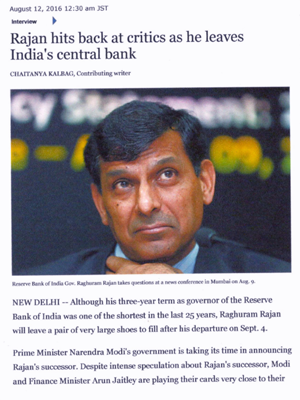
Rajan hits back at critics as he leaves India’s central bank
Published date: 12th Aug 2016, Nikkei Asian Review
View PDFChaitanya Kalbag, Contributing writer
NEW DELHI – Although his three-year term as governor of the Reserve Bank of India was one of the shortest in the last 25 years, Raghuram Rajan will leave a pair of very large shoes to fill after his departure on Sept. 4.
Prime Minister Narendra Modi’s government is taking its time in announcing Rajan’s successor. Despite intense speculation about Rajan’s successor, Modi and Finance Minister Arun Jaitley are playing their cards very close to their chests.
On the question of on who could succeed him, Rajan told the Nikkei Asian Review in an exclusive interview on Aug. 11 that there was no single formula in finding his replacement.
“Sometimes what is needed is somebody who’s going to maintain the system and stabilize the system and build on it, and sometimes who you need is somebody who will shake up the system. So, I think that those things can vary depending on the time,” he said.
At 53, Rajan was one of the youngest ever Indian central bank governors and was seen as one of the most outspoken and controversial.
Among candidates mentioned as potential successors are Urjit Patel, 52, one of the central bank’s deputy governors and a respected economist; Arvind Panagariya, 63, the vice-chairman of the government’s policy think tank, the National Institute for Transforming India, and a former Columbia University professor; Arundhati Bhattacharya, 60, who heads the State Bank of India, the country’s largest bank; Rakesh Mohan, 68, another prominent economist and former RBI deputy governor; and Subir Gokarn, 56, India’s executive director on the International Monetary Fund board, a respected economist and former RBI deputy governor.
In the past, RBI governors have come from within the central bank’s own ranks or from the country’s financial bureaucracy. Rajan was a former IMF chief economist who acquired “star” status when he accurately predicted the global financial crisis of 2008, although his warnings were seen as controversial ahead of the crisis.
There is little doubt that Rajan, a prolific speaker, was one of the most outspoken and controversial central bankers India has seen — and drew considerable flak because of his forthright views. His outsider status drove some of his more pointed comments on touchy subjects such as crony capitalism, once rampant but now much subdued, or even about tolerance under a government perceived as right-wing and hewing to a Hindu majoritarianism.
In his interview with NAR, Rajan was at pains to dispel the impression that he was a relentless critic of the Modi government. “I would say first that I haven’t been a firm critic of the government as has been sometimes portrayed. I have been somebody who has warned or cajoled about the direction of economic policy, absolutely. I think that has been done with the broader intent of macro[economic] stability that the RBI has firmly a mandate [for],” he said.
Rajan appeared to blame a headline-hungry press for studying and analyzing every word he uttered at the RBI and sometimes taking his comments out of context to make him sound like he was criticizing the government.
“That is a hard standard for anybody’s commentary to meet, especially if you have a press which is continuously looking for what they think are slights to the government. It is easy to build on that,” he noted as he sought to correct claims that his governorship was one “which has been off the reservation.”
“I don’t make political comments, I make economic comments. Economic comments can be taken [as] politically based [depending] on who is reading it and how they report it. What I have said is [that] any suggestions I have given to the government on the path of government actions have all been private. I have never publicly said ‘you should do this’ and you should do that.” So, in that sense sometimes these speeches [of mine] are reported as “he’s been a vocal critic of the government.’ Show me a place where I have criticized the government in any of my speeches,” Rajan said.
Rajan’s tenure, which began three years ago in September 2013 under the previous Congress government when the rupee was at record lows and confidence in the economy was ebbing, has been a steadying factor for Modi and his economic team. Still, the prime minister, who is known to brook no dissent within his cabinet, will likely look for a new governor who is less of a celebrity and more attuned to the ruling Bhartiya Janata Party.
A few factors may help Modi and Jaitley steer the economy through the shoals of Rajan’s imminent departure. One of the biggest prizes, the Goods and Services tax, has received parliamentary approval and could herald the creation of a common market for India.
Millions of government employees are about to receive sizeable salary increases, which will fuel consumer spending as India’s festival season begins. The first good monsoon in three years promises a revival in rural demand. Industrial output is starting to rise from a long slumber. Global oil prices are still low, reducing India’s current account deficit. The rupee and stock markets have shrugged off Brexit, or rather the impact of Britain’s decision to leave the European Union.
In addition to the passage of GST, the Modi government is liberalizing foreign direct investment rules and bringing the country’s poor and unbanked population into the financial system by transferring subsidy payments directly to them. Modi appears to be successfully walking a socialist-populist tightrope midway through his five-year term as he approaches elections in several key Indian states early next year.
At his final bimonthly policy review on Aug. 9, Rajan chose to leave key interest rates unchanged. But consumer price inflation, which is forecast to have risen to 5.9% in July after 5.77% in June, is close to Rajan’s comfort zone of 6% that he expected by March 2017. Worryingly, food price inflation has been climbing inexorably.
Nevertheless, Rajan said inflation can be beaten. “Why are we an exception in terms of beating inflation? If you look at emerging markets around the world — Malaysia, Thailand, Indonesia, the Philippines seem to have relatively low levels of inflation. So, if these countries can do it, why can’t we? What is so different about us? A country like Vietnam has a high proportion of food in its consumer price index, so we are not the only country to have a high proportion of food in our CPI,” he said.
Significantly, his last monetary policy review will also be the final one to be led independently by an RBI governor. One of Rajan’s key bequests to his successor is a Monetary Policy Committee that he hammered out after months of closed-door negotiations with the government. The six-member MPC will have three government nominees. Although the governor has a casting vote, the MPC is widely seen as curbing the central bank’s independence.
However, Rajan disputed that interpretation. “The governor is independent and the MPC enhances the RBI’s independence on monetary policy. The governor can still persuade the members of the MPC to his or her way of thinking. So, I am not sure that the MPC implies the RBI governor has no influence. What it does mean however is that basically the RBI does not determine policy alone but based on a consensus within a committee. So, to that extent yes, they have given up a little bit of power, but they gain some because committees are more immune to pressure.”
What about the uncompleted Asset Quality Review he launched that brought into the open a mountain of non-performing assets in the banking system? Despite the government’s pledge to inject fresh capital into teetering state-owned banks, is a financial crisis imminent?
“I think that is too pessimistic a view,” Rajan said. “I think the process is under way, that the culture of forbearance has turned, that the problems are coming out into the open and therefore the solutions are now discussed more openly.”
He said dozens of key infrastructure projects paralyzed by bad debts may not remain abandoned. “In terms of projects there is discussion now about how we [can] bring in good strong management if the project has been mismanaged. Should we bring in turnaround specialists, should those turnaround specialists come from retired people in the industry? So, creative solutions are emerging. If you see asset sales are now happening, so firms are doing the restructuring.”
Rajan laughed off suggestions that he might be in the running to succeed IMF Managing Director Christine Lagarde if she should step down in the wake of a financial ethics case she faces in France. “I am heading towards academia. I think I have done enough administration for a little while and while I like it in reasonable doses, I also want to submerge myself in ideas for a little while,” Rajan said.







kv4ty0
tfsk7z
0ratzc
pav0e2
1fvacw
xkow94
spkozt
36f5i5