The Needle’s Eye
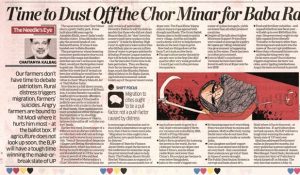
Time to Dust Off the Chor Minar for Baba Ramdev
Published date: 8th April 2016, The Economic Times
View PDFOur farmers don’t have time to debate patriotism. Rural distress triggers migration, farmers’ suicides. Angry farmers are bound to hit Modi where it hurts him most – at the ballot box. If agriculture does not look up soon, the BJP will have a tough time winning the make-or-break state of UP.
The squat and circular Chor Minar sits in a pretty Delhi park. It was built about 800 years ago by Alauddin Khilji, one of India’s early Muslim rulers. It has 225 holes to display the severed heads of condemned thieves. It’s time it was handed over to Baba Ramdev.
The gurupreneur, whose booming consumer goods empire churns out products like soaps and disinfectants that that uses cow’s urine, would put the forgotten urine to good use. He told a lusty crowd earlier this week that if he had not been law-abiding, he would have been heading thousands of people who refused to chant Bharat Mata Ki Jal, or “Hail Mother India’.
Now that he is a full-blown tycoon with estimated turnover of $370 million, it is time Ramdev turned his baleful eye to economic offenders. Not very long ago, China used to publicly execute its criminals in open fields with a bullet in the back of their heads. Now capital punishment is meted out through lethal or by shooting.
Ramdev, like the Queen of Hearts, believes it should be off with the traitor’s heads.
Earlier this week I heard anger of a different sort at a forum with farmers who face rack and ruin as things go from bad to worse in our countryside. Tens of thousands of desperate villagers are fleeing Marathwada in Maharashtra, which has been suffering its worst drought in a century, and Bundelkhand in UP, for nearby cities in search of jobs and food.
If you Listened to Maharashtra’s Cheif Minister, you would think the only Crisis is of patriotism.
Devendra Fadnavis told the state assembly that those who did not chant Bharat Mata ki Jai “Don’t love this country (and) have no place in this country.” It took the Bombay High Court to upbraid cricket authorities who blithely plan to use six million literes of water to prepare pitches for 20 Indian Premier League matches that will be held in the parched state.
Our farmers don’t have time to debate patriotism. They are fleeing their farms because they see no hope, much like Shambu Mahato (Balraj Sahni) in Do Bigha Zamin. Agricultural economist Ashok Gulati says if the government wants to encourage urbanization and reduce India’s dependence on agriculture, then it must create more jobs. “Migration to cities ought to be a pull factor, not a push factor caused by distress.”
Minister of State for Finance Jayant Sinha urged the farmers at the conference to remember steps his government had taken to help them. The Pradhan Mantri Krishi Sinchai Yojana aims to expand irrigation from an unsustainable low of 46 percent. The Fasal Bima Yojana aims too insure crops against booth drought and floods. The Gram Sadak Yojna aims too build roads to and in every village. And the soil health card scheme will try to help farmer decide on best crops to grow.
How bad are things down at the farm? Let’s look at a few facts:
- The agriculture sector shrank by one percent in the Sept.-Dec 2015 quarter after very weak growth of 1.6 and 2 percent in the previous two quarters.
- Agriculture needs to grow by a real 12 percent annually if farmers’ incomes are to double by 2022, which is Prime Minister Narendra Modi’s goal.
- India’s farm productivity is among the lowest in the world. Its rice yields per hectare are 46 percent below China’s, and its wheat yields are 39 percent lower than China’s. Rice output per hectare is even below Bangladesh.
- India is the world’s biggest consumer of pulses, but again, yields are lower than all other producer countries.
- Despite all the talk about higher Minimum Support Prices (they were raised on average by a paltry 50 rupees per 100 kg), wheat and rice procurement are happening only in five states. There has been no cotton procurement.
- Even in Modi’s constituency, Varanasi farmers have been forced to sell rice at 20 percent below MSP.
- By banning exports of everything from rice and wheat to onions and potatoes, Modi is effectively taxing the farmers who do not have free access to markets inside or outside India.
- Cow slaughter and beef export bans in most states have hit farmers very hard — they cannot feed their animals nor get rid of them in times of severe drought.
- The Public Distribution System is corrupt and leaks about 46%.
- Food and fertilizer subsidies — and unpaid bills from last fiscal year will add up to over $58 billion this year, The government ought to really expand Direct Benefit Transfers to farmers rather than throwing more and more into the maws of the corrupt middlemen.
- More than 1,000 farmers are quitting farming every day.
Do farmers count? Rural distress triggers migration, farmers’ suicides, and crippling indebtedness. Angry farmers are bound to punish Modi where it hurts him most at the ballot box. If agriculture does not look up soon, the BJP will have a tough time winning the Make-or- break state of UP next year.
Modi has addressed five farmers’ rallies in the past few months, but every politician is preoccupied now with elections in the states of Assam, West Bengal, Tamil Nadu, Kerala and the union territory of Puducherry which kicked off on Monday. The only date that matters is May 19, when the votes will be counted. The state results will be out a week before Modi celebrates two years in power. The state elections will not alter the arithmetic in the Rajya Sabha, the upper house of parliament, where the BJP still lacks a majority.
At the seminar I attended, after proclaiming the government’s pro-farmer bias, Sinha defended the tepid crop support price increases by saying they needed to be balanced against food price inflation, “khas kar chunav ke Samay (especially at a time of elections).”
In all this talk of villagers and votes, we risk forgetting Baba Ramdev’s rage. The good yogi would do well to study a few role models in the fine art of extermination since we seem to be moving inexorably towards our own version of the Holy Office for the Propagation of the Faith, last seen during the Spanish Inquisition in 1478. They include Tomas de Torquemada, the defender of Roman Catholicism and the Grand Inquisitor of Spain; or Maximilien Robespierre, who ordered the despatch of many foes of the French Revolution to the Guillotines. Closer by in history, Comrade Duch, who was Pol Pot’s chief executioner at the Tuol Sleng torture camp in Phnom Penh, did his grisly duty until 1979, when the Khmer Rouge fell. The same year saw Iran’s Islamic Revolution and the blossoming of Hojatoleslam Sadegh Khalkhal, the chief judge of Ayatollah Khomeini’s Revolutionary Courts, who sent thousands of enemies of Islam to their deaths. Is it Hinduism’s turn now at the tumbrils?