

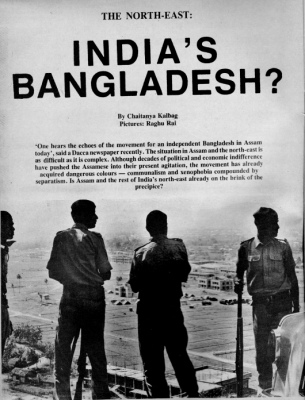
The North East- India’s Bangladesh?
Published date: 12th May 1980, New Delhi
View PDFBy Chaitanya Kalbag
‘One hears the echoes of the movement for an independent Bangladesh in Assam today’, said a Dacca newspaper recently. The situation in Assam and the north-east is as difficult as it is complex. Although decades of political and economic indifference have pushed the Assamese into their present agitation, the movement has already acquired dangerous colours — communalism and xenophobia compounded by separatism. Is Assam and the rest of India’s north precipice?
On the outskirts of Gauhati city stands the gleaming Sarai-ghat Bridge across the Brahmaputra. It was at Saraighat that the legendary general of the Ahoms, Lachit Barphukan, repulsed wave after wave of Mughal attack in the 18th century. But in 1820 the Burmese defeated the Ahoms and six years later handed Assam on a platter to the British, by the Treaty of Yandaboo. That ‘sell-out’ has never been forgotten or forgiven. Saraighat has festered. Today, the ‘deshbhaktas’ (patriots) of the Assam movement swear by that spot. “This is the last struggle,” they say. “This is going to be the last battle of Saraighat.”
The Prime Minister visited Assam on 12 April. Exactly a week later came the Army ‘crackdown’ that fizzled out so ignominiously. During that week, newcomers looked in vain for signs of a struggle in Gauhati. Everything flowed as languidly as the giant river that lends Gauhati and much of Assam its character.
Gauhati was peaceful, but any person with some sensitivity would have felt under currents of unease. The picketers at Narengi were certainly not possessed by fervour. Leaders of the All Assam Students Union (AASU) harangued placid squatters, trying to work up morale. Picketing had once been fun; now there was a sullen, low-density crackle to it.
The AASU delegation emerged from the meeting with Mrs Gandhi in very visible anger, By that evening, however, AASU’s president Prafulla Mahanta and general secretary Bhrigu Phukan, who otherwise got by in English, chose to answer correspondents’ questions in Assamese. Their interpreter, K N Sarma, who is also dean of the faculty of law at Gauhati University was accused at one point by an Assamese journalist of misinterpreting both the questions and AASU’s answers. The event was studiedly low-key.
Were things as innocuous as they seemed? The Assam movement had undoubtedly acquired gigantic proportions. It was no longer confined to the cities and towns, to the literate and conscious citizenry. Bhagavati prasad Barua Bhavan in Gauhati, which headquarters the Gana Sangram Parishad, the Assam Sahitya Sabha, the Jagrata Mahila Parishad and other movement affiliates, was not a-buzz with activity. GSP leaders, Asam Jatiyotabadi Dal (AJD) leaders, and Purbanchaliya Lok Parishad (PLP) leaders all echoed each other in almost exact detail. Their interpretations of the history, the logic, and the aims of the movement rarely differed.
What did they have to say? Assam had never been subjugated by the Mughals, the Burmese had sold the Ahoms down the river to the British and the British had inaugurated the rot. They brought in the outsiders — Bengalis, Biharis, Nepalis — to man the administration, the tea estates, every nook and cranny that held long-term exploitative potential. By 1900 the Assamese had begun to view this tide of lemmings with growing alarm. That was when the influx of the Muslims from East Bengal began. And to the Assamese this was the most voluminous and ominous.
Was the movement only directed against the illegal immigrants from East Pakistan and later Bangladesh? This was what all the leaders reiterated. But on 12 April, the very evening of Mrs Gandhi’s visit, a small and select audience was invited to a preview of a 25-minute colour documentary’ of the movement. It was at the Vandana cinema hall in Gauhati. Obviously, the evening show of the regular film had been cancelled to accommodate the documentary. And the documentary, for those with nagging doubts, said a lot, a little too much.
It began with statistics of population growth, showing how the non-Assamese, particularly the Bengali Muslims, had proliferated. It went on to show how the agitation had mushroomed in strength and popular support. There followed pictures of the ‘martyrs’ of the movement and descriptions of their martyrdom. Even the cover of a Bombay weekly, whose editor is one of the few senior journalists in the country to write glowingly about the movement, was flashed on to the screen and a lengthy except from the editor’s article read out by the commentator. At the end, a map of United’ Assam consisting of the entire north-eastern region (Assam, Arunachal Pradesh, Manipur, Meghalaya, Mizoram, Nagaland and Tripura) glowed on in gaudy red. A tune was played, we were all asked to stand at attention. Later. my neighbour told me it was the ‘national anthem’ of Assam, Amar apanor desh, written by Laxminath Bezborooah, a timber merchant turned nationalist poet.
It was all quite disturbing. A man sitting in the row before mine in the cinema hall had handed me a cyclostyled sheet containing statistics of Assam’s natural resources, their quantum, and how much Assam was paid for them. The man was the PRO not of the movement, but of the Assam State Electricity Board.
That night, sitting in a storm-lashed hotel room, two other leaders of the movement, Prabin Gogoi of the Jatiyotabadi Yuva Chhatra Parishad and Girin Barua of the AJD, opened up a little more. Gogoi had been extensively touring Upper Assam to ‘organise’ the people there. After accusing local politicians of amounting to little else except ‘wearing khadi’, he said crushing the Assam movement would not be possible. Gogoi admitted that “village organisations exist” to preserve the identity of the Assamese and to “protect” land from the foreigners and to resist a crackdown.
Barua was more explicit. He said the Bengalis had never tried to assimilate them selves into Assamese language and culture. He said the British had written in 1946 to Suren Buragohain, a descendant of the prime minister of the Ahoms, Purnananda Buragohain, asking him whether Assam wanted to merge with India or Pakistan or whether it wanted to remain independent. Barua said Nehru had intercepted the letter, persuaded Suren Buragohain to join his cabinet as a deputy minister, and thus betrayed the Assamese people’s interests.
Barua is a very theatrical person, prone to dramatise most of what he says. He said his forefathers had been forced for 40 years from 1836 to learn Bengali (“the Bengalis took over everything: the courts, the jobs, and called Assamese a dialect of Bengali”) until in 1876 Assamese was reintroduced as the official language. After that, he said, the Bengalis “have always been afraid we will educate ourselves. So whenever they get the chance they kick us.” Barua is convinced the Bengalis want to combine Tripura, Assam and West Bengal into a vast Bengali homeland. “Bengalis dressed as military men came and took away our men in North Kamrup, and Major-General ‘Ash’ Dutt, that Bengali actor Utpal Dutt’s elder brother, came to the Nalbari area one night and told his men to arrest all the local male villagers and to rape all the women next morning. The Chinese army in 1962 never touched a hair on our mothers and sisters, but the Indian army was instructed to rape them earlier this year!”
“If Indira Gandhi is a woman she should know what it means if a woman is raped! “Barua said. “It is doubtful if she is a woman.” He said West Bengal had driven Bangladeshi refugees out of Dandakaranya and Marichjhapi but was now fighting for their rights in Assam. “If they can prove in the 1981 census that Bengalis constitute a large percentage in Assam’s population they will demand that Assam be made a bilingual state,” he said.
Where is the Assam movement headed? An idea can be gathered if one realises how passionate the Assamese become when they talk about things Assamese— oil, tea, jute, rice, timber, and land. “We get only Rs 42 per tonne of oil as royalty from India,” they say. ” Is it fair, when so much more is being paid to OPEC?” All tea companies’ offices are located in Calcutta , the ‘Calcutta press’ is distorting the movement’s aims. A strong consciousness exists of how much should ‘rightfully’ belong to the Assamese and how much is being exploited from outside.
Assam is a different place, and the rest of India does not know it well enough. People talk in miles, not kilometres (“Only in India do you calculate distances in kilometres”). The roads are bone-jarringly bad in the ‘interiors’ (“The Indian government has never bothered to repair them”). Trains run on metregauge tracks (“In India all railways are on broadgauge”). There is very little of smoke-spewing industry, but the lack of “native capitalists” is keenly felt. In Upper Assam people follow ‘garden time’, which is one hour ahead of Indian Standard Time. In spite of all this, however, the villages are very neat and clean, pictures of contentment, and the soil is fecund, the vegetation thick. Everywhere, from the air or on the ground, the Brahmaputra looms in its grandeur.
The long-term reasons for the movement are clear, and largely justifiable. Like any other thinly populated and potentially rich region that is adjacent to an over-populated area, large-scale inmigration was inevitable. But inmigration into Assam was also encouraged, initially by the British. By the 1930s, the ‘outsider’ presence was very clearly large, and the Assamese approvingly quote a British census official’s fear in 1931 that “in another thirty years Sibsagar district will be the only part of Assam in which an Assamese will find himself in Assam.”
During World War II, the Muslim League ministry in Assam, led by Mohammed Saadulla, actively encouraged further immigration of East Bengali Muslims into the lush and rich Brahmaputra valley. Saadulla’s aim was to ‘colonise’ and ‘develop’ the huge stretches of uncultivated but fertile land on the north and south banks of the Brahmaputra so that he could aid the ‘grow more food’ campaign during the war. His motives acquired sinister proportions for the Assamese when Partition came and there was a demand that all of Assam be merged with East Pakistan; later, after a referendum, only Sylhet district was given to East Pakistan.
In independent India too. Assamese charge, Muslim politicians like Moinul Haque Chaudhury and Fakhruddin Ali Ahmed connived at further and illegal immigration of Muslims into Assam.
Assam has been neglected for far too long. The Assamese did not organise protests until the early 60s. But in the 19th and early 20th centuries, immigrant Bangladeshis, Biharis, Nepalis, and Bengalis ventured into vocations that were either newly developed or unattractive to local Assamese. The communities that entered Assam were among the most mobile ones in India, whereas only around 60,000 Assamese live outside Assam today. Assamese immobility is even more localised — unless compelled by extreme economic necessity, an Assamese born in a particular district is usually reluctant to move out of it.
Only recently has the Assamese middle class begun to search for and demand its identity. This has brought it into conflict with the ‘outsiders’. Considering the professions or work-patterns of the ‘outsiders’, which would influence their lifestyles, a certain amount of clannishness is bound to exist. But to the Assamese, the spectre of land shortages, the awareness of Assamese natural resources that contribute to India’s self-sufficiency, and the fear of shrinking employment opportunities have amounted to a peculiar xenophobia.
The ‘outsider’ problem will not be solved easily. It is also apparent that the ‘outsider’ problem will remain even if the illegal Bangladeshi immigrants are deported. Between 1951 and 1971, for instance, the number of Assamese-speaking people grew by 79.6 per cent-the largest such growth in any linguistic group in India! Obviously, this figure includes numberless people who are actually ‘outsiders’ but consider themselves ‘Assamised’.
Substantial numbers of immigrants from East “Bengal were settled on 5,967,000 acres between 1930 and 1940 and on 8,926,000 acres between 1940 and 1950. Population counts among the immigrants are at best unreliable. There is another sore point: the immigrants grow cash crops like chilli, jute, mustard, while the Assamese usually grow rice. Even in the tea gardens, aside from a few white-collar jobs, all labour is non Assamese. Barbers, grocers, or the important wine-shop owners in tea gardens are usually Marwaris.
Local patrons obviously would be reluctant to reveal the presence of illegal entrants. Understandably, the Assamese allege that these illegal residents constitute ‘vote banks’ for local politicians. Char settlements are more or less impenetrable and controlled block-wise by headmen or matabbors.
It is easy, when the reasons for the present tension have grown in dimension over many years, and when the movement itself has gained in strength over the last year, to perceive why the agitation is now no longer confined only to anti-foreigner demands. Psychologically, the Assamese people feel increasingly frustrated, driven to the wall. Aside from the anti-foreigner sentiment, the movement has developed other dangerous strains – anti-Bengali, anti-Left, anti-Muslim, anti-non- Assamese, and slowly but discernibly, even anti-Indian.
Why has this happened? First of all, the Assamese have always been intensely conscious of their regional identity. Dozens of little pinpricks have become a gigantic thorn in their flesh. They have never recovered from their ‘sell-out’ to the British. They have felt that the reorganization of the north-east into smaller states was another anti-Assam conspiracy, although it is common knowledge that the vivisected areas desired separation. Also, phobias about attacks on Assamese culture, language and ethnicity have grown.
Secondly and most importantly, the government of India has compounded 30 years of neglect with indecision when the agitation could have been reasonably settled late last year. Delay has led to a hardening of postures on the Assamese side, added to the conviction that the central government is deliberately intransigent, and enabled the movement to snowball.
Thirdly, the local administration, both at the state and district levels, has either openly participated in or encouraged the agitation, or turned a tolerant or blind eye to it. The result is a powder-keg set to explode at any moment.
The Assamese press, both in the English and Assamese languages, has contributed a lot to this process of deterioration. Assam is not highly literate (in 1971 only 28.72 per cent of Assam’s population was educated). In remote towns and villages, the power of persons like school teachers in disseminating and interpreting news is immense. Day after day, week after week for months on end, the papers have carried reports that can at best be termed shrilly chauvinistic and at worst incendiary. ‘Nationalism’ has been a recent trend in Assamese *reportage’ – for instance, how much Assam contributes to the ‘Indian exchequer’, which natural re- sources of Assam are being exploited by “outsiders’ – and this has helped whip up emotions.
News of attacks on Bengali Muslims and Hindus, and the violence in the Barpeta and Nalbari subdivisions in early January this year, was ignored or glossed over. In all of Assam, only two small tabloid Assamese-language newspapers, Kalakhar and Nagarik, have tried to report news objectively. Significantly. the Assamese press grew muted twice-once when President’s rule was imposed last December, the second time when Mrs Gandhi won the elections in January. Many people feel that if there had been some sort of control then, or if the authorities had appeared more determined to check the drift, the press would not have become so emboldened.
The hate-the-Army hysteria, the statement of a senior civil servant explaining his involvement (“Five years from now will my young daughter be snatched away by a Bengali or a Muslim?”) and Purbanchaliya Lok Parishad president Nibaran Bora’s assertion that “Mrs Gandhi has pushed us into a secessionist frame of mind” – all this indicates the direction in which Assam is headed, where emotion smothers logic.
The colour documentary I saw in Gauhati on 12 April was the sort that would incite any Assamese. It had cost at least Rs 15 lakhs to make. Where had the money come from? The literature distributed by various agitation bodies is very slickly put together – good. English, good production, replete with maps and even pictures. When there is hardly a single movement leader who can converse in grammatical English, who is writing the literature, putting it together, and paying for its cost? Movement leaders are surprisingly naive. Their distinctions often blur, their priorities change to suit the occasion. Their pomposity, boastfulness and indiscretion is appalling. Who then is providing policy guidelines and mapping out strategy? Agitation leaders enjoy immense mobility; demonstrators and picketers are transported ‘willingly’ by bus owners. Are such services voluntary and, if not, where is the money coming from? These questions remain unanswered, and are sought to be brushed aside with the catch-phrase “The Assamese people’s contribution to the cause”.
Again, considering the agitation is supposed to be anti-Bangladeshi, here is an excerpt from the weekly Ittehad of Dacca of 21 February, 1980, a report that was reproduced in the Jugaberi of Sylhet on 29 February.
“The nationalist movement in Assam is gradually turning into a movement for autonomy, reminding one of the events that converted East Pakistan of 1969 into Bangladesh of 1971 . It is most surprising that in 1980 one should hear the echoes of that movement for an independent Bangladesh in Assam today. Will the satraps of Delhi be able to strangle the yearning for independence of eastern and north-eastern India by inciting communal violence? History does not lend support to such a view.”
Despite antagonisms between Assam and neighbouring north-eastern states and union territories, the agitation has brought about a surprising commonality of demands in the north-east. Talk about the “United States of Assam” (consisting of all seven north-eastern entities) and jokes about how ‘Indians’ might need visas the next time they visit the region, are often heard nowadays. Is the north- east on the brink of becoming India’s Bangladesh?
The similarities between the north-east and East Pakistan before 1971 are startling. Riots followed the imposition of Urdu as the national language in East Pakistan in 1952; in Assam, the imposition of Bengali also brought about violence. Both decisions were revoked later. East Pakistan consistently felt it received a disproportionate share of the national income; Assam and the north-east too have always held this grouse. East Pakistan’s jute and cotton helped vastly in balancing the Pakistani budget; Assam feels that its jute, tea, oil and rice have been unduly exploited by India. Just as East Pakistan felt that it was industrially retarded in spite of its high population, Assamese feel that industrial development in their region is poor, that Assam is forced to depend on ‘imports’ of many things from India, and that their state is fast becoming over populated.
These pressures led to Bangladesh’s declaration of independence on 26 March 1971. The question is, will history repeat itself in India’s north-east?
The Assam agitation itself has reached a high-strung stage. However much of a moral triumph satyagraha may be, the economy of the state is in animated suspension. Kerosene, diesel, petrol, aviation fuel and most essential commodities are painfully scarce. Work in government offices has come to a standstill. How long can this impasse continue without conflagrating?
A harsh clampdown now will only boomerang on the government in Delhi. 19 April and the events that followed only illustrate this. There is nothing more humiliating for an administration than to withdraw the curfew, allow picketers to re-capture targets, and allow itself to be besieged. Things took a nasty turn in the week following the clampdown. Will events, as one intelligence expert feels. take the course that a British counter- insurgency expert, Major-General Frank Kitson has outlined? Kitson, a veteran of movements similar to that in Assam in Malaya, Cyprus and Kenya, delineates three phases: the preparatory period, the non violent (non-cooperation, civil dis-obedience) phase, and finally the open insurgency phase.
Even if there is no open revolt, it is clear that the Assam agitation has reached a point of no return. It has travelled far beyond a mere settlement of the cut-off year. Increasingly, there is the long-term danger of hostility between Assam and the rest of the country, and between communities within Assam. Whichever side moves first, a step forward now will only mean, in real terms, two steps backward, The big question now is: which side will emerge victorious from the last battle of Saraighat?
The Fifth Columnists
No movement like the Assam agitation can balloon in strength unless it enjoys the encouragement or indifference of officialdom. In Assam, the true story will be a sordid one. A few examples:
Governor Lallan Prasad Singh: Governor Singh’s jurisdiction extends over Assam, Manipur, Meghalaya, Nagaland and Tripura. Sixty-six-year-old Singh’s career covers posts like the Chief Secretary of Bihar in the late ’40s (the youngest at 36 then), 14 years in the Home Ministry in Delhi, the last six of which were as Home Secretary, a two-year Ambassadorship to Nepal in the early ’70s, and the governorship of the North-East since 1973. Younger civil servants who remember Singh’s legendary efficiency and ability wonder why he has remained in this sensitive and thankless post for so long. Knowledgeable sources say he has often expressed a desire to quit but has been asked to continue by the Union Government. Although Singh’s achievements include the historic Shillong Accord in November 1975, which settled the Nagaland imbroglio, he has clearly been unable to cope with the endless tensions in his region. Observers feel that the situation in Assam would not have become so bad had Singh put his foot down at the proper juncture. Significantly, agitation leaders, except for a few who call him “Madam’s agent”, think his “sympathy and understanding” helped prevent a “counterproductive crackdown” from the Centre.
R S Paramasivam: Chief Secretary Paramasivam’s role in the Assam agitation appears to extend beyond mere sympathy. Last year, after he and agitation leader Nibaran Bora “independently” arrived at almost identical figures of “aliens” in the Mangaldoi parliamentary constituency (40,000 ‘objection slips’ were filed at Dispur, the capital, reportedly after coercing village headmen into falsely declaring many old inhabitants as ‘outsiders’) Paramasivam, 52, was asked to go on long leave. Barely two months later, after President’s rule was imposed on Assam, he was reinstated, reportedly at the behest of agitation leaders.
Paramasivam is also accused of allowing the student leaders another astonishing privilege—that of instructing magistrates as to which dealers should be issued permits for lifting diesel and kerosene stocks. Many ‘unsympathetic’ dealers are out in the cold, and Indian oil officials complain that many bogus dealers have thus cornered scarce diesel and kerosene stocks. Paramasivam’s role seems to have been belatedly recognised: he was asked to go on long leave again on 25 April, and was replaced by Ramesh Chandra, Meghalaya’s chief secretary.
Hiranya Bhattacharjee: Deputy Inspector-General in the Border Security Force, Bhattacharjee has allegedly done a lot besides maintaining law and order. Reported to enjoy close links with both movement leaders and agitationists and underground figures from neighbouring regions, Bhattacharjee is spoken of in whispers in Gauhati. He has also gone on long leave.
Jyoti Prasad Rajkhowa: Rajkhowa, 35, was Deputy Commissioner of the key Kamrup district when its Nalbari and Barpeta subdivisions were rocked by violence, arson, loot and rape early this year. Minority groups in this area were allegedly then were attacked by Assamese Hindu villagers. Rajkhowa then failed to turn up or pretended to remain ‘neutral’ spectator. Yet, he is known to have helped inflate the horror stories of Army atrocities on Assamese women. Sentiment against Rajkhowa grew so acute that he was quickly removed from the job as managing director of a public sector undertaking in Gauhati. He has refused to go on leave.
Prafulla Sarma: Sarma was Additional Deputy Commissioner in charge of Barpeta subdivision and was later posted as DC of Kamrup. He is alleged to have been directly involved in the cover-up of the large-scale arson, loot and other incidents in Barpeta early this year. Tainted by such partiality, Sarma was transferred to Silchar in the Barak Valley. Tainted by such partiality, Sarma was transferred to Silchar in the Barak Valley. On arrival in Cachar district, he was refused to go on duty.
Hirendran Kumar Barua: Barua is presently Home Secretary in Gauhati. Pulled out for his “efficiency”, he was sent on temporary posting to Barpeta to take over from Prafulla Sarma. In March this year he asked his subdivisional information and PR officer, Haran Dey, to take a month’s leave. In the latter’s absence Barua proceeded to compile two voluminous files of ‘information’ on the Barpeta subdivision. On 14 April at the Circuit House in Barpeta Barua insisted on giving an 1½-hour ‘briefing’ on the subdivision and the events that occurred in the area. He showed maps and charts seemed to indicate an over-assessment of the ‘illegal Muslim immigrants’; yet his figures of victims of arson, loot and ‘panic’ made amazing reading: out of 1,200 families affected, Barua claimed, 665 were Assamese Hindu, 85 Bengali Hindu, and immigrant Muslims 16; out of 430 looted/affected families, 328 were Assamese Hindu, 25 Bengali Hindu, and 77 immigrant Muslim (a total of 272 ‘panic-stricken’ families. 199 were Assamese Hindu, 70 Bengali Hindu, and only 3 immigrant Muslims). Considering that district officials are normally chary to divulge the ‘true facts’, was to say the very least, curious. Barua’s eagerness to divulge the ‘true facts’, was to say the very least, curious. He said the new Superintendent of Police of Kamrup, Harikrishna Deka, was not interested in detecting illegal immigrants.
Kamaleswar Bora: Bora, 51, took over from Rajkhowa as DC of Kamrup after the latter was shunted. Reluctant to take over, Bora said he would only join if there was no agitation and no non-Assamese in the area. He would only return to the headquarters if administration could run at full swing. “We have given affected families what compensation and relief we could” said the mild-mannered Bora, as well as issued permits to many dealers.
Most incredible was the manner in which he dealt with the question of 41 protesters who were on fast unto death at the Barpeta District Jail. Asked what steps he had taken, Bora said he would allow himself to be locked in if he had to lift curfew orders and permit picketers to re-enter Narengi?
These are only a few names and instances. In all of Assam, only Dibrugarh district has a non-Assamese DC, Bira Kishore Misra; and this area has been, save from the Duliajan incident in mid-January, free of major trouble. It is well known that members of the Assam Civil Service (ACS), who man many key posts in the state’s administration, have been often openly chuffed out or ignored blatant breaches of the peace and of agitators.
Official complicity also extends to intelligence-gathering and policing operations. Discreet movement leaders allege that since most intelligence officials are non-Assamese, they are responsible for informing Delhi that the agitation is not non-Assamese. The indiscreet leaders are openly contemptuous of Delhi’s intelligence-gathering machinery and boast that their network is better than “Madam’s”. It is not inconceivable that wrong information may have consequently been conveyed to Delhi.
Police complicity is far more blatant. In many villages scattered over the Barpeta and Nalbari subdivisions, victims of arson, loot and violence, when asked them, reiterated and pointed: that the Assam Battalion (the armed wing of the Assam Police) has on each occasion come first with rifles and scared villagers with a few warning shots, followed by Assamese youths being egged on by the All Assam Students Union (AASU) and Janata Dal (Jal) who had set fire to and looted the dwellings of Bengali Muslims and Hindus. One police official who is also suspected of notoriety is Sub-Inspector Singh who is now posted at the Kirkirı police outpost in the oweimarı Reserve in northern Barpeta subdivi-sion. This reserve is almost totally inha-bited by Muslims and was marked by large-scale violence by Assamese villa-gers in January: Singh is alleged to have been a silent spectator to the attacks.
Victims Of A ‘Non-violent’ Movement
The Assam agitation has thrown up ‘martyrs’ by the score. On Rongali Bihu day (14 April) flags were hoisted, pledges taken to make the ‘supreme sacrifice’, and homage paid to a portable cardboard ‘Shahid Bedi’ (martyrs’ memorial), on which were painted the words “I shall sacrifice my today for my countrymen’s future”
But amid all the remonstrances that the movement is peaceful, many instances have surfaced where arson, loot and rape have been perpetrated on Bengali Muslims and Hindus in the countryside. Some examples:
In November 1979 a Bengali bank officer was dragged out of his car and killed in Tinsukhia after Purna Nirmalya, an Assamese student, died as a result of a petty quarrel over non-payment of a bill of Rs 1.80 in Nahorkatiya township. Nirmalya was alleged to have been killed at the instigation of a Bengali restaurateur.
Three Bengali Muslim villages were attacked and many houses burnt and looted on 3 January 1980 in the Barikadonga circle, 45 km north of Nalbari.
In Gelpahar village in the Nalbari subdivision. Bengali Hindu houses were selectively set on fire and their inhabitants attacked on 4 January.
Between 5 and 7 January Barpeta and Nalbari subdivisions were rocked by unprecedented violence. More than 15,000 houses belonging to Bengali Muslims and Hindus were razed to the ground. Kurihar Pam village, which has a large number of Muslims, was the target of a concerted attack. Although close to the Sarthebari police station, Kurihar Pam villagers are separated from it by a stretch of Assamese houses so that they could not even run to Sarthebari for help.
When Neularbhitha village, under the Kowaimari Reserve in northern Barpeta subdivision was attacked in early January, five women (Bengali Hindu) fled to the nearby bazar. They were taken there by a patrolling police party to the Sarthebari police station, where on 9 January Kaushalyabala Rajvanshi was allegedly raped by policemen. When the women were shifted to the Dakshinpaka relief camp on 10 January Rajvanshi lodged a complaint with the police there about the rape. No action has yet been taken.
Under the pretext of ‘evicting’ illegal squatters, two Bodo tribals, Bihu Ram and Habi Ram, were killed in police firing in Phulung (North Gauhati) on 26 November. Wrongly identified as ‘Bangladeshis’, the Bodos (who are original inhabitants of Assam) were reportedly set upon by the Assam Police in collaboration with AASU.
There are many other such cases, most undocumented. It was in the wake of this violence that the Disturbed Areas Act was clamped on Kamrup district for two months from 8 January and the Army began to stage flag marches.
The most heinous crime however is the murder of Dr Robi Mitra, technical manager of Oil India Limited, at Duliajan on 18 January. The much-condemned firing on ‘peaceful’ picketers outside the OIL installation also occurred that day. The picketers, egged on by Gana Sangram Parishad ‘leaders’ Nitya Dutta and Biren Chutia, laid siege to the Tipling police outpost opposite OIL. At 7.55 am, 10 minutes after the deadline given by the Deputy Commissioner of Dibrugarh, B K Misra, to the picketers to disperse, a lathi-charge was ordered. The crowd grew more violent and tear-gassing began. A CRP man lobbing the tear-gas grenades as well as the Superintendent of Police, Priyo Goswami, were injured by brickbats. At 8.05 am, Misra ordered 28 rounds to be fired.
Before the injured in the firing (four of whom succumbed later) could be taken to the nearby Duliajan hospital inside the residential township, a section of the crowd had run to the hospital. From there, someone telephoned Dr Mitra at his residence and asked him to rush to the hospital because some OIL employees had been injured in the firing. Mitra was then temporarily in charge of OIL—the resident chief executive. Ajit Sarma, had gripped by some mysterious malady left for Gauhati the previous day. On the 17th, Mitra, his deputy C G Banerji and the administrative manager B M Chopra had been warned by police not to venture out of their houses the next day, whoever summoned them. But Mitra, a conscientious man, jumped into his car and drove to the hospital.
He was dragged out, his car was smashed, and he was stoned, speared and stabbed to death. It was over in a matter of minutes. Mitra’s body was then carried into the hospital’s executive ward. By the time the police party brought in back the injured from the firing reached the hospital Mitra was dead.
Ajit Sarma’s father Debeswar Sarma, who owns the pro-agitation Dainik Janambhoomi in Jorhat, editorialised on 19 January that Mitra’s death and the firing would not have occurred if Sarma had been present in Duliajan. Three OIL employees are known to have confessed before DC Misra about knowledge of who killed Mitra. Mitra’s murder has been ascribed to ‘anti-social’ elements; but in a township as tiny as Duliajan (4,500 workers, 450 officers) anti-social elements would be only too recognisable. Many OIL employees, non-Assamese, have quit their jobs in panic. There is a sullen and tense atmosphere in Duliajan. Mitra’s successor as technical manager, Banerji, handed in his resignation but has been asked to continue. The chief medical officer of the hospital Dr J C Laskar, who has also been interrogated in connection with Mitra’s death, and Ajit Sarma are both on long leave when a blanket ban has been placed on all OIL executives’ leave.
Robi Mitra was an immensely popular man in Duliajan. There has been no progress in locating his murderers. Although he was killed in broad daylight in full view of the Duliajan hospital, not a ward-boy, nurse or doctor has come forward to testify as to who killed him. There is little doubt that OIL employees were directly involved. Mitra is supposed to have recognised the voice of the man who summoned him to the hospital over telephone and to have told his wife who it was.
Whether or not the Mitra murders are brought to book, Duliajan symbolises the insensate twists the agitation is taking: hisdeath is obscured by the ‘martyrdom’ of the four picketers who died in the firing. Priyo Goswami is called the ‘General Dyer of Assam’s Jallianwala Bagh’, but there are few tears being shed for Robi Mitra in Assam today.
will my young daughter be snatched away by a Bengali or a Muslim?” and Purbanchaliya Lok Parishad president Nibaran Bora’s assertion that “Mrs Gandhi has pushed us into a secessionist frame of mind”—all this indicates the direction in which Assam is headed, the emotion in mothers’ voices.
The colour documentary I saw in Gauhati on 12 April was the sort that would incite any Assamese. It had cost at least Rs 15 lakhs to make. Where had the money come from? The literature distributed by various agitation bodies is very slickly put together—good English, good production, replete with maps and even pictures. When there is hardly a single government leader who can converse in grammatical English, who is writing the literature, putting it together, and paying for its cost? Movement leaders are surprisingly naive. Their distinctions often blur, their priorities change to suit the occasion. Chief proponent, Goswami is providing no clear guidelines and mapping strategy: Agitation leaders enjoy immense mobility; demonstrators and picketers are transported willingly by bus owners. Are such services voluntary and, if not, where is the money coming from? These questions remain unanswered, and are sought to be brushed aside with the catch-phrase “The Assamese people’s contribution to the cause”.
Again, considering the agitation is supposed to be anti-Bangladeshi, here is an excerpt from the weekly Ittehad of Dacca of 21 February, 1980, a report that was reproduced in the Jugaberi of Sylhet on 29 February:
“The nationalism movement in Assam is gradually turning into a movement for autonomy, reminding one of the events that Bangladesh of 1971…It is most surprising that in 1980 one should hear the echoes of that movement for independence Bangladesh in Assam today…Will the seat scraps of Delhi be able to strangle the yearning for independence of eastern and north-eastern India by inciting communal violence? History does not lend support to such a view.”
Despite antagonisms between Assam and neighbouring north-eastern states and union territories, the agitation has brought about a surprising commonality of demands in the north-east. Talk about the “United States of Assam” (consisting of all seven north-eastern entities) and jokes about how “Indians” might need visas the next time they visit the region, are often heard nowadays. Is the north-east on the brink of becoming India’s Bangladesh?
The similarities between the north-east and East Pakistan before 1971 are startling. The following the imposition of Urdu as the national language in East Pakistan in 1952; in Assam, the imposition of Bengali also brought about violence. Both decisions were revoked later. East Pakistan consistently felt it received a disproportionate share of the national income; Assam and the north-east too have always felt this. East Pakistan’s jute and cotton helped vastly in balancing the Pakistani budget; Assam feels that its jute, tea, oil and rice have been unduly exploited by India. Just as East Pakistan felt that it was industrially retarded in spite of its high population, Assamese feel that industrial development in their region is poor, that Assam is forced to depend on imports of many things from India, and that their state is fast becoming overpopulated.
These pressures led to Bangladesh’s declaration of independence on 26 March 1971. The question is, will history repeat itself in India’s north-east?
The Assam agitation itself has reached a high-strung stage. However much of a moral triumph satyagraha may be, the economy of the state is in a shambles: pension, kerosene, diesel, petrol, aviation fuel and most essential commodities are painfully scarce. Work in government offices has come to a standstill. How long can this phase continue without conflagration?
A ‘harsh clampdown’ now will only boomerang on the government in Delhi. 19 April and the events that followed only illustrate this. There is nothing more humiliating for an administration than to withdraw the curfew, allow picketers to re-capture targets, and allow itself to be besieged. Things look nasty even in the week following the clampdown. Will events, as one intelligence expert feels, take the course that a British counter-insurgency expert, Major-General Frank Kitson has outlined? Kitson, a veteran of movements similar to that in Assam in Malaya, Cyprus and Kenya, delineates three phases: the preparatory period, the non-violent (non-cooperation, civil disobedience) phase, and finally the open insurgency phase.
Even if there is no open revolt, it is clear that the Assam agitation has reached a point of no return. It has travelled far beyond a mere settlement of the cut-off year. Increasingly, there is the long-term danger of hostility between Assam and the rest of the country, and between communities within Assam. Whichever side moves first, a step forward now will only mean, in real terms, two steps backward. The big question now is: which side will emerge victorious from the last battle of Saraighat?






e2w4cv
4ezy9s
io2job
qi1z51
twr9ps
oidd6t
opiicx
ilrb31
Ответственная игра — это комплекс правил, ориентированных на защиту психологического и материального равновесия участника.
Ключевая идея состоит в том, что процесс должна восприниматься только как развлечение, а не как метод заработка.
Пользователю рекомендуется предварительно устанавливать ограничения по длительности и деньгам и строго их придерживаться.
https://online-festival.ru/detail/3076-tayna-podvala-pochemu-mat-mnogodetka-khranila-pochti-400-skeletov.html
Необходимо уметь замечать первые симптомы проблемного поведения, такие как желание отыграться и игнорирование повседневными делами.
Операторы обязаны предоставлять функции самоконтроля: тайм-ауты, ограничения пополнений и блокировку аккаунта.
Соблюдение этих правил даёт возможность сохранить азарт в комфортных границах, не причиняя вреда себе и окружающим.
Разумное отношение к азарту — это подход к казино, базирующийся на самоограничении и осознании последствий.
Она предполагает добровольное лимитирование продолжительности и расходов на процесс.
Любой игрок должен предварительно определять пределы потерь и неукоснительно их придерживаться.
https://1-mk.ru/detail/430-mikhail-pronin-pokidaet-dolzhnost-biznes-ombudsmena-ryazanskoy-oblasti/
Осознанный гемблинг — это подход к игровым развлечениям, базирующийся на контроле и осознании последствий.
Она подразумевает осознанное лимитирование времени и бюджета на игру.
Каждый участник должен предварительно устанавливать лимиты ставок и строго их придерживаться.
https://kart1na.ru/entry/329-bonusy-i-frispiny-v-slote-rocket-ot-1win-prakticheskoe-rukovodstvo/
Ответственная игра — это подход к игровым развлечениям, базирующийся на самоограничении и осознании рисков.
Эта концепция предполагает добровольное ограничение времени и бюджета на игру.
Любой игрок обязан заранее определять пределы ставок и неукоснительно их соблюдать.
https://futuretech.moismi.ru/rtk5F8rGygu3/
Разумное отношение к азарту — это подход к игровым развлечениям, основанный на контроле и осознании последствий.
Эта концепция включает осознанное ограничение времени и денег на игру.
Любой игрок обязан предварительно устанавливать пределы потерь и неукоснительно их соблюдать.
https://sorrybabushka.ru/interesting/497-kogda-geyming-stanovitsya-modnym-trendom-pochemu-onlayn-kazino-privodyat-k-potere.html
Ответственная игра — это модель поведения, при которой гемблинг рассматривается лишь как досуг, а не способ заработка.
Данный подход предполагает определение лимитов по длительности и финансам до начала игры, а также способность прерваться.
Ключевые принципы — не пытаться отыграться, использовать тайм-ауты и обращаться за помощью при возникновении симптомов зависимости.
https://nashipesni.ru/pub/2026-06-29-bonusy-i-promokody-1win-dlya-novykh-igrokov-v-aviator/
Осознанный гемблинг — это подход к казино, основанный на контроле и осознании последствий.
Эта концепция включает добровольное лимитирование продолжительности и расходов на игру.
Каждый игрок обязан заранее устанавливать лимиты потерь и строго их придерживаться.
https://rosotels.ru/detail/2026-07-04-kak-ukhazhivat-za-kozhey-podmyshek-i-pravilno-vybirat-dezodoranty.htm
Ресурсы для 18+ могут служить источником интимного просвещения, помогая людям понимать свою сексуальность.
Такие платформы дают возможность изучать многообразие подходов в защищённом пространстве, снижая опасность физических последствий.
В отношениях совместный просмотр может укреплять взаимопонимание и служить поводом для откровенного разговора о фантазиях и предпочтениях.
видео анальный секс
Ответственная игра — это подход к азартным сессиям, основанный на самоограничении и понимании последствий.
Эта концепция предполагает добровольное лимитирование времени и бюджета на процесс.
Каждый участник обязан заранее определять лимиты ставок и строго их придерживаться.
https://kart1na.ru/entry/332-shestaya-beremennost-supermodeli-natali-vodyanovoy-v-44-goda-ona-vyshla-v-svet/
zxxj09
На представленном сайте можно обнаружить много нужной сведений.
На страницах сайта представлены обзоры и руководства для любого интерес.
Пользователь имеете возможность найти как широкую базу, также специализированные кейсы.
Этот ресурс может оказаться полезным профессионалам в своей деятельности.
https://nashipesni.ru/pub/2026-05-27-samye-kultovye-modeli-krossovok-dolceandgabbana-za-poslednie-10-let/
Помимо этого на портале часто появляются актуальные руководства.
Призываем самостоятельно просмотреть собранную здесь базу.
Следовательно, эта платформа служит полезным местом сведений.
На представленном ресурсе удастся обнаружить массу практичной информации.
Здесь размещены публикации и советы под любой вкус.
Пользователь можете изучить и общую базу, так и детальные материалы.
Наш портал поможет профессионалам в своей обучении.
https://yazgez.com/read-blog/6482
Кроме того здесь периодически публикуются новые материалы.
Призываем самостоятельно просмотреть доступную здесь информацию.
Таким образом, наш портал является ценным хранилищем сведений.
Осознанный подход к гемблингу — это стиль поведения, при которой азарт являются формой досуга, а не средством поправить финансовое положение.
Она базируется на контроле длительностью и бюджетом, а ещё на осознании личных пределов.
https://online-festival.ru/detail/3307-svyashchennik-razdavavshiy-snotvornoe-poluchit-bolee-poluveka-tyuremnogo-zaklyucheniya.html
Разумное отношение к азарту — это стратегия к казино, основанный на самоограничении и осознании последствий.
Эта концепция подразумевает осознанное ограничение времени и бюджета на игру.
Каждый участник должен предварительно устанавливать лимиты потерь и неукоснительно их соблюдать.
https://ipcfms.ru/read/394-polnyy-obzor-igrovykh-avtomatov-v-randx-casino.html
Ответственная игра — это стратегия к азартным сессиям, базирующийся на самоограничении и понимании последствий.
Эта концепция предполагает осознанное ограничение времени и расходов на процесс.
Любой участник обязан заранее устанавливать лимиты потерь и неукоснительно их придерживаться.
https://labdiz.ru/full/517-obzor-igrovogo-portfelya-randx-casino-populyarnye-slot-igry-i-zhivoe-kazino.htm
Осознанный гемблинг — это принцип к казино, основанный на контроле и понимании рисков.
Она включает осознанное ограничение продолжительности и денег на процесс.
Каждый игрок обязан предварительно устанавливать пределы ставок и строго их соблюдать.
https://tltrock.ru/material/2026-07-08-the-future-of-cashman-casino-trends-and-predictions-for-the-industry-leader.html
Mindful gaming is a set of principles that ensure gambling remains a form of entertainment instead of a source of financial strain.
It involves establishing individual boundaries on duration and money spent, as well as being aware of the signs of harmful behaviour.
In essence, this approach encourages informed decisions and helps users to maintain balance over their gaming activities.
https://kart1na.ru/entry/313-elektronnaya-podpis-dlya-volgogradtsev-za-rubezhom-start-pilotnogo-proekta-1-iyulya/
Ответственная игра — это подход к игровым развлечениям, основанный на самоограничении и понимании рисков.
Эта концепция предполагает добровольное ограничение времени и бюджета на игру.
Любой участник обязан предварительно устанавливать пределы потерь и строго их придерживаться.
https://sorrybabushka.ru/interesting/506-chonguk-iz-bts-stanovitsya-globalnym-poslom-yuvelirnogo-doma-graff.html
Осознанный гемблинг — это подход к игровым развлечениям, основанный на контроле и понимании рисков.
Эта концепция включает осознанное ограничение продолжительности и расходов на процесс.
Любой участник должен предварительно устанавливать пределы потерь и неукоснительно их соблюдать.
https://labdiz.ru/full/496-letnie-skidki-i-bonusy-1win-kak-igroki-novichki-mogut-prevratit-privetstvennoe-predlozhenie-v-stilnyy-vyigrysh.htm
Mindful gaming is a collection of principles that ensure gambling remains a form of entertainment instead of a means of financial strain.
Key aspects include establishing individual boundaries on time and wagers, as well as being aware of the signs of problematic behaviour.
Ultimately, this approach promotes informed choices and helps players to keep balance over their playing activities.
https://legicon-pravo.ru/data/3232-turnir-yunykh-plovtsov-s-osz-v-nalchike-sobral-tridtsat-uchastnikov.html
Разумное отношение к азарту — это принцип к казино, базирующийся на самоограничении и осознании рисков.
Она включает добровольное лимитирование продолжительности и расходов на процесс.
Каждый участник должен заранее определять пределы ставок и строго их соблюдать.
https://s3.superlooks.ru/x0Dl2TCmesJl/
Responsible gambling is a collection of practices that ensure betting remains a form of entertainment rather than a means of financial strain.
Key aspects include setting individual limits on time and money spent, as well as recognising the indicators of problematic behaviour.
Ultimately, responsible gambling promotes conscious decisions and helps users to maintain control over their gaming habits.
https://ipcfms.ru/read/374-svod-novinok-v-byuti-sfere-kollaboratsii-innovatsii-i-neozhidannye-sochetaniya.html
Ответственная игра — это выбор, при котором азарт являются формой отдыха, а не средством поправить финансовое положение.
Такой подход строится на контроле временем и расходами, а также на понимании своих пределов.
https://legicon-pravo.ru/data/3484-ozen-life-maadhoo-privatnyy-oazis-na-maldivakh.html
Разумное отношение к азарту — это стратегия к казино, основанный на самоограничении и понимании последствий.
Эта концепция включает осознанное ограничение продолжительности и бюджета на процесс.
Любой участник должен предварительно устанавливать лимиты ставок и строго их соблюдать.
https://energia-group.ru/full/2026-05-30-belyy-dom-zavershil-dvukhchasovoe-soveshchanie-po-iranu-bez-konkretnykh-vyvodov.html
Для учителей повышение компетенций имеют решающее значение, поскольку они дают возможность осваивать новейшие методики.
За счёт таким курсам учителя способны приспосабливаться к изменяющимся условиям образования.
Следовательно существенно улучшается качество обучения, что непосредственно влияет на воспитанниках и их достижения.
https://1777.ru/stavropol/programmy-kursov-povyshenija
Ответственная игра — это принцип к азартным сессиям, основанный на контроле и осознании рисков.
Она предполагает осознанное лимитирование времени и бюджета на процесс.
Каждый игрок должен предварительно устанавливать пределы ставок и строго их придерживаться.
https://edu.sochidaily.ru/GshkrtLBvdsg/
Кроссовки бренда — это безупречный микс неповторимой элегантности и новейших веяний.
Ключевой чертой данных кроссовок считается броский дизайн с сочетанием дорогих материалов и фирменной отделки.
Такие модели великолепно подходят для городской жизни, добавляя в стиль долю элегантности.
https://relax-spb.ru/read-info/3145-sverdlovskuyu-oblast-zhdet-liven-shtormovoe-preduprezhdenie-i-rekomendatsii-spasateley.html
Разумное отношение к азарту — это стратегия к казино, основанный на самоограничении и осознании рисков.
Она подразумевает осознанное лимитирование продолжительности и денег на игру.
Любой игрок обязан предварительно определять лимиты потерь и неукоснительно их придерживаться.
https://techguru.podium24.ru/xS3UFphdLrMw/
Сникеры D&G — представляют собой идеальный микс итальянской классики и новейших веяний.
Ключевой чертой подобных кроссовок служит броский дизайн с применением премиальных тканей и узнаваемой фурнитуры.
Они отлично подходят для повседневной эксплуатации, внося в образ нотку шика.
https://pilot-club.ru/info/2026-07-14-trendovye-stili-krossovok-dolce-andamp-gabbana-v-2024-godu-chto-aktualno-na-ulitsakh/
Кеды Dolce&Gabbana — представляют собой безупречный симбиоз итальянской классики и актуальных веяний.
Отличительной особенностью этих кроссовок является броский дизайн с применением качественных сырья и культовой отделки.
Эти кроссовки отлично сочетаются для повседневной носки, добавляя в лук нотку роскоши.
https://rosotels.ru/detail/2026-07-14-trendovye-stili-krossovok-dolce-and-gabbana-v-2024-godu-chto-aktualno-na-ulitsakh.htm
Конторы дают возможность делать пари на спортивные события.
Важно отдавать предпочтение надёжных букмекеров, а также внимательно анализировать роспись перед оформлением пари.
Ставки могут превратиться интересным досугом, однако необходимо соблюдать баланс ответственной игры и контролировать расходы.
https://magictales.sneakero.ru/tnlUi7qPm4J4/
הפורטל הזה מספק מגוון רחב של מידע המיועדים לקהל המקומי.
באתר תוכלי להכיר חוויות מגוונים בתחום למבוגרים באיכות מעולה.
השירות מאפשרת אפשרות פשוטה לחומרים אלה תוך שמירה על אנונימיות הגולש.
https://hasfaniyot.net/
Видеослоты — это одни из самых известные развлечения в гемблинг-индустрии.
У них главное преимущество — несложные правила, красочная графика и разнообразие дополнительных функций.
Пользователи в состоянии подбирать автоматы по тематике, количеству барабанов и размеру волатильности.
https://businessmind.watchco.ru/EV0bQGsq2cYA/
Правила осознанной игры — это регламент, направленный на укрепление дисциплины над финансовыми расходами и исключение зависимости.
https://social.urgclub.com/read-blog/206532
Осознанный подход к гемблингу — это стиль поведения, при которой игры являются формой отдыха, а не средством поправить финансовое положение.
Она базируется на управлении временем и бюджетом, а ещё на осознании личных пределов.
https://online-festival.ru/detail/3406-trendovye-stili-krossovok-dolce-and-gabbana-v-2024-godu-chto-aktualno-na-ulitsakh.html
Игровые автоматы — являются одни из самых известные развлечения в онлайн-казино.
https://music.fashionablelook.ru/duNfwh4Zk1fd/
БК предлагают шанс делать ставки на спортивные матчи.
Важно выбирать надёжных операторов, а также тщательно анализировать роспись перед заключением ставки.
Ставки способны быть интересным хобби, однако важно соблюдать принципы осознанного подхода и ограничивать расходы.
https://crafty.omskdaily.ru/CUU1STfKYi4H/
На данном сайте вы сможете отыскать обилие нужной информации.
https://sorrybabushka.ru/interesting/531-novinki-ot-annbeauty-foreo-i-drugikh-byuti-brendov-chto-stoit-znat.html
На этом портале можно найти обилие нужной материалов.
https://telegra.ph/Sem-zapovedej-Rick-Owens-filosofiya-zakodirovannaya-v-chernoe-03-04
Здесь портале вы сможете обнаружить много полезной сведений.
https://protivbed.ru/full-article/zagadka-korichnevykh-yaits-pochemu-britanskie-polki-otdayut-predpochtenie-belym-2077/
На данном сайте вы сможете отыскать обилие полезной информации.
https://kart1na.ru/entry/366-personalnyy-brend-stil-kak-instrument-karernogo-rosta/
На этом сайте можно найти массу нужной материалов.
https://ipcfms.ru/read/427-krossovki-dlya-trenirovok-v-zale-chto-vazhno-uchityvat-pri-vybore.html
Здесь сайте можно найти обилие нужной сведений.
https://nbcollector.ru/sneakerhead/2026-07-20-sravnenie-dizayna-krossovok-dolce-and-gabbana-s-klassicheskimi-modelyami/
На нашем сайте можно найти жилье в Турции.
На сайте (аренда виллы в Турции) представлены лучшие объекты аренды жилья в Турции.
Наш сайт даст возможность найти жилье в Турции.
На этом веб-сайте удастся обнаружить немало нужной сведений.
https://spacehey.com/profile?id=4291893
Təhlükəsiz oyun — bu o deməkdir istifadəçinin davranışını idarə etməsi və oyunun hobbi olaraq saxlanılması üçün prinsiplər sistemidir.
O zaman və maliyyə məbləğlərinə məhdudiyyətlər qoymağı, həmçinin təhlükəli vəziyyətlərini tanımağı nəzərdə tutur.
Nəticə olaraq, məsuliyyətli oyun istifadəçilərə oyun üzərində hakimiyyəti qorumağa imkan verir və arzuolunmaz risklərin qarşısını almağa xidmət edir.
https://www.gyaan.com/blog-details/spiritual-interiors-of-spas-and-parlours/
Контролируемый игровой процесс — это подход, предназначенный на сохранение баланса над игровым поведением и осознание потенциальных проблем, связанных с игровой деятельностью, при одновременном акценте на отдых как базовую причину участия.
https://randx-super.ru/
Трейдинг — это процесс, заключающийся в покупке и реализации торговых инструментов с целью прибыли на изменениях их стоимости.
Прибыльный трейдинг требует в тщательном изучении конъюнктуры, создании подхода и управлении риск-менеджменте.
Это способен давать стабильный заработок, однако требует самоконтроля и регулярного самообразования.
TradeBase отзывы
Sağlam oyun — o deməkdir oyunçunun öz hərəkətlərini idarə etməsi və oyunun əyləncə olaraq saxlanılması üçün qaydalar toplusudur.
O zaman və pul xərclərinə limitlər qoymağı, həmçinin mənfi oyun əlamətlərini dərk etməyi əhatə edir.
Bu, bu yanaşma oyunçulara mərc üzərində nəzarəti qorumağa imkan verir və arzuolunmaz risklərin minimuma endirməyə xidmət edir.
pin up bonus code
yjteqz
На нашем ресурсе можно почерпнуть много нужной знаний.
https://icefashion.ru/read/1840-podarochnyy-gid-kakie-sumki-jimmy-choo-podkhodyat-dlya-raznykh-prazdnikov/
Здоровый подход к азарту — это алгоритм, ориентированный на сохранение дисциплины по отношению к собственными действиями и минимизацию рисков.
https://n1.mvmedia.ru/fmanTfQY52Rd/
Digital games represent a popular type of entertainment for countless users around the world.
Such experiences deliver compelling gameplay and community engagement, often letting gamers to connect with people instantaneously.
Featuring a vast variety of styles, one can find something for each play style, be it relaxed or competitive gaming.
https://relax-spb.ru/read-info/3045-the-fascinating-story-behind-cashman-casino-a-glimpse-into-its-history-and-evolution.html
Interactive games are a popular form of pastime for numerous players globally.
These games provide immersive adventures and interactive opportunities, typically enabling gamers to team up with fellow players in real time.
Featuring a vast selection of genres, there is an option for all play style, whether relaxed or intense gaming.
https://bm2.irkpress.ru/3cokpJ0ZaT8V/
Internet experiences deliver players an compelling avenue to connect and have fun with friends worldwide.
https://rosotels.ru/detail/2026-07-03-listya-uzhe-v-dyrkakh-kak-spasti-kapustu-ot-krestotsvetnoy-bloshki.htm
dxmi9o
eds5ee
Web-based games bring players a amazing avenue to bond and play with peers everywhere.
https://em-center.ru/press-center/248-reload-boni-und-promotionen-maximieren-sie-ihre-spielzeit-bei-superbet.html
Сообщество ЛГБТ включает граждан с нетрадиционной сексуальной ориентацией и гендерной идентичностью порно гей
Грузоперевозки выполняют основополагающую роль в экономике любой государства.
Эти услуги обеспечивают непрерывное обеспечение торговых точек и заводов всеми требуемыми материалами.
Эффективная доставка даёт возможность снижать время и издержки на перемещение товаров, что улучшает прибыльность предприятий.
Таким образом, грузоперевозки представляют собой важнейшим компонентом нынешней экономической системы.
https://perevozimgruz.by/
Web-based entertainment provide users a great opportunity to unite and unwind with others worldwide.
https://pixabay.com/users/ivanbabak2026-57049286/
Сообщество ЛГБТ объединяет лиц с различной сексуальной ориентацией и гендерной принадлежностью.
porno gif gay
Товарные перевозки играют основополагающую задачу в экономике любой государства.
Эти услуги поддерживают бесперебойное пополнение складов и предприятий всеми требуемыми товарами.
Эффективная транспортировка даёт возможность сокращать время и издержки на перемещение продукции, что улучшает прибыльность предприятий.
Таким образом, грузоперевозки представляют собой важнейшим элементом современной рыночной среды.
https://perevozimgruz.by/
Mindful gaming is a set of principles that encourages users to sustain oversight over their betting engagement while noticing the associated dangers.
https://buyandsellhair.com/author/ivangorov2026/
Controlled play is a practice that aims for participants to sustain management over their playing engagement while being aware of the inherent risks.
https://ledtechexpo.ru/news/2026-07-28-plyusy-i-minusy-programmy-loyalnosti-cashman-casino.html
Safe wagering is a system that promotes users to keep discipline over their wagering habits while understanding the possible harms.
https://allods.my.games/forum/index.php?page=User&userID=263293
Prudent betting is an approach that facilitates participants to exercise balance over their gaming decisions while noticing the attendant dangers.
https://www.bloggportalen.se/BlogPortal/view/ReportBlog?id=326312
Responsible gambling is a framework that facilitates participants to exercise management over their wagering engagement while understanding the associated dangers.
https://connect.garmin.com/app/profile/4a77d31a-a555-4cfe-ad52-8aea24de136e
Mindful gaming is a system that facilitates players to preserve management over their gambling activity while being aware of the possible harms.
https://pr-realty.ru/estate/1268-obzor-igrovogo-portfelya-randx-casino-ot-klassicheskikh-slotov-do-novykh-videoslotov/
Prudent betting is a system that encourages participants to retain oversight over their wagering habits while identifying the likely pitfalls.
https://muview.ru/read-full/2026-06-23-kushva-posle-tornado-ochistka-ulits-i-spasatelnaya-rabota/
Mindful gaming is a framework that promotes players to exercise discipline over their gambling behaviour while acknowledging the attendant dangers.
https://bookmeter.com/users/1758246
Responsible gambling is a methodology that supports users to keep control over their wagering habits while noticing the associated dangers.
https://jc-g.ru/
Mindful gaming is a practice that supports users to maintain management over their playing decisions while being aware of the associated dangers.
https://nbisse.ru/publication/2026-07-28-tragediya-na-krymskom-shosse-v-stolknovenii-s-avtobusom-pogibli-dva-rebyonka-i-muzhchina/
На данном портале можно найти массу ценной материалов.
https://webtaller.ru
Mindful gaming is a system that facilitates participants to exercise discipline over their gaming engagement while understanding the possible harms.
https://energiadoma.ru/full-read/111-okolo-10-000-molodykh-socheytsev-uzhe-vovlecheny-v-antinarkoticheskie-programmy.html
Здесь легко просмотреть перечень открытой данных.
Там представлены телефоны предприятий и индивидуальных предпринимателей.
Указанная информация являются открытыми и способны востребованы для поиска контактов.
Ресурс регулярно обновляется, чтобы пользователь в любой момент имели актуальной базой.
https://orq.me/
Networked play bring players a compelling opportunity to engage and have fun with peers worldwide.
https://www.tariqahmed.com/2026/08/11/polnyy-perechen-igrovykh-avtomatov-s-randx-casino-litsenziey/
Ежегодный техосмотр считается необходимой практикой для обеспечения исправности автомобиля.
Во время диагностики находятся потенциальные неисправности, которые могут привести серьёзных поломок на пути.
Регулярное посещение техосмотра позволяет избежать серьёзных вложений на сложный ремонт позже.
Также технически годный транспорт гарантирует безопасность вашу и пассажиров на движении.
Техосмотр
jmtd12
Конторы выступают как лицензионные платформы, что организуют ставки на различные события.
Главная задача оператора — сформировать коэффициенты на все результаты игры, отражающие шансы определённого варианта.
При выборе платформы рекомендуется обращать внимание на оформление лицензии, имидж и комфорт системы.
Добросовестный контора обеспечивает справедливые расчёты, большую роспись и мгновенную поддержку клиентов.
http://wou.malaysia2host.com/home.php?mod=space&uid=267233
Накрутка поведенческих факторов — представляет собой метод искусственного завышения рейтинга в результатах поиска.
Она включает воспроизведение активности посетителей: переходы, время просмотра и длительность нахождения.
Однако подобные схемы способны спровоцировать фильтры Google и Яндекса и снижение органического охвата.
В итоге лучше делать упор на только белые техники работы с сайтом.
накрутка пф позиций яндекс
Конторы являются специализированные платформы, которые проводят интерактивные пари на различные матчи.
Важнейшая роль оператора — дать ценности на каждое варианты встречи, отражающие прогноз того или иного события.
При выборе букмекера важно смотреть на оформление разрешения, имидж и комфорт приложения.
Стабильный контора обеспечивает прозрачные выплаты, широкую линию и оперативную помощь игроков.
какие букмекеры дают бонусы
Конторы выступают как специализированные платформы, что организуют интерактивные пари на самые разные состязания.
Важнейшая цель конторы — выставить коэффициенты на все исходы игры, учитывающие возможность того или иного события.
При выборе оператора важно проверять на существование разрешения, имидж и удобство интерфейса.
Стабильный контора гарантирует прозрачные расчёты, большую роспись и оперативную обратную связь пользователей.
Gwall
Подбор облицовочной плитки представляет собой важным шагом при ремонте помещения.
При подборе следует учитывать размер, оттенок, фактуру и материал изделия.
Также важно продумать дизайн оформления, дабы плитка гармонировала с общей обстановкой.
Для каждого различных помещений рекомендуются определённые типы изделий — например, для ванной — влагостойкую, а для напольного покрытия — износостойкую с противоскользящим слоем.
https://tsmtsu.sakura.ne.jp/tsm/keijiban2/light.cgi
A generic version is a medicine that includes the exact active substance as the innovator medication.
It is manufactured after the patent on the branded medicine runs out, permitting other manufacturers to market equivalents.
These versions are considerably less expensive than brand-name drugs, largely because they do not incur the high costs of research and advertising.
Nevertheless, every generic must pass stringent safety and efficacy assessments to confirm that it works as well as the brand-name drug.
suhagra and alcohol
На этом портале есть шанс отыскать интересную информацию.
https://energiadoma.ru/full-read/121-elets-zarozhdayushchayasya-tochka-sovremennoy-artisticheskoy-karty-rossii.html
Adult videos represent a category of visual media designed for mature audiences.
They can function for learning about intimacy as well as for private pleasure.
Nevertheless, it remains crucial to distinguish among real-life experiences and staged scenarios.
Responsible viewing includes respecting personal limits and choosing licensed providers.
gay porn videos
На этом веб-сайте удастся почерпнуть интересную информацию.
https://invaexpo.ru/week/382-obzor-samykh-populyarnykh-videoslotov-2024-goda-grafika-bonusy-i-rtp/
На этом портале есть шанс найти нужную информацию.
https://zhkhtv.ru/read-full/1116-staroe-ozero-v-kislovodske-ofitsialno-otkryto-dlya-letnikh-kupaniy.html
На данном веб-сайте вы сможете найти важную информацию.
https://liveforsport.ru/full-text/1587-future-trends-what-s-next-for-beepbeep-casino-in-the-online-gaming-industry.html
На этом веб-сайте можно отыскать важную информацию.
https://e-transavto.ru/read/kambek-argentiny-i-uverennyy-bilet-shveytsarii-razbor-matchey-483/
Здесь веб-сайте удастся найти ценную информацию.
https://nashipesni.ru/pub/2026-07-10-ekspozitsiya-martiny-bedan-v-saint-laurent-montaigne-ot-vspleska-memphis-k-budushchim-2025-godam/
На этом веб-сайте вы сможете почерпнуть интересную информацию.
https://milanodress.ru/
Тут сайте есть шанс обнаружить полезную информацию.
https://sorrybabushka.ru/interesting/563-pskov-v-tsifrakh-vakansii-s-dokhodom-bolee-100-tys-rubley-v-iyule-2024.html
На данном портале удастся отыскать нужную информацию.
https://s6.superlooks.ru/e8Ainlk3iIhM/
Бот Раздеватор может показывать без одежды женщин по фото.
Этот софт использует определённые технологии для обработки фотографий.
раздеватор бесплатный без тг
Инструмент способен формировать похожие картинки с помощью предоставленного снимка.
Но нужно понимать, что такой бот посягает на неприкосновенность персон и запрещён к использованию.
Анонимайзер и VPN-сервис — это технологии, используемые для сокрытия реального сетевого адреса юзера.
Они гарантируют конфиденциальность в интернете и оберегают приватность от посторонних.
Основное различие в том состоит в том, что прокси работает на уровне конкретных приложений, а туннель — кодирует целиком сетевой поток.
Соответственно, данная технология лучше применяется для преодоления блокировок ресурсов, а второе решение — для комплексной защиты и сохранения абсолютной невидимости.
https://proxyvpn.uk/
At this resource, one can come across a wealth of practical materials.
Our portal features comprehensive posts on a wide range of areas.
Whether a novice or an expert, you’ll discover something valuable.
Much of the information is easy to navigate, which makes it easy to browse the information you’re looking for.
http://alaminmedicalcheckup.com/hospitality/
El juego consciente se define como un conjunto de principios mediante el cual busca conservar el equilibrio respecto a el juego así como prevenir los riesgos relacionados a las apuestas.
Requiere establecer restricciones de tiempo al momento de participar, así como detectar las señales que indican una conducta problemática.
https://www.apkfiles.com/apk-622658/descargar-mobcash-apk-oficial-gesti-n-de-caja-m-vi
También, favorece elecciones informadas y busca que el entretenimiento siga siendo la finalidad principal de la experiencia.
Para decirlo de otro modo, este enfoque ayuda a los usuarios a conservar el dominio sobre sus hábitos así como a gozar el juego de manera segura.
На нашем сайте вы сможете обнаружить массу ценных публикаций.
Здесь опубликованы многочисленные руководства на важные вопросы.
Каждый посетитель сможет найти немало интересного и расширить собственный багаж знаний.
Материалы постоянно дополняются, чтобы читатели всегда имели доступ к самой свежей подборке.
https://sakhaday.ru/news/vmesto-nadoevshih-makaron-gotovlyu-alio-olio-i-peperonchino-vsego-15-minut-i-uzhin-gotov
Здесь ресурсе удастся отыскать ценную информацию.
https://bookmarks.luxepodium.com/jVsAv5oE6ZrL/
На данном портале удастся почерпнуть ценную информацию.
https://liveforsport.ru/full-text/699-sud-otmenil-prigovor-ubiytse-retsidivistke-iz-za-narusheniya-prava-na-poslednee-slovo.html
Здесь ресурсе есть шанс отыскать ценную информацию.
https://rosotels.ru/detail/2026-07-08-bonuses-and-promotions-a-deep-dive-into-beepbeep-casino-s-reward-system.htm
ИИ-агенты являются программные системы, умеющие осуществлять задачи без постоянного участия человека.
Такие агенты характеризуются умением адаптироваться посредством данных и вырабатывать независимые идеи.
Такие системы широко внедряются в разных сферах, например обслуживание клиентов, оптимизацию рабочих процессов, личных помощников и исследовательские разработки.
https://awards.geomi.ru/cases/aimonitor-pro
Ключевыми достоинствами выступают высокая эффективность функционирования, круглосуточная работоспособность и способность анализировать значительные количества информации.
В перспективе ИИ-агенты станут ещё более самостоятельными и умными, и это предоставит дополнительные возможности для человечества.