

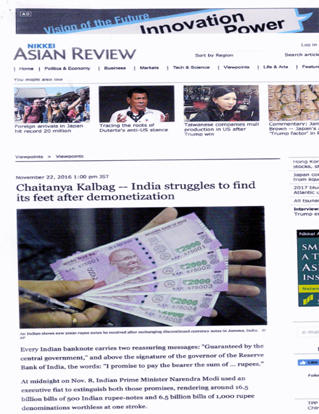
India struggles to find its feet after demonetization
Published date: 22nd Nov 2016, Nikkei Asian Review
View PDFChaitanya Kalbag, Contributing writer
Every Indian bank note carries two reassuring messages: “Guaranteed by the central government,” and above the signature of the governor of the Reserve Bank of India, the words: “I promise to pay the bearer the sum of … rupees.”
At midnight on Nov. 8, Indian Prime Minister Narendra Modi used an executive fiat to extinguish both those promises, rendering around 16.5 billion bills of 500 Indian rupee-notes and 6.5 billion bills of 1,000-rupee denominations worthless at one stroke.
Two weeks into his wrenching demonetization of high-value bills, analysts believe Modi has taken the biggest gamble of his career, combining political audacity with economic brinkmanship.
The decision has triggered nationwide chaos. Much of India’s cash-based economy has ground to a near standstill. Stock markets are at six-month lows. Millions of people have spent days waiting in line at overburdened banks to exchange useless old currency or deposit it in bank accounts. Nearly every day, the government has announced new steps to manage the crisis, first increasing the limit of money that could be exchanged, then slashing it; one day granting a higher withdrawal limit to farmers who desperately need to buy seeds as the winter sowing season starts, and on the next, allowing more money to hapless families as the country’s wedding season kicks off.
The pain has been made worse because India, despite its size, is very underbanked. The World Bank says that as of 2014 India had 13 bank branches per 100,000 population, compared to 32.4 in the U.S. and 33.9 in Japan, the country has only about 200,000 automated teller machines, many of which still need to be recalibrated for newly printed banknotes of different sizes.
Political gamble
After a four-day silence on the issue, Modi has used unusual situations to talk about his crusade against black money. On Nov. 12 during his recent visit to Japan, he told a crowd of about 500 Indians at the port city of Kobe that he thanked the millions of his countrymen who had coped with the inconvenience. “Many people [with black money] who had parked their aged parents in old people’s homes suddenly decided to deposit up to 250,000 rupees ($3,675) in their accounts,” he said mockingly, referring to the limit of old notes an individual was allowed to deposit in an account. A week later he spoke by video link, just before a Coldplay concert at a youth festival in Mumbai, telling the crowd: “To make public policy cool is no mean task,” and vowing to clean up India before quoting Bob Dylan’s lyrics from “The Times They Are a Changin’.”
A senior official involved in policymaking said that while Modi had emphasized the secrecy of his demonetization plan of the announcement, it had been in the works for months. He said the central bank’s former Gov. Raghuram Rajan had been opposed to demonetization, while his successor Urjit Patel, who took office on Sept. 4, had immediately signed off on the printing of a new 2,000-rupee banknote, along with new designs of existing denominations. Although two government printing presses had been working overtime to print the new notes, supplies have been slow to reach the big cities and the vast Indian hinterland.
Modi said demonetization was aimed at India’s huge black economy — some sources estimate it comprises around half of the nation’s $2 trillion gross domestic product. But the official said the demonetization would hit transactions in the works; about three quarters of the cancelled currency was in play in current transactions.
Get the Hoover out
Will demonetization vacuum up all the black money? Economists believe most illicit, untaxed funds would be diverted into buying gold or real estate; indeed, gold imports spiked in the days immediately following the announcement. But will India ever be cashless?
A Nomura Securities report said that India’s cash-to-gross domestic product ratio was high at 12%, compared with an emerging-market average of about 4%. The demonetization erased about 86% of total currency in circulation. RBI data shows that between 2011 and 2016, the number of 500-rupee notes rose by 76% and of 1,000-rupee notes by 109% — which begs the question, why did the central bank continue to print so much currency when the country’s GDP only grew by a total of 30% over the five-year period?
Modi has aggressively pushed financial inclusion, and the government has opened 255 million Jan Dhan (“people’s wealth”) zero-balance bank accounts for the unbanked poor, to use for any social welfare transfers and ideally, for deposits. But nearly a quarter of those accounts were still empty as of Nov. 9, and the remainder each had average deposits of only 1,788 rupees. In 2014, the year Modi took power, the World Bank estimated only 53% of the population above the age of 15 had bank accounts.
One senior economist said that with all major banks this year signing up for the government’s United Payments Interface scheme, which enables fund transfers between bank accounts and to merchants using a smartphone app, the government ought to have concentrated on moving more transactions online.
Some critics question whether demonetization will also hit counterfeiting and terrorist funding, two other reasons Modi cited for the demonetization. RBI data shows a total of 632,026 counterfeit bills were detected by banks in the year to March 2016, from an estimated total of 90.27 billion banknotes in circulation, Government ministers have said Pakistan-based terrorist groups-raiding India-ruled Kashmir use counterfeit currency; experts say it is only a matter of time before new currency notes are copied, which is why the government continually issues new series with enhanced security features and phases out old ones as soiled notes are returned.
Although the government has given Indians until Dec. 30 to exchange or deposit their old banknotes, progress has been slow. The RBI says that from Nov. 10 to Nov. 18 a total of 5.45 trillion rupees, about a third of the demonetized banknotes, had been exchanged or deposited in banks.
Parliament’s winter session, which began on Nov. 16, the exact midpoint of Modi’s five-year term, has been paralyzed by opposition parties accusing Modi of financial skullduggery and demanding a rollback of the demonetization, which is now effectively impossible. But political parties, including Modi’s, are not prepared to be transparent about their election fundraising, which runs into billions of dollars.
Black economy
Modi’s big reform will doubtless force more people to pay their taxes. In the 2015-16 fiscal year, 28.7 million Indians filed tax returns but only 12.5 million actually paid taxes — less than 1% of the population. In this tax-evasion culture, demonetization is seen as breaking the social contract. If the government does not improve infrastructure or provide better services, people will continue to avoid paying taxes.
Demonetization is unpleasant, confiscatory, and underlines a failure in tax administration, a second senior economist said, characterizing it as one step removed from the arbitrary expropriation of property. Most black money is spawned by completely legal activity, except that no tax is paid to a government that is seen as reneging on its part of the social contract.
The broader question here is what impact demonetization will have on India’s economy in the short to medium term. Nomura estimates the loss of about 1.9% of GDP. It sees GDP growth as slowing to an annual 6.5% in the September-December quarter from an earlier forecast of 7.3% but expects GDP to grow by a healthy 7.7% in 2017. Furthermore, it expects the banking system to be flooded with 4.5 trillion rupees in new deposits, leading to lower deposit and lending rates.
Mumbai-based Ambit Capital is more pessimistic and forecasts the informal sector — which accounts for about 40% of GDP and around 80% of the labor force — to contract and prompt the closure of around half of all non-tax paying businesses, with tax-paying businesses in the formal sector the ultimate beneficiaries. Economic activity will be paralyzed in the short term, Ambit says, and GDP might even contract in the September-December quarter. Ambit sees GDP growing only 3.5% in 2016-17 from an earlier forecast of 6.8%, and at 5.8% in 2017-18 against an earlier 7.3% estimate.
Whatever the immediate impact, most economists expect a temporary disinflationary effect, and likely further cuts in the benchmark repo rate — the discounted rate at which a central bank repurchases government securities from the commercial banks — by the RBI at its Dec. 6-7 policy meeting. Modi has spoken of more policy measures to be introduced after Dec. 30. His government was forced to deny a spate of rumors, one of which suggested that all bank lockers would be sealed and all jewelry and household gold holdings would be seized. Hopefully, by the new year, Modi will know if he rolled the demonetization dice correctly.






I don’t think the title of your article matches the content lol. Just kidding, mainly because I had some doubts after reading the article.
3xmx4a
oe9yi8
dhhsif
Игровые автоматы — это самые востребованные развлечения в казино.
https://relax-spb.ru/read-info/3125-jelly-sandals-korol-letney-obuvi-2026-15-modeley-vyderzhivayushchikh-lyubuyu-pogodu.html
На данном веб-сайте можно найти массу полезной сведений.
https://telegra.ph/Obuv-s-harakterom-pochemu-krossovki-Premiata-vybirayut-te-kto-razbiraetsya-02-16
Здоровый подход к азарту — это набор правил, предназначенный на поддержание контроля над финансовыми расходами и понимание потенциальных проблем, сопутствующих с игровой деятельностью, при параллельном акценте на развлечение как базовую причину участия.
https://randx-super.ru/
На данном сайте удастся почерпнуть обилие полезной материалов.
https://nanmed.ru/read/4353-gubernator-filimonov-i-zhurnalist-petrov-obsudili-podderzhku-uchastnikov-svo-v-vologodskoy-oblasti/
Концепция разумного риска — это подход, направленный на обеспечение дисциплины в отношении своими решениями и минимизацию негативных последствий.
https://b6.hypebeasts.ru/0YFGaR5QgXAB/
A generic drug is a medication that includes the same active substance as the original product.
This type of product is designed to be equivalent the reference medication in dosage form, safety, and efficacy.
After the intellectual property rights on the brand-name product ends, other manufacturers can produce and market generic alternatives at a lower cost.
super kamagra dosage
Трейдинг — это деятельность, состоящий в покупке и реализации финансовых инструментов с целью дохода на колебаниях их цены.
Прибыльный трейдинг предполагает в тщательном анализе рынка, создании подхода и управлении рисками.
Данный вид деятельности может генерировать стабильный заработок, однако требует самоконтроля и регулярного обучения.
Отзывы о сайтах
A generic version is a drug that contains the identical active ingredient as the innovator’s medication.
It is designed to mirror the reference medication in strength, safety, and efficacy.
After the patent on the brand-name product ends, other pharmaceutical firms can produce and market generic versions at a reduced price.
alcohol and tadalafil safety
Məsul oyun — bu o deməkdir şəxsin davranışını nəzarət altında saxlaması və mərc prosesinin əyləncə olaraq saxlanılması üçün metodlar toplusudur.
Bu yanaşma zaman və pul xərclərinə limitlər müəyyən etməyi, həmçinin problemli oyun əlamətlərini dərk etməyi nəzərdə tutur.
Bu, məsuliyyətli oyun istifadəçilərə mərc ərzində nəzarəti qorumağa yardım edir və mümkün fəsadların azaltmağa yönəldir.
pin-up casino app
На данном ресурсе легко найти массу ценной информации.
https://dvery35.ru/article/4707-tulskuyu-oblast-obstrelyali-13-dronov-pvo-rossii-sbila-381-vrazheskiy-apparat.html
Безопасное увлечение ставками — это система, предназначенный на поддержание баланса над финансовыми расходами и осознание опасностей, связанных с игровой деятельностью, при одновременном акценте на досуг как главную функцию участия.
https://randx-super.ru/
Controlled play is a philosophy that guarantees gambling stays a leisure activity not a source of distress.
The concept includes establishing personal limits on spending and time, as well as understanding the early signs of risky play.
At its core, this mindset fosters conscious actions and helps individuals to maintain mastery over their gambling experience.
https://www.boygeorgefever.com/board/board_topic/9134313/8761938.htm
Prudent betting is a framework that supports gambling continues to be a source of enjoyment not a financial burden.
The concept includes establishing personal limits on budget and time, as well as understanding the warning signals of unhealthy habits.
At its core, responsible gambling encourages balanced behaviour and allows participants to uphold control over their gambling engagement.
https://teresasilvano.com/
Online games constitute a favored mode of leisure for numerous individuals globally.
These games deliver engaging experiences and social interaction, often enabling users to compete with friends instantaneously.
Featuring countless variety of types, one can find something for each preference, be it casual or hardcore engagement.
https://legicon-pravo.ru/data/3393-khoroshie-nastroenie-ot-chetveronogikh-druzey-kogda-pitomtsy-iz-ekaterinburga-zastavlyayut-smeyatsya.html
Digital games constitute a common type of recreation for millions individuals across the globe.
Such experiences present immersive experiences and social connection, often enabling users to compete with friends instantaneously.
With a diverse array of categories, one can find something for all play style, be it casual or competitive gaming.
https://www.elephantjournal.com/profile/xakox72112/
Internet games constitute a widely enjoyed source of entertainment for millions people worldwide.
They deliver engaging worlds and social engagement, frequently enabling players to team up with fellow players in real time.
Given countless selection of genres, there is an option for all preference, be it relaxed or intense gaming.
https://zhkhtv.ru/read-full/1616-spinning-threads-of-fortune-how-random-number-generators-power-online-slot-games.html
Internet games serve as a common mode of amusement for numerous users globally.
These games offer immersive worlds and interactive interaction, typically allowing gamers to compete with people instantaneously.
With a vast range of styles, there is an option for any player, whether casual or intense engagement.
https://artlover.omskdaily.ru/YvvDUkRtXoL4/
Digital games represent a popular type of leisure for countless users across the globe.
These games offer immersive gameplay and social interaction, typically allowing players to interact with fellow players instantaneously.
Given countless range of categories, there exists something for each preference, whether casual or hardcore gaming.
https://biznes-war.ru/corporate/3275-novgorodskaya-telebashnya-ozaritsya-v-den-pamyati-i-skorbi.html
Web-based games serve as a prevalent source of amusement for numerous individuals globally.
They offer compelling gameplay and community connection, frequently letting gamers to team up with fellow players synchronously.
Featuring a diverse variety of styles, there exists something for all preference, whether casual or intense play.
https://r2.balmain1.ru/f5nVVAZRDSpf/
Networked adventures provide participants the superb way to unite and compete with friends worldwide.
https://mazko.ru/infopost/342-traurnye-bannery-v-voronezhe-simvol-skorbi-posle-raketnogo-udara/
Online entertainment bring players an compelling method to engage and compete with peers around the world.
https://greencape.ru/travel/2026-07-13-how-to-navigate-cashman-casino-s-bonus-structure-for-maximum-gains/
В наши дни модный лук выполняет ключевую роль при выработке положительного имиджа и повышении личной уверенности.
https://sorrybabushka.ru/interesting/542-krossovki-5-dollarov-dostupnye-varianty-dlya-studentov.html
j09qlb
Interactive gaming bring participants the wonderful avenue to engage and explore with friends worldwide.
https://www.freecodecamp.org/IvanBabak2026
Mindful gaming is a methodology that promotes participants to maintain control over their betting decisions while understanding the potential risks.
https://euro-ent.ru/shos-biz/2026-06-28-legal-and-regulatory-challenges-facing-online-casinos.html
Prudent betting is a set of principles that promotes participants to retain management over their wagering actions while acknowledging the potential risks.
https://satin-shop.ru/full-text/2026-06-28-mobile-slot-games-the-rise-of-gaming-on-the-go.html
Controlled play is an approach that facilitates users to retain mastery over their gambling habits while noticing the associated dangers.
https://vivatpersonal.ru/detail/2026-07-11-volgogradskaya-oblast-11-iyulya-livni-molnii-i-zhar-do-31-c.html
Responsible gambling is a set of principles that promotes users to sustain control over their gambling habits while understanding the possible harms.
https://penzu.com/public/d794212152f3eb02
Prudent betting is an approach that facilitates users to retain discipline over their gaming behaviour while being aware of the associated dangers.
https://justpaste.it/dqwi0
Responsible gambling is a methodology that ensures users to sustain control over their betting activity while being aware of the likely pitfalls.
https://franch-expo.ru
Safe wagering is a methodology that promotes players to preserve control over their playing engagement while noticing the attendant dangers.
https://megadomoz.ru/
Gaming entertainment give individuals a amazing opportunity to unite and explore with fellow players worldwide.
https://b7.chenews.ru/g1fuNqjp0iaU/
Safe wagering is a system that ensures players to maintain discipline over their wagering activity while recognising the possible harms.
https://homirussia.ru/cozy/867-zvuki-megapolisa-chto-byot-po-slukhu-gorozhan-i-kak-sokhranit-etot-khrupkiy-dar.html
Controlled play is a framework that ensures players to maintain management over their betting behaviour while noticing the likely pitfalls.
https://energiadoma.ru/full-read/111-okolo-10-000-molodykh-socheytsev-uzhe-vovlecheny-v-antinarkoticheskie-programmy.html
Safe wagering is an approach that supports participants to sustain discipline over their gambling decisions while acknowledging the associated dangers.
https://jaguar-online.ru/auto/340-psikhologiya-azartnykh-igr-pochemu-igroki-lyubyat-frispiny-i-progressivnye-dzhekpoty/
На этой платформе можно просмотреть справочник достоверной данных.
В нём представлены телефоны организаций и частных предпринимателей.
Эти сведения считаются общедоступными и могут быть использованы для проверки реквизитов.
Сайт регулярно обновляется, дабы вы всегда имели актуальной базой.
https://orq.me/