

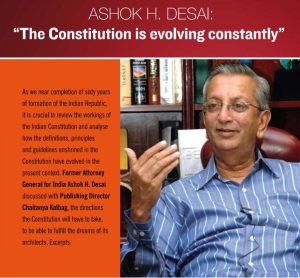
Ashok H. Desai – The Constitution is evolving constantly
Published date: Halsbury's Law, Oct 2008
View PDF“The Constitution is evolving constantly”
As we near completion of sixty years of formation of the Indian Republic, it is crucial to review the workings of the Indian Constitution and analyse how the definitions, principles and guidelines enshrined in the Constitution have evolved in the present context. Former Attorney General for India Ashok H. Desai discussed with Publishing Director Chaitanya Kalbag, the directions the Constitution will have to take, to be able to fulfill the dreams of its architects. Excerpts:
HLM (Halsbury’s Law Monthly): We wanted to focus this interview on the Constitution of India and wanted to know your views on what the Constitution will look like in 2050, a hundred years after the Republic was formed. In your view, will the Indian Constitution survive in its current form until 2050?
Ashok H. Desai: The answer to this partly lies in looking at what was the state of the Constitution 50 years ago; what was expected at that time and what we find today. The Constitution is evolving constantly. There has been a big difference today on the contents of the law, as also in the nature of the legal approach. For instance, the Constitution started off with a modest idea of what Articles 21 and 14 should be. Article 21 was regarded as ensuring a procedure for protecting life and liberty as sanctioned by law. There is a very interesting history behind it. Sir B.N. Rau, one of the main authors of the Constitution, had visited America to consult Justice Frankfurter about the Bill of Rights, including the due process clause. Frankfurter advised against it because in his view due process would mean different judges taking their own view of what was due and reasonable. The legal issue could then become subjective and political, We thereafter adopted the more limited phrase ‘procedure established by law’.
The Gopalan case, decided in 1950 on that basis makes strange reading today. The Supreme Court then held that each fundamental right had to be read as dealing with its own field and the area of life and liberty was dealt with only by Article 21. Justice Das gave an instance that in the middle ages in England, the cook of the Bishop of Rochester, who was accused of poisoning the Bishop, was by law of Parliament, ordered to be boiled in oil. The judge said that a Parliament would not pass such a law today. But if it did, it would be constitutional—the punishment was death and the procedure was being boiled in oil.
Now over the years, this right has been enlarged beyond recognition. The court has adopted the concept of ‘due procedural fairness’ and has gone further to read into the Article “substantive due process”. We have gone far beyond the American concept of “due process of law”, although the words our Constitution uses are more limited. Our judges have interpreted Article 21 far more broadly than the American Courts.
HLM: Do you think that Article 14 has been read ‘broadly’ by the Indian Constitution?
Desai: Article 14, which deals with Equality, was really thought of as a provision by which one dealt with discrimination between two similar classes. Then in Royappa and Shetty, the Supreme Court laid down that if you treated a person arbitrarily, you were creating dis crimination. This was an inventive leap. Now the concept of non-discrimination includes the mandate that the State must act fairly and reasonably. Just see the unexpected consequence. It means that a large number of executive decisions of the government and sometimes even laws are tested on the touchstone of what is reasonable. Now the moment you ask what is reasonable, a policy issue arises. As Hailsham said, two totally reasonable people might come to opposite conclusions.
HLM: Do you think our Constitution Makers imagined that the Supreme Court and the High Courts would assume such power?
Desai: The Constitution makers were a remarkable group. If you read the debates, you find both learning and a wide range of opinions. But none of them would have dreamt that the Supreme Court or the High Courts would assume these powers and that the fundamental rights which they were adopting for the first time in our history would now result in the Court entering the arena of policy. So if you look at what changes have been brought by the Court, one has to be cautious in envisaging the changes of the next 50 years.
Look at another area in the Constitution about the appointment of judges. I think the Supreme Court by successively interpreting consultation as concurrence and concurrence as veto power, then assuming virtually the right to appoint, then the “consultation” with the Chief Justice becoming enlarged to three and then a collegium of five, has adopted an aggressive interpretation well beyond the strict language of the Article. We may like the judgments because we may prefer the judges being appointed by the collegium rather than the executive, but one cannot dispute that here is an interpretation which was never contemplated.
HLM: What are you views on the theory of original intent?
Desai: As you recall, in America, there is a whole theory of original intent.
Judges like Scalia and Thomas are very keen they must find the intention of the Constitution Makers at the time it was enacted. It is quite interesting that they enthusiastically cite Dr. Johnson’s dictionary, as this is how English was understood when the US Constitution was crafted. We have thankfully rejected that view because it would put the dead hand of the past, on the modern generation. We have accepted the idea that the Constitution can be changed by judicial interpretation to meet the needs of the hour.
Another significant change is the concept of Public Interest Litigation. It is a result of greater assertion of fundamental rights. People turn to courts when the other institutions do not perform.
When the other organs of the State fail to discharge their constitutional obligations or they are indifferent to constitutional objectives of rendering social, economic and political justice, people turn to courts. The judiciary through PILs has made significant pronouncements on a wide range of areas such as prisoners’ rights, the police, child labour, bonded labour, environment, accountability, politics and elections, human rights and judiciary. The judiciary has exercised its judicial powers, to give effect to its perception of the constitutional mandate. Even if it occasionally assumed the role of a policy maker, legislator and even a monitor to oversee the implementation of its directions.
Some issues relate to our court system. The basic function of the Supreme Court is interpreting the Constitution. Although Article 136 permits special appeals and Article 32 is for breach of any fundamental right and enables citizens to approach the Court directly, it was never envisaged as one more court of appeal. Today, the Supreme Court is taking on the burden of one more appellate body about rent, company disputes and a range of cases, which do not raise any constitutional issue nor have the essential element of Article 136 about it. A substantial amount of work in the Supreme Court has, is not related to Article136.
HLM: Are we in danger of having too many bodies of laws? Are there too many laws about too many things? Look at the number of laws that a lawyer has to be familiar with, and judges have no time to educate themselves.
Desai: You have raised a very basic problem about our system of courts. Apart from direct taxes, most benches and really lawyers are generalists in an era where laws are becoming more and more specialised. In England the Human Rights Act of 1998 was not brought into force for two years so that practitioners and judges would get familiar with it. In India, not only do the laws multiply but the lawyers and judges have no time or the opportunity to study them in any depth. One approach would be more specialised benches. As a lawyer, if certain types of matters come to me, say a complicated direct tax matter, I am modest enough to say that it is not my cup of tea (although with a little effort I can perhaps argue the matter!). I think it much fairer for my client to go to a person who specializes in that area. But if I become a judge, I can lay down the final law on the subject. The other day I was at a patent conference held between Indian lawyers and American lawyers. The American lawyers were very keen to find out what is the specialization in High Courts in patent matters. They were quite taken aback when I mentioned that there was no such specialization and any judge on the original side could take a patent case. Now frankly, every judge is not equally familiar with patent law, trademark law or for that matter, with criminal law or tax law. I am a great believer that there should be specialised benches in each court, just as today you have tax benches.
HLM: So are you saying that there are contradictory judgments?
Desai: I am afraid so. The American courts of appeal adopt a system of self-restraint, where a case is decided on the narrowest possible point. If the Court can decide it on that point, the judges would not expound the law on the whole field or the other issues. Our courts seem to deal with every possible issue which arises, some of which may not have arisen in the lower courts. I do not appreciate the system in our Supreme Court, with litigants filing affidavits in appeals. An appeal is to be argued on the record before the High Court. You do not file another affidavit, where the ingenuity of our appellate lawyer would bring in many new points.
The respondent replies to it and the battle then moves from what was argued in the High Court to some different area. Our judges don’t sit en banc (all together). So we virtually have 12 Supreme Courts. As a member of the Bar I must also share the blame. The judges do not receive the assistance from the Bar, which they are entitled to. In England, it is regarded as unprofessional not to do full research and place the relevant case law on the subject.
I have one unorthodox suggestion; it would be a good idea for judges to write the judgments in hand. In the Indo British Forum, I asked the judges of the House of Lords on the subject. I was very surprised when Templeman said that the judicial work of the House was then being done by ten judges, who shared three stenographers. Most of them wrote their judgments by hand, excepting Goff, who typed directly onto his computer.
HLM: What are the greatest challenges faced by our courts today?
Desai: The greatest problem of our system is the fact that the judges are over-burdened. We have an inverted pyramid of work. The higher you are elevated the greater is the burden you carry as a judge. CJ Venkatachalliah used to say that he did not know what bonded labour was until he became a Supreme Court judge. You will be astonished to learn that our Supreme Court judges receive more than seventy briefs over the weekend. They have to work very hard since their weekend is spent ploughing through 70 special leave petitions. They have to satisfy their conscience that injustice is not done.
Further, it must be compulsory in my view for the parties to give skeletal arguments at least a week in advance and coupled with a rule that the skeletal argument should not exceed more than, say, five pages. The Supreme Court must ultimately deal with some specific issues of law. Today lawyers go on developing points as they are on their feet hoping something might strike home.
As a result of this burden, the brother judges do not have time to scrutinise the details of the lead judgments with which they concur. If you read books on the U.S. Supreme Court, which are now being published, including “The Brethren”, the judges discuss sentences in each other’s judgments because they were going to lay down the law; our judges do not have that time. They agree on the result, but they leave it to the brother judge to write the reasoning. And that explains an interesting facet of the great craftsmanship of Justice Bhagwati. I will give you two instances, One is Shetty’s case, which I had argued.
He laid down law on arbitrariness but he dismissed the petition. Now what happened was that the judges had agreed that my petition should be dismissed but left the reasoning to Bhagwati. In the process, he laid down what has now become the settled law on arbitrariness and then denied the relief on a collateral point. Similarly, there is a decision in Khudiram, where he laid down the law regarding ‘preventive detention’. But at the end of it, the learned judge held that these safeguards had not been not violated in the case, and therefore dismissed this petition.
Since I am a member of the legal profession, one must be self-critical, but I must add that despite all the problems and occasional hiccups, the public have great confidence in the judiciary. This high public esteem is partly due to the enfeeblement of other institutions and partly because of the perception that the court is responding to the “the felt necessities of time”. The executive may complain of “the imperial judiciary”, but the public at large regards it to have stood the test of time.
Ashok H. Desai, Senior Advocate of the Supreme Court of India, and former Attorney General for India, has been practising law for over fifty years. Attorney General from 1989-90 and Solicitor General of India from 1989-90, Desai’s lists of achievements is singularly unique. He presented India’s Report to the United Nations Committee on Human Rights in Geneva in 1997 and led the Indian delegation to the United Nations Preparatory Committee on Money Laundering Bill in Vienna in 1998. He has been a Consultant to the Commonwealth Workshop on Administrative Law at Lusaka, Zambia in 1990 and was the Chairman of the Committee on Administrative Law of International Bar Association from 1986-88. In 2001, he was awarded with the Padma Bhushan and the Law Luminary Award. He is the Vice President of the Bar Association of India and President of Inns of Court (India) Society. Among other positions he has held are: Legal Correspondent, Times of India, and Professor, Law College, Bombay and Bombay College of Journalism.





Alright, so I stumbled upon kun11. Not bad! Give it a shot, might be your lucky day. Here’s the link: kun11
Having a bit of a pain getting logged into 20bet login. anyone else having trouble? Maybe I should just try some different website… anyway You can try some 20bet login, might work for me
Alright, nạp tiền qh88 qh88.vet, let’s get this bread! Hope the deposit process is quick and simple. Nobody likes waiting to play! Test it out nạp tiền qh88 qh88.vet!
[744]PHTAYA Casino: Best Online Slots in the Philippines. Quick PHTAYA Login, Easy Register & PHTAYA App Download for Real Wins. Experience PHTAYA Casino: Best online slots in the Philippines. Quick PHTAYA login, easy register & PHTAYA app download for real wins. Join PHTAYA slots today! visit: phtaya
[364]SSBET777 Online Casino Philippines: Easy Login, Register, & App Download for the Best Slot Games. Join SSBET777 Online Casino Philippines! Fast ssbet777 login & register to play the best ssbet777 slot games. Get the ssbet777 app download and win big today! visit: ssbet777
[8865]jljl991 Online Casino Philippines: Easy jljl991 login, register, and app download for the best jljl991 slots and rewards. Experience jljl991 Online Casino Philippines. Enjoy easy jljl991 login, jljl991 register, and jljl991 app download. Play the best jljl991 slot games and win big rewards today! visit: jljl991
[9355]Philippines’ Top Online Casino: Easy sa88 Login, Register, & App Download. Play the Best sa88 Slot & Live Casino Games Today. Experience the best of sa88, the Philippines’ top online casino. Quick sa88 login & sa88 register. Get the sa88 download for mobile and play sa88 slot or live casino games today. Join sa88 casino now! visit: sa88
[6328]ta777 Official Site: Best Online Slot Casino in the Philippines. Easy ta777 Login, Fast Register, and Secure App Download. Experience the ta777 official site, the top online slot casino in the Philippines. Enjoy easy ta777 login, fast ta777 register, and secure ta777 app download. Play premium ta777 slot games and start winning big today! visit: ta777
[9291]Me777 Login, Register & App Download: Experience the Best Me777 Slot Games in the Philippines Official Casino. Join Me777, the #1 Philippines casino! Quick me777 login & register to play top me777 slot games. Get the me777 app via me777 download for non-stop mobile action. visit: me777
[5640]The Philippines’ Most Trusted Legit Online Casino for Perya, Color Games, and Instant GCash Payouts visit: peryaplus
[9990]Jilibay Online Casino Philippines: Top Jilibay Slots, Easy Login, Register & App Download for the Ultimate Gaming Experience. Join Jilibay Online Casino Philippines for top Jilibay slots! Quick jilibay login, easy jilibay register, & fast jilibay app download. Play and win big today! visit: jilibay
[7105]PH77 Online Casino Philippines: Fast PH77 Login, Register & App Download for Premium PH77 Slot Games. Join PH77 Online Casino Philippines for the ultimate gaming experience! Enjoy fast PH77 login, easy PH77 register, and secure PH77 app download for premium PH77 slot games. Start winning today at the most trusted PH77 online casino. visit: ph77
[8374]8jl: Top Online Casino Philippines – 8jl Login, Register, & App Download for Best 8jl Slot Games Experience 8jl, the top online casino Philippines. 8jl register now for premium 8jl slot games. Easy 8jl login & 8jl app download for the best 8jl casino online action. Play & win today! visit: 8jl
[948]ubet95 Official Link: Fast ubet95 Login & Register. Download the ubet95 App to play the best ubet95 slot games in the Philippines. Visit the ubet95 official link for fast ubet95 login & register. Start your ubet95 app download to play the best ubet95 slot games in the Philippines. Sign up now! visit: ubet95
шумоизоляция арок авто
шиномонтаж выездной москва рядом со мной https://vyezdnoj-shinomontazh-77.ru
Привет всем! В этой статье я расскажу про устройство эксплуатируемой кровли. Суть здесь в чем: эксплуатируемая кровля — нужен надёжный материал. Ценишь качество — обращайся: монтаж мембранной кровли. Как правило под террасную доску используют полимеры. В общем хочешь террасу на крыше — без вариантов нужна мембрана. Мы используем армированную мембрану, сверху — геотекстиль и дренаж. Резюмируем: это отличные параметры — терраса без протечек.
шумоизоляция авто https://vikar-auto.ru
шумоизоляция торпеды
шумоизоляция дверей авто https://shumoizolyaciya-dverej-avto.ru
При поиске качественных ссылок часто используется база трастовых сайтов для хрумера https://www.olx.ua/d/uk/obyavlenie/progon-hrumerom-dr-50-po-ahrefs-uvelichu-reyting-domena-IDXnHrG.html.
накрутка подписчиков в Телеграм
skanus pyragai https://pyragaireceptai.lt
Thanks for sharing. I read many of your blog posts, cool, your blog is very good.