

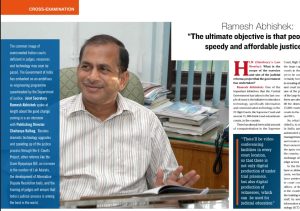
Ramesh Abhishek
Published date: Halsbury's Law, Nov 2008
View PDFThe common image of overcrowded Indian courts deficient in judges, resources and technology may soon be passé. The Government of India has embarked on an ambitious re-engineering programme spearheaded by the Department of Justice. Joint Secretary Ramesh Abhishek spoke at length about the good change coming in an interview with Publishing Director Chaitanya Kalbag. Besides dramatic technology upgrades and speeding up of the justice process through the E-Courts Project, other reforms like the Gram Nyayalaya Bill, an increase in the number of Lok Adalats, the development of Alternative Dispute Resolution tools, and the training of judges will ensure that India’s judicial process is among the best in the world.
Ramesh Abhishek:
“The ultimate objective is that people get speedy and affordable justice”
HLM (Halsbury’s Law Monthy): What is the scope of the exercise and size of the judicial reforms project that the government has undertaken?
Ramesh Abhishek: One of the important initiatives that the Central Government has taken in the last couple of years is the initiative to introduce technology, specifically information and communication technology, in the 21 High Courts, the Supreme Court and around 15, 000 district and subordinate courts, in the country.
There has already been a fair amount of computerisation in the Supreme Court, High Courts, metro courts and the large capital city courts, but the courts in the rest of the country are yet to be computerized, and this has certainly been one of the hindrances in ensuring efficient case management and court management. This is also one of the problems in the handling of the large backlog of cases we have; there are already over 26 million cases till the district and taluka levels. The 15,000 courts are the total number of courts in the country including the SC and HCs.
So, what the government has decided is, to computerise all the courts in India and create a completely automated system of case and court management in every court complex, and create a national judicial data grid that connects all the courts, right from the apex court to the lowest court in the country, so that there is seamless exchange of information and knowledge across the judicial system.
In the first phase, for which we have a cabinet approval of Rupees 442 crore, we have already given laptops, laser printers, internet connectivity in court complexes and the home offices, of the 13,500 judicial officers in the country, and most importantly, the training to all the judges and court staff, by and large, in use of these information and communication technology (ICT) tools. We are now in the process of developing 3000 sites in all the court complexes in the country-there are roughly 3000 court complexes, in which these 15,000 courts are located. Then we are in the process of procuring hardware; application software also is being developed and standardised, with the guidance of the e-committee, which is a part of the Supreme Court and is headed by a retired judge of the Court.
We are hoping that in the year 2009, we should be able to complete this first phase, after which there will be subsequent phases of the e-courts project, which would be taking the computerisation programme forward by digitization of case records, should be one of the important items of the later phases. There’ll be video-conferencing facilities in every court location, so that there is not only digital production of under trial prisoners, but also digital production of witnesses, which can be used for judicial education. Then we are going to set-up gateways, so that the judicial system is able to interact seamlessly with other actors in the criminal justice system, like police, correction facilities, forensic labs and medical facilities etc., because exchange of information between all these entities has become a big problem now. This is one of the critical e-governance projects in the country.
HLM: This sounds like a very ambitious project. How many years will this project take?
Abhishek: It is envisaged that this programme will be done in 3 phases, over a period of 5 years. The first one is being done now, and is to be completed in 2 years and perhaps a few months beyond that also…it is a highly decentralised activity across the country and we face huge management and administrative challenges and issues. As a matter of fact, that only goes to show how important computerisation is, to get information regarding the judges, technical staff, hardware etc. So, we are going to put all this in the ICT network. It is no doubt an ambitious programme, but it is really required and we are all working on it.
HLM: Will digitisation make available all historical information, case law, citations and judgments to every judge for his/her reference, going forward?
Abhishek: The High Courts are courts of record, so the first phase will aim at digitizing the records of the High Courts, and later on we will move to the district courts also.
So far as the legal resources are concerned, it is certainly one of the important objectives that judges should be able to access all the legal resources that are available on the net, so that they have access to whatever laws, statutes, citations and judgments are available on a particular subject. So it is certainly one of the prime objectives of this programme to ensure that the judges in the country have access to the best legal resources.
HLM: This is very important in terms of modernising the work flow in a court and making the justice system work faster and better. Do you feel that it’s also going to result in easier access for the average Indian to the courts and to faster justice and litigation?
Abhishek: The ultimate objective of this whole exercise is to have speedy disposal of cases, so that people get speedy and affordable justice. In terms of immediate outcomes, our project deliverables include that the status of every case would be available online to people; the moment the judgment is passed, it would be posted on the net and people will be able to get certified copies instantly. The ultimate idea is to speed-up the entire court management and case management process, so that the cases are disposed of faster… the entire effort of technology is being made only in that direction.
HLM: Could you also talk about some of the other steps that are being taken for judicial reforms.
Abhishek: One of the important judicial reform measures is to have more courts in the country. As you know, the Supreme Court has also given a judgment that we should have far more courts than what we have, considering the number of courts per million population.
This department in the Government of India, supports fifteen hundred plus fast-track courts in the country, which are in existence since the year 2005; they have contributed to the disposing of a very large number of sessions cases. We (Ministry of Law and Justice) are also bringing a Gram Nyayalaya Bill in the Parliament, which will set-up more than 5000 courts in the country at the Block level; at the intermediate Panchayat level. They are village courts—Gram Nyayalayas— and they would be looking at handling small criminal and civil cases. Criminal cases would be up to 1 year of punishment and civil cases will be of minor pecuniary jurisdiction, to be decided by their respective High Courts. These will be mobile courts and will go right to the doorstep of the litigants, disposing of cases in a summary manner— that is of course subject to the enactment of the law and before that the approval of the Parliament. These 5000 courts will be a very important addition to our existing 15,000 trial courts.
Another very important area of work is that of alternate dispute resolution (ADR). I think this is one of the areas that needs a lot of attention, and of late a lot of mediation and conciliation centers are being opened in the country; every High Court now has a conciliation and mediation center. Many other projects and ideas are also being worked on, for instance, training of lawyers and judges in mediation and conciliation…a lot of work is going to happen in that area because in many countries, as in the U.S., a lot of cases are disposed of and further cases don’t even come to the courts because of ADR tools.
Even arbitration is coming up in a big way, as an important ADR measure that we have. Lok Adalats also help in the disposal of a lot of cases…then we have evening courts, such as in Gujarat, and mobile courts in Punjab and Haryana, and morning courts in Andhra Pradesh. So, many of these models are present, whereby a lot of cases are getting disposed of…the Delhi High Court is also now contemplating having an evening court and many other High Courts are in the process of adopting such measures and facilities.
HLM: There is a feeling that then judiciary does not have the time to educate itself. Do you think that the reformative measures mentioned by you will start to make a big difference in that part of the process and that judges will become better informed?
Abhishek: Judicial education is a very important part of the number of reform measures that are being done. The National Judicial Academy in Bhopal is training more than 3000 judges every year, starting from district judges to High Court judges. Even the State Judicial Academy, which is responsible for the induction and training of judicial officers and undertaking of other refresher training programmes, is present in every state now. Judicial education is being carried out in a focused way now and this is certainly going to help the judges better equip themselves with the knowledge of law, as well as many other tools which are required, for instance, case management, court management and the use of technology.
HLM: Is there any proposal to expand the Supreme Court in numbers or add another layer of appellate court that might help in reducing the backlog?
Abhishek: The government has already introduced a Bill in the parliament to increase the number of judges in the Supreme Court from 25 to 30, excluding the Chief Justice of India… so that is already under the consideration of the Parliament. We have already increased the number of High Court judges in the last one year. We have increased the number by almost 170, so there has been a significant increase in the number of High Court judges across the country.
HLM: How many are there altogether?
Abhishek: Earlier, there were 725 judges in 21 High Courts, now we have increased that to 877. The number has been increased, so that the increasing workload in the High Courts can be addressed by these additional judges. So, the review keeps taking place and we increase the number, as and when required.
HLM: I am seeing that people like yourself have been studying the systems in other countries quite closely, to see how they correlate to populations, litigation backlog etc. That is a big change in terms of assimilating learnings from other parts. of the world, in making sure that our system gets better.
Abhishek: There is a very regular interaction of our judiciary with the judiciary of other countries. There are a number of institutional mechanisms, whereby our judiciary interacts with judiciaries of other countries. Our honourable judges of Supreme Court and High Courts pay visits to other countries to share knowledge on various judicial matters of administration and legal issues, so we have a lot of interaction and we learn from each other.
HLM: There was a recent report in the newspapers about the move to make judiciary more accountable to the public in general. Do you think that hinges on the entire issue of judiciary- executive separation?
Abhishek: The government had introduced a Judges Enquiry Bill in the Parliament in 2006, and the standing committee of the Parliament had given its report. Now the government is planning to go back to the Parliament with a slightly amended version of that Bill. The idea is to have a National Judicial Council, consisting of sitting judges… which will basically be a review of the judges by their peers, so the accountability in the judiciary is going to be the responsibility of their peers only. The independence of the judiciary is going to be fully protected in this way and at the same time, this proposed mechanism will make sure that there is greater accountability in the system
“We are going to set-up gateways, so that the judicial system is able to interact seamlessly with other actors in the criminal justice system, like police, correction facilities, forensic labs and medical facilities”
HLM: 60 percent of all litigation involves the government, do you see that procedurally improving in any way?
Abhishek: By procedural changes, we can ensure that the disposal of cases may be faster, but so far as the government being a party is concerned, that is mainly because of the nature of the government we have in the country. For example, in criminal cases, it is always the government that goes to the court with the charge sheet and prosecution, so invariably government is a party; it is fighting the cases most of the time. In civil cases, the government has the ownership of land etc. The government in our country has a very important role, so there is bound to be a lot of litigation. I really don’t know how this can be reduced or curtailed; it needs a lot of detailed study, I guess.
HLM: Do you expect to see any major change from the recommendations coming from bodies like the Administrative Reforms Commission and the Law Commission of India?
Abhishek: So far as the Law Commission is concerned, a number of reports of the Law Commission have been acted upon by the government. As a matter of fact, the Judges Enquiry Bill is a result of one of the reports of the Law Commission only. So I think the Law Commission plays a very important role in suggesting significant legal and procedural changes. I am sure that other Ministries also, depending upon the nature of the report, take action on the recommendations of the Law Commission; it is certainly given the importance it deserves.
*(The views expressed by Mr. Ramesh Abhishek are purely his own and do not represent the views of the government)
Ramesh Abhishek, Joint Secretary, Department of Justice, Government of India is a member of the Indian Administrative Service since the year 1982. In addition to his other duties, he is also the Mission Leader of the e-Courts Project that is being implemented to bring in e-governance in the Indian judiciary. He was Member-Secretary of the Task Force on Judicial Impact Assessment chaired by Justice Jagannadha Rao that submitted its Report in June 2008. He was also Convener of the committee chaired by Prof. Madhav Menon on drafting a National Policy on Criminal Justice System that submitted its Report in July 2007. Prior to his current assignment, he was appointed by the Chief Justice of India as Member (management) of the E-Committee in the Supreme Court of India from 2005 to 2007. He had earlier worked in Bihar as the District Magistrate of Patna and East Champaran, among his other assignments. He worked for the United Nations in the peacekeeping mission in Kosovo, where he directed the Department of Judicial Administration, which was responsible for the administration of justice in that province. He is a Mason Fellow and has a Master’s Degree in Public Administration from Harvard Kennedy School and a Master’s Degree in Politics from the Jawaharlal Nehru University, New Delhi.






**mitolyn**
Mitolyn is a carefully developed, plant-based formula created to help support metabolic efficiency and encourage healthy, lasting weight management.
[2308]phdream88 Online Casino: Secure phdream88 Login & Register for the Best Slot Games and App Download in the Philippines. Experience the best phdream88 slot games at phdream88 Online Casino. Secure phdream88 login, easy phdream88 register, and fast phdream88 app download in the Philippines. visit: phdream88
[6018]Plot777: The premier Philippines online casino. Experience top-tier Plot777 slot online games. Fast Plot777 login, easy Plot777 register, and secure Plot777 app download via our official Plot777 casino link. Join Plot777, the premier Philippines online casino! Experience top-tier Plot777 slot online games today. Enjoy fast Plot777 login, easy Plot777 register, and secure Plot777 app download via our official Plot777 casino link for a premium gaming experience. visit: plot777
[4097]panalo99 login|panalo99 app|panalo99 register|panalo99 slots|panalo99 download Experience the ultimate online gaming at Panalo99, the premier casino platform in the Philippines. Complete your Panalo99 register today to access a wide variety of exciting Panalo99 slots and exclusive rewards. Enjoy a seamless Panalo99 login experience on desktop or mobile. For gaming on the go, the Panalo99 app is available—start your Panalo99 download now and win anytime, anywhere! visit: panalo99
[703]PH222: Top Casino Games & Slot Online in the Philippines. Easy ph222 Login, Register, and App Download. Experience the best ph222 slot online and ph222 casino games in the Philippines. Secure ph222 login, fast ph222 register, and easy ph222 app download for big wins! visit: ph222
[5809]Lovejili Online Casino Philippines: Secure Lovejili Login, Easy Register, and App Download for the Best Slot Games. Join Lovejili Online Casino Philippines! Experience secure Lovejili login, easy Lovejili register, and Lovejili app download for the best Lovejili slot games and premium casino online action. Start winning today! visit: lovejili
[9386]365jl Official Link: Fast 365jl Login, Register & App Download for Top 365jl Slot Games in the Philippines. Join 365jl, the top online casino in the Philippines! Use our 365jl official link for fast 365jl login, easy 365jl register, and 365jl app download. Experience premium 365jl slot games and start winning big today! visit: 365jl
[4882]The Top Online Casino in the Philippines: Premium Slots and Fast GCash Gaming. visit: taya333
[5078]The Philippines’ Most Trusted PAGCOR Licensed Online Casino & Legal Gambling Site visit: pagcor
[6598]25phwin slots|25phwin register|25phwin download|25phwin login|25phwin giris Experience the ultimate gaming thrill at 25phwin, the premier online casino in the Philippines. Play the latest 25phwin slots, complete your 25phwin register for exclusive bonuses, and enjoy a seamless 25phwin login. Get the app via 25phwin download for mobile play and fast 25phwin giris to start winning today! visit: 25phwin
[7154]KG77 Login, Register & Slot Philippines: Official Link Alternatif and App Download for Premium Casino Games. Join KG77 Philippines for a premium casino experience! Secure kg77 login & kg77 register to play top kg77 slot titles. Use our official kg77 link alternatif or kg77 download the mobile app for 24/7 gaming action. visit: kg77
[6688]Philslot Online Casino: Top Slot Games, Easy Login, Register & App Download in the Philippines Join Philslot Online Casino for the best philslot slot games in the Philippines. Enjoy easy philslot login, fast philslot register, and get the philslot app download to win big today! visit: philslot
[3932]Bigwin29 Official Link: Secure Login, Register, and Play Top Slots. Download the Bigwin29 App Today for the Best Philippines Casino Experience. Access the Bigwin29 official link for secure Bigwin29 login and register. Play top Bigwin29 slot games and start the Bigwin29 app download for the best PH casino! visit: bigwin29
Если нужно автоматизированное размещение ссылок, можно базы хрумера купить у проверенных поставщиков.
Thank you for your sharing. I am worried that I lack creative ideas. It is your article that makes me full of hope. Thank you. But, I have a question, can you help me?
Incrível a experiência nesse site. O sistema é muito moderno e os pagamentos caem rapidinho na conta. Recomendo a todos! Veja brboxwin