

Bharatiya Janata Party – Gilding An Image
[India Today]
Published date: 15th Apr 1982
View PDFALL GOOD Hindus hope to reincarnate as better Hindus, and the Bharatiya Janata Party (BJP) will be celebrating its second birthday on April 5 with the conviction that it is well on the way to establishing itself as a “nation alternative”. More than anything else, a strident section in the party is anxious to shed its old ideological and doctrinaire fat, and to convince people that it has changed a lot from the Bharatiya Jana Sangh.
The BJP is therefore trying to metamorphose into a coolly professional electoral organisation, and it has embarked on an ambitious three-pronged campaign to refurbish its image and ‘modernize’ its approach. Electorally, its strategy is to establish dominance over all other opposition parties, even in areas where the Jana Sangh never gained a foothold. It has launched a public relations blitz aimed at convincing both the public and a sceptical press that it is a high-profile party that considers activism its forte and secularism its credo. And organisationally, the BJP is overhauling its entire infrastructure
Select Gathering: These changes were mooted in documents given to participants at the party’s first National Study Camp. held at Vrindavan, Mathura, from September 19-22 last year. Circulated among a select gathering of 200 delegates, the documents chalk out every component of the party’s strategy for the future. They have only just now become available to the press, and provide a rare insight into the BJP’s reorganization plans. The central strategy document. written by an anonymous author. ‘D.N.’, homes in on the imperatives of electoral success-the corner-stone of the party’s plans. “A myth was built up,” says D.N., “that the only honest politician is one who does not seek power. This myth grew and it has reached a stage where many BJP politicians believe that renunciation is the only sure sign of sincerity.”
INDIA TODAY has learnt that this keynote paper was prepared at the Deen Dayal Research Institute in Delhi, which has emerged as a sort of BJP ideological think-tank under the stewardship of former party general secretary Nanaji Deshmukh. Together, the Vrindavan papers read more like a management course’s term-papers, and are very candid in their examinations of the party’s internal dynamics and weaknesses.
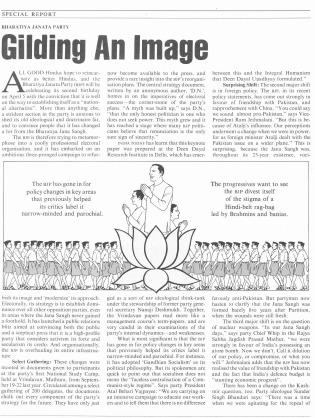
What is most significant is that the BJP has gone in for policy changes in key areas that previously helped its critics label it narrow-minded and parochial. For instance, it has adopted ‘Gandhian Socialism’ as its political philosophy. But its spokesmen are quick to point out that socialism does not mean the “faceless centralisation of a Communist-style regime”. Says party President Atal Behari Vajpayee: “We are carrying on an intensive campaign to educate our workers and to tell them that there is no difference between this and the Integral Humanism that Deen Dayal Upadhyay formulated.”
Surprising Shift: The second major shift is in foreign policy. The BJP, in its recent policy statements, has come out strongly in favour of friendship with Pakistan, and rapprochement with China. “You could say we sound almost pro-Pakistan,” says Vice-President Ram Jethmalani. “But this is because of Atalji’s influence. Our perceptions underwent a change when we were in power. for as foreign minister Atalji dealt with the Pakistan issue on a wider plane.” This is surprising, because the Jana Sangh was, throughout its 25-year existence, vociferously anti-Pakistan. But partymen now hasten to clarify that the Jana Sangh was formed barely five years after Partition, when the wounds were still fresh.
The third major shift is on the question of nuclear weapons. “In our Jana Sangh days,” says party Chief Whip in the Rajya Sabha Jagdish Prasad Mathur, “we were strongly in favour of India’s possessing an atom bomb. Now we don’t. Call it dilution of our policy, or compromise, or what you will.” Jethmalani adds that the BJP has now realised the value of friendship with Pakistan and the fact that India’s defence budget is “stunting economic progress”.
There has been a change on the Kashmir question, too. Party ideologue Sunder Singh Bhandari says: “There was a time when we were agitating for the repeal of Article 370, which gives special status to Kashmir. Now we are not. There are few explanations in these major policy changes except for the argument that the BJP has “matured” but Jethmalani says, “I think it is the influence of the people who joined the BJP after 1980, and who were neither in the Jana Sangh nor the Rashtriya Swyamsewak Sangh (was). Another leader says the BJP’s Framework of perceptions, except for its economic policy, are modelled primarily on the Janata Party manifesto of 1977.
Action Fronts: Many of the policies formulated at Vrindavan were endorsed by the party’s National Executive when it met at Bhubaneswar from February 13 to 15. and action has already been launched on various fronts. Although the Jana Sangh had conducted similar study camps, their proceedings remained secret. The decision to give the press access to the Vrindavan papers came from Vajpayee. By last fortnight, the party had set up cells to handle propaganda and publicity, its anti-corruption drive, and the minorities. It is shortly going to set up an economic cell headed by Satish Agarwal, who is currently chairman of the Public Accounts Committee of Parliament.
But these changes cannot exert much impact unless the BJP convinces the country that it is in fact evolving. Its most important thrust, therefore, is in the field of propaganda. Mathur is in charge of this prestigious cell, and has enthusiastically set out to capture the hearts and minds of his countrymen. His Vrindavan paper spells out in painstaking detail the wooing of the Fourth Estate (see box). An integral part of the media blitz is the proposed launch of two fortnightlies, in English and Hindi, “to serve as documentation of party activity and ideological pronouncements”. The Hindi magazine, says Mathur. should be out by April 15.
ALL this effort is aimed at projecting the party as the alternative to the Congress(I). Since its formation in 1980, the BJP has gained considerable leeway in Kerala, and is “successfully carving out a niche” for itself in Karnataka and Andhra Pradesh. “My meetings in the south are heavily attended,” says Vajpayee. “Two years back this was unthinkable. But organisationally we are not strong in the south, we need to channelize people’s enthusiasm.”
Vajpayee expects the party to sweep Himachal Pradesh and do well in Haryana at the Assembly polls this summer and present a challenge to the Congress(I) in the 1985 general elections. Convinced that the BJP is the only disciplined and cadre-based party in the country apart from the CPI-M the Vrindavan strategy paper harangues party workers into positive vote-gathering attitudes. “We as an organisation suffer from mental blocks,” it says. “Our workers have the makings of organisers and not activists.”
Coupled with some very realistic assessments of other opposition parties, and the realisation that the BJP cannot hope to dislodge strong regional parties like the All India Anna Dravida Munnetra Kazhagam and the Dravida Munnetra Kazhagam in Tamil Nadu, the Akali Dal in Punjab and the National Conference in Kashmir, is the cynical and cold-blooded decision to “channelise discontent prevailing in different sections so as to win their support, and to cut them away from opponents”.
Estimates: Specifically, the BJP is now projecting itself as “an alternative party” in Madhya Pradesh, Rajasthan. Himachal Pradesh and Delhi, “number two” in Gujarat. “fast coming up” in Maharashtra. Karna- taka and Andhra Pradesh, “damaged” because of the Janata experiment in Uttar Pradesh and Bihar, “a complementary force” in Haryana. Kashmir and Punjab. “blessed with a large fund of goodwill” in Assam and Kerala, but “not even a number three force” in West Bengal and Orissa.
“There are various indicators which prove beyond doubt that we are the rising force.” the strategy paper says, and goes on to give a state-wise breakdown of the number of Lok Sabha seats it can fight today, and the number of candidates it can hope to put up by 1985. In what closely resembles a flight of fancy, the strategy paper says the BJP would win 195 Lok Sabha seats if an election were held now, and by 1985 be in a position to win as many as 243 seats.
The strategists do not mention that the BJP’s present strength in the Lok Sabha is 15. This is in sharp contrast to the Jana Sangh’s high-water mark in the 1967 general elections, when it polled 9.41 per cent of the votes and gained 35 Lok Sabha seats. In 1971 this dropped to 7.35 per cent and 22 seats. In 1980, the Janata (of which the Jana Sangh was still a constituent) polled 18.93 per cent of the votes.
Optimistic Claims: On this basis, the party projects its performance in 1985 at a percentage between 25 and 40. The strategists insist that “the ruling party is at best a stagnant party. The Left is confined in some areas and in their own struggles. The other forces are either under fear of total eclipse or striving for a mere existence”.
The Assembly elections. therefore, will serve the BJP as an important dress rehearsal for the big fight for Central power 34 months.
ATAL BEHARI VAJPAYEE – The Struggle Within
The trouble with Atal Behari Vajpayee, 55, is that he is too transparent. A rotund, dhoti-clad orator given to overheated rhetoric, Vajpayee’s misfortune is that he heads a party consisting in large part of hardcore adherents of the Rashtriya Swyamsewak Sangh (RSS), and he cannot conceal the fact that the RSS bit chafes. Ever since the Bharatiya Janata Party (BJP) was formed on April 5, 1980, Vajpayee, its president, has been playing out a battle of wits with his opponents within the party. The battle will have no winners or losers-such is the character of the BJP and the men who make up its ranks. But its highs and lows have ruffled the party’s facade of solidarity.
Vajpayee’s differences, particularly with a powerful section of leadership led by General Secretary Lal Krishna Advani and Vice-Presidents Vijaya Raje Scindia and S.S. Bhandari, surface with almost predictable regularity. Last fortnight he drew fire from his critics when he told a meeting in Andhra Pradesh’s Telangana region that his party was prepared to cooperate with the Congress(1) Government if it came out with “viable programmes” for solving “burning problems” like unemployment.
Opposing Renomination : If that bordered on heresy, Vajpayee could hardly have endeared himself to the BJP’s hard- core RSS files when the party was last month finalizing candidates for the Rajya Sabha elections. Sources say that Vajpayee did not want Advani, who is projected as an alternative leader of the party, to get a ticket. According to these sources, Vajpayee opposed Advani’s re-nomination for a third term on the ground that Pitamber Das, an ex- president of the Jana Sangh, was denied a third term in the Rajya Sabha in 1974. Ultimately, of course, Advani did obtain renomination, but the differences were once again out in the open.
Vajpayee himself denies that any rift separates him from other up leaders. “We are all like a family,” he says, “and there is bound to be a little dissent in a democratic party. But we don’t hush this up, and once a decision is reached by consensus, it is adhered to.” Perhaps, but that is clearly much too convenient a way of explaining away the controversy which has dogged Vajpayee. Such as:
At the party’s first plenary session in December 1980, it took all of Vajpayee’s persuasive powers to persuade Scindia to withdraw a memorandum she circulated opposing his proposal to adopt “Gandhian socialism”.
Nine months later. Advani and Vajpayee were on opposite sides of the fence when Vajpayee, advocating coalition government, admitted in a New York speech that no single party could form an alternative government in New Delhi. Advani and other hard liners believe it would be suicidal to try to make up with parties who in the past fought the party on the issue of “dual membership” of the BJP and Rss.
At the BJP’s national study camp for 200 select leaders at Vrindavan last year. Vajpayee’s supporter Kanwarlal Gupta circulated a paper differing with Advani on the issue of cooperating with the Opposition.
After the Sadhupur massacre, Vajpayee went on a much publicised padyatra from Dehuli to Sadhupur, asking Lok Dal leader Charan Singh to join him.
Vajpayee shocked his colleagues last year by suspending Dina Nath Pandey, a Bihar MLA of the BIF. after he was indicted by the Jitendra Narain commission looking into the Jamshedpur riots of April 1979. The suspension was revoked against Vajpayee’s wishes after a three-member investigating team led by Ram Jethmalani decided that the commission report was false and biased.
Vajpayee rot orts that he suspended Pandey “in order to respect the institution of enquiry commissions. I also wanted to signal to air workers that if they went astray they would be in for stern action.”
Criticism: Vajpayee has erred, in his opponents’ eyes, by not rejecting other opposition parties’ unity moves outright. In December last year, he even allowed himself to be persuaded to host a dinner meeting with Lok Dal Chairman Charan Singh. At its last National Executive Committee meeting in Bhubaneswar on February 13, the party indirectly rebuked Vajpayee’s proclivities by resolving to “retain its separate identity”. It did favour “concerted action” by opposition parties inside and outside legislatures on specific issues, but went only so far as to endorse “electoral arrangements with other parties.
Deep inside, however, Vajpayee resents the looming shadow of the RSS over the BJP. Privately, he has often argued that the BIP ought to have an independent political entity, with the ass remaining discreetly in the background. His plight has been worsened by the animosity of two powerful men in the ass leadership-Nanaji Deshmukh and Dattopant Thengadi. Deshmukh, who had himself fallen briefly out of favour with ass bosses last year over his manner of operation as chairman of the Deen Dayal Research Institute, is reportedly back in the good books, and was invited to the annual meeting of the ass Akhil Bharatiya Pratinidhi Sabha in Nagpur last week.
Nor is the RSS overly pleased with the minor personality cult growing around Vajpayee. He is peerless in the party in his crowd-gathering abilities. The strategy. document of the BJP discussed at Vrindavan waxes eloquent over “Atalji’s personal magnetism,” and calls him “a charismatic leader whose popularity cuts across party, community and regional limits.” Of late Vajpayee’s public meetings have attracted crowds in lakhs in such diverse parts of the country as Bangalore and Varanasi. Paradoxically, the hard liners in the party to say nothing of the ass are not impressed. They would much rather see the MP grow as a cadre-based outfit where the individual subserves ideology and organisation and not the other way around. In plain words, Vajpayee’s public profile is too bold for their liking.
Yet Vajpayee’s political survival depends totally on the BJP and its cadres. “That is why he will never quit the party, says a hardliner, and will only make occasionally dissenting noises, much like the ineffectual rebellion of a Hindu wife against her tyrannical husband.”
Stern Disapproval: These fissures in the air’s leadership are nevertheless being viewed with stern disapproval by the chiefs of the RSS, more so because they are widening at a time when elections to at least half-a-dozen state Assemblies are in the offing. There is loud concern. about the BJP loss of ideological moorings. Critics in the us insist that after death of theoretician Deen Dayal Upadhyay, Vajpayee has frittered away much of the party’s ideological base. The Vrindavan policy paper sums this up succinctly. “It must be admitted,” it says, “that our principles and programmes do not generate high hopes. We have also suffered a setback on the ideological plane. The ideological temper which gave a sense of unity, u zeal to work, cohesion, commitment, devotion and sacrifice, we partly lost during the Janata period.
BJP propaganda chief Jagdish Prasad Mathur reinforces this prevailing feeling in the party when he says: “Advaniji and Bhandariji are the only leaders of stature in our party now who play the role that Deen Dayalji used to fulfill Vajpayee may not be in a position to do so he may be a leader, but he cannot fill Deen Dayalji’s shoes.”
Currently, however, the BIP is riding a wave of optimism. Of the 12 Lok Sabha and 58 state Assembly by-elections it contested in 1980 and 1981, it won the prestigious Sagar Lok Sabha seat, and nine Assembly seats.
It is quite clear, therefore, that Vajpayee might dare to rock the not boat, but when the crunch comes he will never jump overboard. He cannot discard a system that gave birth to, and nurtured, his own political career. That is his predicament.
CHAITANYA KALBAG





Thanks for sharing. I read many of your blog posts, cool, your blog is very good.
0u93mt
fufpb5
r1i0b4
y49pij
pwl0by
r05h9j
lovped