

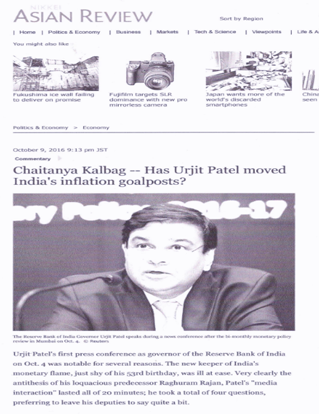
Has Urjit Patel moved India’s inflation goalposts?
Published date: 9th Oct 2016, Nikkei Asian Review
View PDFChaitanya Kalbag, Contributing writer
Urjit Patel’s first press conference as governor of the Reserve Bank of India on Oct. 4 was notable for several reasons. The new keeper of India’s monetary flame, just shy of his 53rd birthday, was ill at ease. Very clearly the antithesis of his loquacious predecessor Raghuram Rajan, Patel’s “media interaction” lasted all of 20 minutes; he took a total of four questions, preferring to leave his deputies to say quite a bit.
This is not a surprise. Deepak Parekh, an eminent banker and chairman of India’s Housing Development Finance Corporation, who worked closely with Patel at the Infrastructure Development Finance Company between 1997 and 2006, said in a recent media interview: “Well, he is a quiet person… some people say he is a loner, but he is conservative. He is a man of few words. He will not be giving many interviews because I think he is a little shy.”
Patel also did not grant a single post-policy interview to any journalist. This was in sharp contrast with both Rajan and Rajan’s predecessor Duvvuri Subbarao, who were frequently seen and heard. Patel has not delivered a single speech in his five weeks in office. Interestingly, Rajan kept talking until his final day in the office. His Sept. 3 speech was fittingly titled: “The independence of the central bank.” That independence has been sharply whittled down by a newly created six-member Monetary Policy Committee. Under Patel’s chairmanship, the MPC met for two days before announcing on Oct. 4 a 6-0 vote in favor of an interest-rate cut.
The RBI’s announcement of a 25 basis-point cut in the benchmark repo rate took almost everyone by surprise. The cut was counter intuitive. Six out of 10 bankers in advance surveys had forecast the RBI would hold rates steady at 6.50%. The central bank has now cut the key lending rate by 175 basis points since January 2015.
As one senior economist noted, Patel has “thoroughly confused the public … he has moved the goalposts.” The bewilderment is because India’s consumer price index inflation has stayed stubbornly above the RBI’s 5% target for March 2017. Driven by higher food prices it even rose to 6.07% in July before falling back to 5.05% in August. Rajan had been steering the RBI on a “glide path” toward a single-point goal of 4% CPI inflation by March 2018.
Two points at Patel’s press conference appeared to underline a more dovish approach to inflation targeting and a move away from Rajan’s more fierce approach, even if it meant a small trade-off with growth.
First, Patel was at pains to put emphasis on the 4% plus-or-minus 2% band legislated in the new RBI Act. “[The] RBI indicated its resolve to contain inflation through self-imposed targets and framework agreement with the government. Now, all those ad hoc measures are superseded by the legal amendment,” he said in his press conference.
In other words, as Nomura Securities noted in a recent report, Patel seemed to have tweaked the framework to aim for a 2% to 6% inflation band from a single-point target of 4%. “In fact, our main takeaway from today’s policy meeting is that there has been a dilution of the tenets of the flexible inflation targeting framework under the new RBI [Patel] compared with the old RBI (Rajan)” Nomura said.
Sonal Varma, Singapore-based India chief economist at Nomura, told the Nikkei Asian Review that the inflation band could technically permit anything from a 3% inflation rate to a 5.8% inflation rate. “From the perspective of investors, households, analysts – it’s too wide a range. What are we targeting – 2% to 6%? Are we going to get to 4%?”
India’s inflation is among the highest as well as fastest growing among in emerging Asian economies. and is also growing at the fastest rate. Globally, inflation is not only on a downward curve, but several countries are fighting deflation, oil prices are down, the output gap is negative, and bank balance sheets are negative. “This is as good as it gets to keep inflation low,” Varma added. “The bigger challenge in India is expectations.”
In its Oct. 4 report, the RBI appeared to highlight the upside risk of inflation. It said that its September survey of household expectations saw inflation at 9.5% three months ahead and 11.4% a year ahead, driven mainly by higher food and healthcare costs. RBI staff forecast CPI averaging 5.3% in the fourth (Jan-March) quarter of this fiscal year. Big pay rises for government employees coupled with festival-season spending are also seen spurring price rises.
“Expectations have to be brought down,” Varma said. “Probably in Japan people haven’t seen nominal salary increases in 20 years, but in India people expect nothing less than 5%. India is still a supply-constrained economy. Most of the rest of the world is demand constrained.” Even at zero or negative interest rates in advanced economies, investment is not picking up.
BANKS AT FAULT?
Economists believe the real problem lies with Indian banks which are not transmitting lower interest rates to borrowers. Industry is not borrowing, so banks are concentrating on retail lending.
Patel said the RBI would deal with the growing mountain of non-performing assets at Indian banks with firmness but also and with pragmatism. “Just five sectors contribute 61% of the stressed assets of the banking sector — infrastructure, steel, textiles, power and telecoms. These sectors are each individually important and dealing with stressed assets will require skill and creativity. There are many reasons that led to this situation, but now helping banks to deal with this situation is of utmost importance for the country,” the governor noted.
The other goalpost Patel has moved relates to the real neutral interest rate, or the difference between the benchmark interest rate and inflation. It is an equilibrium rate, and some economists view it as the centerpiece of monetary policy. If you keep the real neutral rate too high you deter investors, if it is too low, you deter depositors.
RBI executive director Michael Patra explained that the central bank had adopted a lower real neutral rate of 1.25%, because it “does not stay still at a point in time, and changes with things like demographics or the potential output itself. And the world over, the sense is that the neutral rate is going down and that is why you see many countries actually putting in place negative interest rates.” But the senior economist said this effectively gives the central bank a lot of leeway to trim rates even further. Rajan had adhered to a neutral rate range of 1.5% to 2.0%.
To take India’s example, the RBI could justify further cuts by arguing that if the inflation target is 4% and the real neutral rate is 1.25%, then the nominal interest rate could go as low as 5.25% — which could mean more swinging cuts are in store. “You’ve thrown away the lynchpin of your interest-rate regime,” the economist said.
The central bank governor, however, was sanguine about the immediate future. “If I look at over the next seven, eight quarters, the government has introduced structural policies, reform policies which is of course done to address supply constraints. There is larger investment in railways and roads which will improve infrastructure, the ease of doing business, [and] proactive food management have played a crucial role in the past two years and will continue to play a crucial role in times to come. There is an improvement in pulses supply which has been the main contributor [to inflation] and there has been a sharp improvement in [India’s] competitiveness ranking,” he said.
Is Patel’s confidence justified? India has jumped 16 places to 39 among 138 countries in the World Economic Forum’s Global Competitiveness Index. But the International Monetary Fund was glum in its World Economic Outlook issued in early October, ahead of its annual meetings in Washington D.C. The Fund underlined the precarious nature of recovery eight years after the global financial crisis. It saw global growth at 3.1% this year and 3.4% in 2017. While emerging markets are forecast to speed up incrementally, to 4.2% this year and 4.6% the next, the IMF did see India as a bright outlier, averaging 7.6% both this fiscal year and next. But, it cautioned, India must keep up investment-friendly reforms.
That means India’s gross domestic product growth is seen as flat after rising 7.6% in 2015/16. Most economists say India needs to grow by between 8% and 10% annually over a sustained period if it wants to lift about 370 million people from dire poverty.
This is not going to be easy. The pace of GDP growth slowed to an annual 7.1% in the first (April-June) quarter. Commerce and Industry Minister Nirmala Sitharaman said at the WEF’s India summit on Oct. 6 that the country still needs to remove regulatory hurdles and improve competitiveness and the ease of doing business if it wants to grow faster.
Aside from inflation and bank balance sheets, the other challenge for Patel is the redemption of $26 billion in foreign currency non-resident (FCNR) deposits, which are maturing between September and November. Rajan approved the scheme on the day he took over in September 2013, faced with a weakening rupee and a possible balance of payments crisis.
As Rajan noted in his Sept. 3 speech, the rupee has been one of the most stable emerging-market currencies over the past three years; it currently trades at about 66.74 to the dollar. India’s foreign exchange reserves stood at $370 billion on Sept. 23. Although the RBI expects a temporary hiccup in liquidity and a likely blip in the exchange rate, the central bank has said it has prepared adequately for the FCNR redemptions.
Rajan’s final speech as governor was extraordinarily candid. Talking about the RBI’s independence, he said: “The Reserve Bank cannot just exist, its ability to say ‘No’ has to be protected.” He explained why the RBI governor needed to be ring-fenced: “There is a reason why central bank governors sit at the table along with the finance ministers in G20 meetings. It is that the central bank governor, unlike other regulators or government secretaries, has command over significant policy levers and has to occasionally disagree with the most powerful people in the country…It is dangerous to have a de facto powerful position with low de jure status.” Has that begun to happen to Urjit Patel?







I don’t think the title of your article matches the content lol. Just kidding, mainly because I had some doubts after reading the article.
kgexrv
y1jrta
n05jl5
qvr4no
or75zx
t3wflm
xcmtzx
4e2kql
fzzgvl
m3ldqi
zzbibw
xwdosz
to3qvn
rjayfg
cz9dqe