

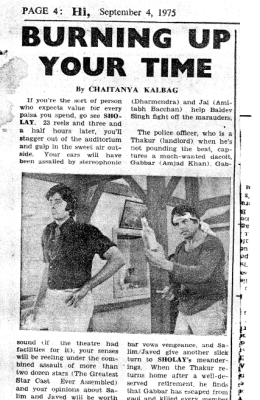
Burning up your time
Published date: 4th Sept 1975, Hi Newspaper
View PDFChaitanya Kalbag
If you’re the sort of person who expects value for every paisa you spend, go see Sholay, 23 reels and three and a half hours later, you’ll stagger out of the auditorium and gulp in the sweet air outside. Your ears will have been assailed by stereophonic sound (If the theatre had facilities for it), your senses will be reeling under the combined assault of more than two dozen stars (The Greatest Star Cast Ever Assembled) and your opinions about Salim and Javed will be worth recording (The Greatest Story Ever Told.)
Sholay starts off with a dacoits-chasing-and-waylaying-train sequence that jars simply because you expect only Injuns to pour down a slope with war cries and flying hooves. On board, there’s a police officer, Baldev Singh (Sanjeev Kumar) taking two notorious crooks to prison. When the dacoits attack, the jailbirds, Veeru (Dharmendra) and Jai (Amitabh Bacchan) help Baldev Singh fight off the marauders.
The police officer, who is a Thakur (landlord) when he’s not pounding the beat, captures a much-wanted dacoit, Gabbar (Amjad Khan). Gabbar vows vengeance, and Salim/Javed give another slick turn to Sholay’s meanderings, When the Thakur returns home after a well-deserved retirement, he finds that Gabbar has escaped from gaol and killed every member of his family, except for a daughter-in-law, Radha (Jaya Bhaduri). The Thakur is shocked. And a gust of wind blows the shrouds off the corpses lined up in his courtyard. And the audience begins to hate Gabbar. The Thakur grabs a horse (you’ll know how if you read Sudden) and flies to Gabbar’s camp. Gabbar ties him up and chops off his arms. The audience groans.
The armless Thakur now remembers Veeru and Jai. He hires them to get Gabbar for him, alive. There’s a big reward out for Gabbar, and the Thakur offers to give the pair a bonus for their efforts. The audience now sits back and heaves a sigh of relief. It knows Gabbar’s finished now. With Dharm and Amitabh on his heels, there can’t be another ending. The rest of Sholay, therefore, is a foregone conclusion with the usual mirchi-masala thrown in.
Director Ramesh Sippy knows that you can’t have two big stars in a tiny village, and not have any “romantic interest”, so you find a very unlikely tongawali providing the hamlet’s public transport—a double-chinned, made-up female called Basanti (Hema Malini). And Veeru flips for her.
Veeru and Jai now organise rebellion in the village. Gabbar’s representatives are sent scurrying back when they come to collect the monthly tribute, Gabbar can’t swallow this insult, of course. He begins reprisal raids on the village. Follows carnage and heroics from Veeru and Jai.
At this stage you begin to realise that you have had enough value for your money. Sholay (The Flame) has been burning up your time. Our heroes seem to be taking mighty long in devising a plan to nab Gabbar. The villagers turn against the Thakur and his gunmen when they find Gabbar’s taking revenge with a vengeance. Sanjeev’s histrionics convince them they are wrong. And you’re beginning to nod off.
And then, all of a sudden Salim/Javed upset a hornets nest, Gabbar kidnaps Basanti and Veeru (who in the meantime has been betrothed to her) gallops to the hideout to try to rescue her. And like you guessed, Veeru’s captured, too. But there’s Jai. Good old Jai frees Veeru and Basanti and holds off the dacoits, while the lovers make it back to safety.
The rest of the movie is disproportionately rapid in sequence, Veeru comes with reinforcements, to discover that Jai is dying. The entire village, strangely, turns up to witness the last moments of the Bacchan. The distraught Veeru nips off again to Gabbar’s hideout (the number of trips people make to that feared place is amazing—must be like a Sholay attracting the moths), overpowers the whole place, and pins a hapless Gabbar to the ground. You see what real rage can achieve? Veeru’s attempts to grind Gabbar into the dust are interrupted by the Thakur, who proceeds to give a good demonstration of savate, and mercifully brings this story to an end.
Sholay is technically above reproach. The stunt scenes especially draw gasps from the staidest characters. R. D. Burman’s music, however, is again below par. The gipsy song-and-dance sequence (with Jalal Agha and Helen) is pretty good. R. D. should try and find out if the Pathans need playback singers. He’d do better there.
Most of the stars give good performances. Amjad Khan is superb as Gabbar. He makes the audience hate him, and yet, when the denouement comes, there is a tinge of sadness because he’s been ultimately brought to his knees.
Like I was saying, go see Sholay. And afterwards, go home and sleep it off (The Best Rest Ever Earned).
[/vc_column_text][/vc_column][/vc_row]








Thank you for your sharing. I am worried that I lack creative ideas. It is your article that makes me full of hope. Thank you. But, I have a question, can you help me?
qrcapb
add3sg
thu4ew
b5f4fz
nhc8gu
ywp7aq
1yf961