Iran — westward ho again?
Published date: Business Standard, 23rd Jan 1981
View PDFFrom Chaitanya Kalbag
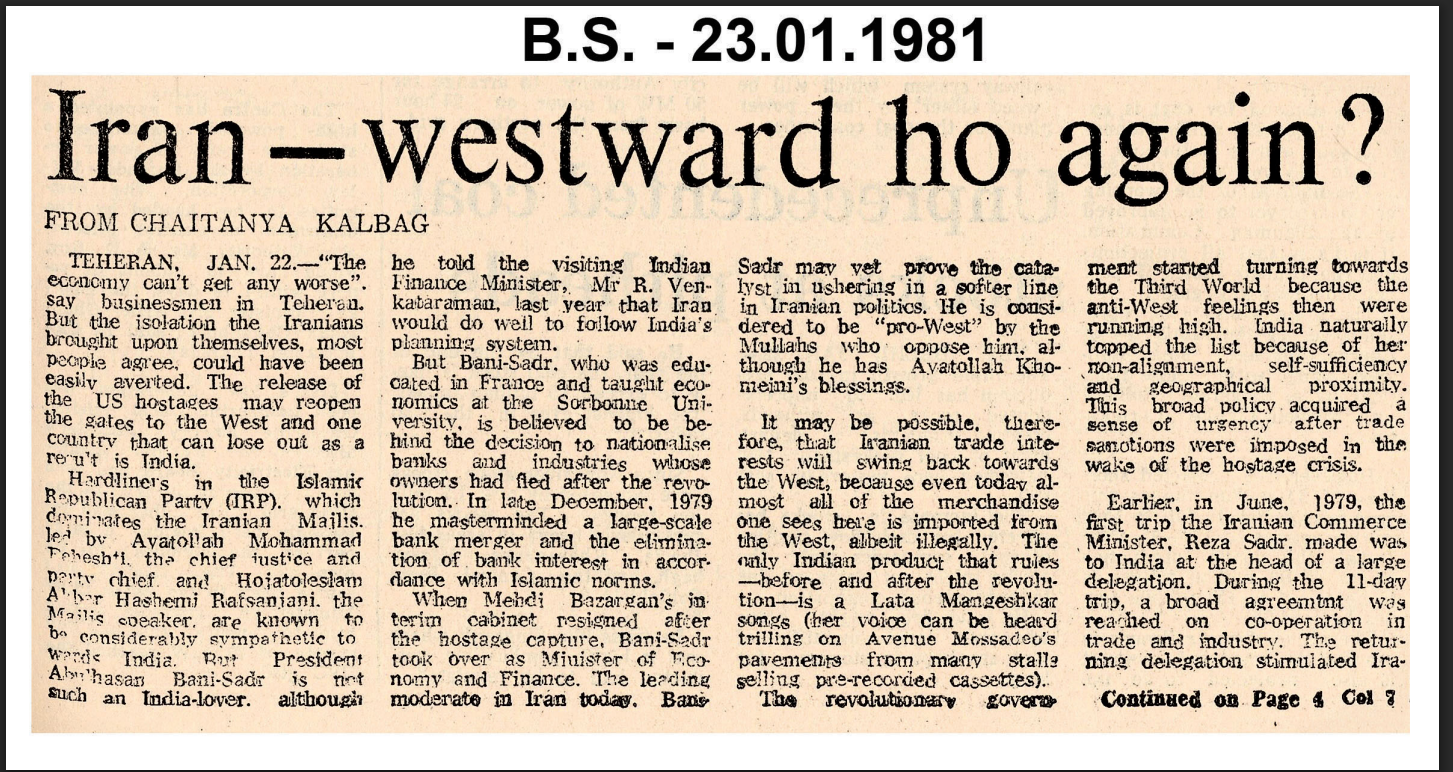
TEHERAN, JAN. 22—“The economy can’t get any worse”, say businessmen in Teheran. But the isolation the Iranians brought upon themselves, most people agree, could have been easily averted. The release of the US hostages may reopen the gates to the West and one country that can lose out as a result is India.
Hardliners in the Islamic Republican Party (IRP), which dominates the Iranian Majlis, led by Ayatollah Mohammad Beheshti, the chief justice and party chief, and Hojatoleslam Akbar Hashemi Rafsanjani, the Majlis speaker, are known to be considerably sympathetic to West India. But President Abolhassan Bani-Sadr is not such an India-lover, although he told the visiting Indian Finance Minister, Mr R. Venkataraman, last year that Iran would do well to follow India’s planning system.
But Bani-Sadr, who was educated in France and taught economics at the Sorbonne University, is believed to be behind the decision to nationalise banks and industries whose owners had fled after the revolution. In late December 1979 he masterminded a large-scale bank merger and the elimination of bank interest in accordance with Islamic norms.
When Mehdi Bazargan’s interim cabinet resigned after the hostage capture, Bani-Sadr took over as Minister of Economy and Finance. The leading moderate in Iran today, Bani-Sadr may yet prove the catalyst in ushering in a softer line in Iranian politics. He is considered to be “pro-West” by the Mullahs who oppose him, although he has Ayatollah Khomeini’s blessings.
It may be possible, therefore, that Iranian trade interests will swing back towards the West, because even today almost all of the merchandise one sees here is imported from the West, albeit illegally. The only Indian product that rules—before and after the revolution—is a Lata Mangeshkar song (her voice can be heard trilling on Avenue Mossadeq’s pavements from many stalls selling pre-recorded cassettes).
The revolutionary government started turning towards the Third World because the anti-West feelings then were running high. India naturally topped the list because of her non-alignment, self-sufficiency and geographical proximity. This broad policy acquired a sense of urgency after trade sanctions were imposed in the wake of the hostage crisis.
Earlier, in June, 1979, the first trip the Iranian Commerce Minister, Reza Sadr, made was to India at the head of a large delegation. During the 11-day trip, a broad agreement was reached on co-operation in trade and industry. The returning delegation stimulated Iranian importers’ interest in India.
Early last year, Iran Jeep (formerly a subsidiary of General Motors) finalised a deal with Bombay’s Mahindra and Mahindra for the supply of 4,000 jeeps. A Mahindra delegation recently visited Iran and the two parties are in regular touch. Iran Jeep wants the Mahindras to supply 15,000 jeeps more until 1984. The total value of this deal would exceed Rs 85 crores. But the Mahindras do not have the capacity to meet the demand. A joint project is, therefore, being envisaged.
Negotiations are also in progress with Telco and Leyland Motors for the supply of buses. The initial proposal is to purchase at least 2,000 buses, with an eventual collaboration and transfer of technology after a number of years (the buses on Iran’s roads are either Mercedes-Benz or Leyland now). Simultaneously, negotiations with the Teheran bus company, Sherkatevahid and with Iran National (former Benz collaborators) are going on for the supply of over 4,000 buses.
Even before the revolution, Iran was importing bicycles from India. But enquiries have shot up after the war, with petrol rationing forcing more and more people to pedal their way to work. An Iranian delegation recently visited India and went around some bicycle factories in Delhi, Panipat, Ludhiana, and Lalpura. Hero, Atlas and Roadmaster are the three brands most in demand, and Jihade Sazindagi (the reconstruction crusade), a parallel government organisation that possesses huge funds and, supervised by Khomeini, undertakes rural development, is interested in buying 10,000 bicycles. In the case of bicycles, too, Iran’s ultimate aim is to go in for transfer of technology.
One product in high demand in Iran today is an agricultural pumpset and India has stepped into this gap in a big way. A deal was recently finalised for the supply of 5,000 Kirloskar diesel engines valued at over Rs 2.6 crores. Jihade Sazindagi, which is the body importing pumpsets, is interested in buying more.
The war produced a soaring demand for tents and blankets for the estimated three million refugees. Unfortunately, India’s tent prices were found to be too high and the order went to Pakistan. But early in 1980, Jihade Sazindagi secured a supply of 10,000 tents through the State Trading Corporation.
Iran was also interested in buying sugar and rice from India, but were told that enough surplus capacity did not exist to meet their requirements. But the Iranian Ministry of Agriculture, whose subsidiary, the meat organisation, is in charge of importing meat (which used to come mainly from Denmark and Australia) secured three Indian shipments of buffalo meat totalling 15,000 tonnes, earlier this month. Negotiations are on for the import of Indian wheat.
The Iranian Red Crescent recently finalised a deal with Krishna Woollen Mills, Bombay for the supply of 2 lakh blankets. A quarter of the order has already been shipped. A further order for 4 lakh blankets is reportedly in the pipeline. “We’re submerged with requirements,” says M. S. Malik, first secretary (commerce) in the Indian embassy in Teheran.
Whether this boom will last through 1981 is in doubt given the Iranians’ predilection for western products. In spite of anti-American sentiment being whipped up by the clergy, visitors quickly reach a unanimous conclusion: When Iranians die they go to America.