Iraq’s oil outlets badly crippled, Iran sitting pretty
Published date: 24th Jan 1981, Business Standard
View PDFFrom Chaitanya Kalbag
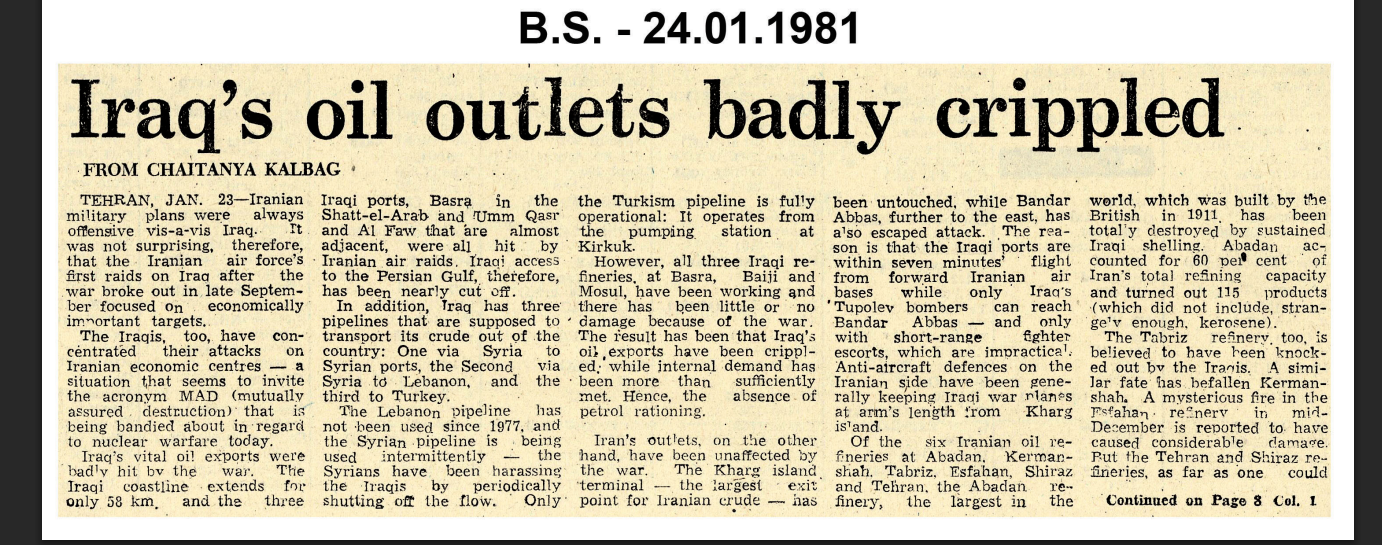
TEHRAN, Jan. 23 — Iranian military plans were always offensive vis-à-vis Iraq. It was not surprising, therefore, that the Iranian Air Force’s first raids on Iraq after the war broke out in late September focused on economically important targets.
The Iraqis, too, have concentrated their attacks on Iranian economic centres — a situation that seems to invite the acronym MAD (Mutually Assured Destruction) that is being bandied about in regard to nuclear warfare today.
Iraq’s vital oil exports were badly hit by the war. The Iraqi coastline extends for only 58 km, and the three Iraqi ports, Basra in the Shatt-el-Arab and Umm Qasr and Al Faw that are almost adjacent, were all hit by Iranian air raids. Iraqi access to the Persian Gulf, therefore, has been nearly cut off.
In addition, Iraq has three pipelines that are supposed to transport its crude out of the country: one via Syria to Syrian ports, the second via Syria to Lebanon, and the third to Turkey.
The Lebanon pipeline has not been used since 1977, and the Syrian pipeline is being used intermittently. The Syrians have been harassing the Iraqis by periodically shutting off the flow. Only the Turkish pipeline is fully operational. It operates from the pumping station at Kirkuk.
However, all three Iraqi refineries, at Basra, Baiji and Mosul, have been working and there has been little or no damage because of the war. The result has been that Iraq’s oil exports have been crippled, while internal demand has been more than sufficiently met. Hence, the absence of petrol rationing.
Iran’s outlets, on the other hand, have been unaffected by the war. The Kharg Island terminal — the largest exit point for Iranian crude — has been untouched, while Bandar Abbas, further to the east, has also escaped attack.
The reason is that the Iraqi ports are within seven minutes’ flight from forward Iranian air bases, while only Iraq’s Tupolev bombers can reach Bandar Abbas — and only with short-range fighter escorts, which are impractical. Anti-aircraft defences on the Iranian side have generally been keeping Iraqi warplanes at arm’s length from Kharg Island.
Of the six Iranian oil refineries at Abadan, Kermanshah, Tabriz, Esfahan, Shiraz and Tehran, the Abadan refinery, the largest in the world, which was built by the British in 1911, has been totally destroyed by sustained Iraqi shelling. Abadan accounted for 60 per cent of Iran’s total refining capacity and turned out 115 products.
The Tabriz refinery, too, is believed to have been knocked out by the Iraqis, and a similar fate has befallen Kermanshah. A mysterious fire in the Esfahan refinery in mid-December is reported to have caused considerable damage. But the Tehran and Shiraz refineries, as far as one could discover, are fully operational.
But they contribute little to Iran’s total refining needs.
The oil wells in the Kermanshah region are in Iraqi hands. But the Iraqis have failed to snap two vital links from the captured Khorramshahr, and the pulverised Abadan, which go above Susangerd to the biggest Iranian oilfields around Agha Jari. Reliable sources indicate that Iranian oilfields in Masjed Soleman, Haft Gel, and Naft-e-Safid have not been hit by the fighting. The result: Iranian crude production has not suffered.
But from a 1974 high of six million barrels per day, the revolutionary government deliberately brought down production to a record low of 1.5 million barrels per day. This was the estimated production at the time the war broke out. The United States stopped its Iranian oil imports after the hostages were captured in November, 1979 (the US off-take used to be 700,000 barrels per day). Japanese and European customers, too, halted their imports of about one million barrels per day in April, 1980.
Japanese explained their decision by saying that the yen raised Iranian price ($35.37 per barrel) was too high.
During 1980, India was expecting a total supply of 11 million tonnes of crude from Iraq and Iran. This represented about 69 per cent of India’s total oil import of 16 million tonnes that had been targeted for the year. The war, therefore, posed a major threat to India’s petroleum supplies. The Indian Government put out the impression that crude imports from Iraq and Iran were at a standstill. This correspondent has discovered that this is not true.
India was the only country to try to lift her entire contracted requirements from Iran for 1980. Iraqi supplies, on the other hand (which used to total 6 million tonnes annually, Iran accounting for the remaining 5 million tonnes), fell short of the 1980 contract by an estimated two million tonnes.
Iran could afford to continue her oil exports mainly because her oilfields were largely intact — even those large offshore ones in the Persian Gulf. The outflow of oil has also continued unaffected for the Iranians because they retain control of the three strategic islands at the mouth of the Straits of Hormuz — Greater Tunb, Lesser Tunb and Abu Musa — which the Shah seized from the UAE in 1971.
India is a favoured oil customer for Iran, because her payments are prompt and her imports steady. When the war with Iraq broke out, the National Iranian Oil Company and the Iranian oil ministry immediately got in touch with the India Government and apprehending the Kharg Island terminal’s imminent destruction by the Iraqis, requested that India try and lift all her contracted crude for 1980 as quickly as possible.
This set off a frenetic period for officials in the petroleum ministry in Delhi and Indian embassy personnel in Teheran who were coordinating the massive operation.
Throughout October, 1980, all tankers of the Shipping Corporation of India were put on the Iranian route and there were tankers berthing and embarking at Kharg terminal almost every day, according to a source. The result was that by end November, India had lifted her entire contracted quantity of Iranian crude.
This was not all: the Iranian oil ministry was keen on signing a fresh contract for the same quantity for 1981. The only caveat was that prices were subject to revision after the OPEC conference at Bali in mid-December. The contract was, therefore, signed, and even now, India continues to draw crude at an average rate of 1.5 lakh barrels per day.
Last week, the Iranians raised their crude prices by $2 to $37.37 per barrel. Iranian crude is the best being imported by India (previously, the best crude used to come from Libya). It is light and has a low content of impurities like paraffin and tar, and has very little ash content. Hence, the high price.
Petroleum contracts are signed for a calendar year. According to the contracts signed so far for 1981, Iraq and Iran have pledged to maintain last year’s levels. Algeria, Kuwait, Venezuela and Nigeria will supply half a million tonnes each, Mexico and Abu Dhabi will supply 1.5 million tonnes each while the Soviet Union has agreed to supply 2.5 million tonnes. This amounts to 18.5 million tonnes, but the petroleum ministry has taken into account the possibility of continued stoppage of Iraqi oil exports. This means that India will just about manage to import her targeted 16 million tonnes.
The rates charged by the other suppliers are lower than Iran’s. Saudi Arabia’s benchmark rate, post-Bali, is $32 a barrel. The Bali meeting fixed an official ceiling of $41 per barrel, but most exporters are expected to charge premiums of as much as $5 a barrel on the extra oil they have been producing to meet the shortages stemming from the Iran-Iraq war.
The implications of the war for India, nevertheless, continue to be grave. The estimated expenditure on oil imports in 1979-80 was Rs 5,000 crores, and an official 1979 study has noted that if India continues to import oil at current rates, her foreign exchange reserves will be totally exhausted by the year 2000. The total estimated loss of domestic production during the current year as a result of the Assam agitation is 5.2 million tonnes, while the northern and southern depots in Bombay High are expected to produce seven million tonnes.
The implications of the damage caused to Iran’s refineries are largely internal, and have led to unprecedented rationing of motor oil, gasoline, and heating oil. Fuel oil exports have been stopped and Iran continues to be dependent on kerosene imports. Shortages of spares and skilled workers had also hit the Iranian oil industry after the revolution.
Strategically, Abadan is located at a very vulnerable area, just across the border with Iraq, and most Iranian oil men feel that the government will never attempt to rebuild it.
“The only sensible people working in Iran today are located at the National Iranian Oil Company,” says an Asian diplomat who has had frequent dealings with NIOC. Another source confirms this, and adds that foreign-policy problems sometimes have to be routed through NIOC to the concerned Iranian ministry because NIOC men are listened to with respect. They are the only ones keeping Iran’s export revenues flowing in. Iran’s monthly earnings from oil are close to $ one billion.