

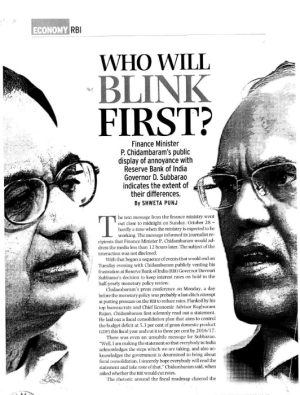
Who will Blink First?
[Business Today]
The text message from the finance ministry went out close to midnight on Sunday. October 28, hardly a time when the ministry is expected to be working, the message informed its journalist recipients that Finance Minister P. Chidambaram would address the media less than 12 hours later. The subject of the interaction was not disclosed.
With that began a sequence of events that would end on Tuesday evening with Chidambaram publicly venting his frustration at Reserve Bank of India (RBI) Governor Duvvuri Subbarao’s decision to keep interest rates on hold in the half-yearly monetary policy review.
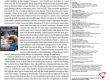
Chidambaram’s press conference on Monday, a day before the monetary policy, was probably a last-ditch attempt at putting pressure on the RBI to reduce rates, flanked by his top bureaucrats and Chief Economic Advisor Raghuram Rajan, Chidambaram first solemnly read out a statement. He laid out a fiscal consolidation plan that aims to control the budget deficit at 5.3 percent of gross domestic product (GDP) this fiscal year and cut it to three percent by 2016/17.
There was even an unsubtle message for Subbarao. “Well, I am making the statement so that everybody in India acknowledges the steps which we are taking, and acknowledges the government is determined to bring about fiscal consolidation. I sincerely hope everybody will read the statement and take note of that,” Chidambaram said when asked whether the RBI would cut rates.
The rhetoric around the fiscal roadmap cheered the markets and industry, even though the targets seemed unrealistic, as Chidambaram had not announced any concrete steps to contain the budget deficit. Predictably. Subbarao was not impressed. In his policy review, he cut the cash reserve ratio from 4.5 percent to cut interest rates.
The move stung Chidambaram, and he did something uncharacteristic for a finance minister. He indicated that the RBI was not on the same page as the finance ministry. “If the government has to walk alone to face the challenge of growth, well, we will walk alone, ” he said.
Differences between the finance ministry and the RBI on their diagnoses of economic challenges are not uncommon. But a public rebuke of monetary policy by the finance minister is unusual. Subbarao, though, plays down the perceived differences with Chidambaram. “We have shared goals. Both of us want high growth and low inflation,” he told Business Today in an interview a day after the policy review.
The public airing of differences perhaps works to the RBI’s advantage.
“The RBI’s firm stance on rates will help improve its credibility as a central bank fighting inflation,” says Samiran Chakraborty, Head of Regional Research, South Asia. Standard Chartered Bank.
Ironically, Chidambaram and Subbarao were on the same side not so long ago. Subbarao was the finance secretary when Chidambaram, in his last avatar as finance minister, announced deviating from the fiscal roadmap in the budget for 2008/09 due to the government’s rising expenditure on social sector programs.
In his policy. Subbarao countered the argument of low rates to spur investment. “A revival in investment activity, which is key to stimulating growth, depends particularly on the recent policy announcements by the government being translated into effective actions,” he said.
He was referring to a renewed burst of intent beginning September 13, following Chidambaram’s induction into the finance ministry the previous month. More space was created for foreign investment in retail and aviation. And the diesel price was increased to rein in fuel subsidies.
There was some support for Chidambaram’s standpoint among economists Business Today spoke to. “I think the RBI could have taken a leap of faith and reduced the repo rate and hoped to kick off a virtuous cycle,” says Ajit Ranade, Chief Economist, Aditya Birla Group.
Most economists, however, say the government faces a lack of credibility in its desire to rein in the fiscal deficit. In the absence of Details and a recent history of fiscal overruns, the RBI appears wary of taking the government’s words at face value. In April, Subbarao frontloaded rate cuts by a half-percentage point, assuming the government would make good its budget promise of a fiscal deficit at 5.1 per cent in 2012/13. Now, the target has been revised to 5.3 per cent. Economists expect the gap to be wider. Already, the deficit has touched 66 per cent of the budget estimate in the first half of the current fiscal year.
A high level of fiscal deficit is one part of the problem dubbed ‘twin deficits, ‘ the other being a high current account deficit. The current account gap, the excess of imports of goods and services over its exports, touched a record level of 4.2 percent of GDP in 2011/12. In the current financial year, Chidambaram says it will be a tad lower at 3.7 percent of GDP, which would still make it one of the highest levels the economy has seen.
“The RBI would like to hear what the government’s plan is. What we have heard is just consolation; no mistake that the government will have to move on crucial issues if it is serious about getting the economy back on track. “Interest rates are a necessary but not sufficient condition for investment. Issues like land acquisition and environmental clearances need to be resolved. Without that, it seems difficult to revive investment,” says Devendra Pant, Chief Economist, India Ratings and Research, a Fitch Group company.
“Subbarao had a reason to be cautious,” says D.K. Joshi, Senior Director and Chief Economist, Crisil. “Inflation is a genuine worry. It hasn’t gone down despite growth slowing. It is better to be safe than sorry.” Inflation has remained stubbornly high for nearly three years. Inflation based on the wholesale price index moderated from its peak of 10.9 percent, as the Economist, Yes Bank, expects inflation to average around eight percent this fiscal year.
A day after his half-yearly monetary policy review, Reserve Bank of India (RBI) Governor Duvvuri Subbarao met with Chaitanya Kalbag and Anand Adhikari to explain the intent of the bank’s policy actions. He also spoke about the growth-inflation debate and the perceived differences between the central bank and the finance ministry. Edited excerpts:
What has made you so resolute in the face of so much pressure to lower interest rates?
First of all, I want to say that all the criticism that we face is legitimate criticism, it is par for the course. Criticism is value adding, so I have sympathy for it. But there are different points of view. Also, it is not correct to say that inflation has not come under control. It has not come down as much as we want, but certainly it has come down from the high of 10.9 per cent in 2010 to 7.5 per cent, averaging over the last several months. We need to bring it down this is a poor country and inflation is a regressive tax on the poor. I believe it is possible to bring inflation down through monetary policy action supplemented by supply response from the economy, which has to be managed by the government.
What do you expect in terms of a supply response?
First, on infrastructure. India is unique in the sense that we are one of the economies in the world that is supply constrained. There is shortage of infrastructure both in quantum and quality. We need to improve that so that corporates become more competitive, so that economic production becomes more competitive. Second, we need to improve supply of food, especially of protein foods. There were some initiatives in last year’s budget, and also in this year’s budget, to encourage more efficient production of food-protein, pulses, edible oil etc… That must be taken forward. Third, is skilled labour. It is one thing to have a huge labour force but another to have a labour force that is not adequately skilled. The skill shortage is going to be a big threat. We need to focus on that. These are some of the important supply constraints.
When you talk about fiscal profligacy and fiscal control, what do you think is not happening quickly enough? What steps do you want to see?
We have said earlier that announced policies must be translated quickly in order to inspire investment. From the RBI, I do not have a very good sense of what is happening in the field. But from what we hear and what we read, we gather that there are delays in getting permission and approvals. There are delays in getting land. These are essentially governance problems and they need to be resolved in Delhi and the state capitals, and most importantly, at the district level. Then, all the linkages; we talk about so much installed capacity lying idle in the power sector because the linkages have not been established. We need to do that. In the first instance, since you asked me what can be done in the short term, we must be focusing on those which give us largest marginal returns. Whatever capacity is already installed must be put into production.
Do you feel there is a danger of stagflation occurring? How real is that fear?
I don’t think the fear is real. Stagflation is characterised by low growth and persistent high inflation. Admittedly, our growth has moderated and inflation has been stubborn. But you must also recognise that the output gap that we see is quite recent. It is quite small and it is shrinking. So, it will be incorrect to say that we are in a stagflation situation.
Do you feel that there needs to be some austerity?
Austerity is always important. Austerity is a value. But when you look at in terms of numbers, savings that austerity can get are quite small. But, as a value, we should promote austerity.
Your projection of 7.5 per cent inflation in 2012/13 is higher than your comfort level. We have a bunch of elections coming up and quite obviously the next budget cannot be but populist. How are things going to get better?
I have no specific response to that characterisation of the political economy situation. When I was speaking about
austerity earlier, I was speaking with reference to the austerity measures the government institutes and not in the larger context of fiscal austerity, as is being spoken about in Europe today. If in Europe, it is fiscal austerity versus growth, I believe that in India, it is fiscal austerity for growth. We need fiscal consolidation. That will help rein in inflation. That will make available credit for the private sector. So, the government must spend only in those areas where it needs to spend. Beyond that the government must leave it to the private sector.
Is there a compelling case for inflation-indexed bonds in the light of inflation risks?
I think there is a strong case for inflation-indexed bonds. That is good for investors, savers, the RBI and everybody watching the inflation numbers… because you have a better assessment of inflation expectations. It is good for external sector management. The demand for gold, which has driven up the current account deficit. will come down. But there is concern about introducing an inflation-indexed bond at a time when inflation is quite high.
But it was not a successful experiment when launched in 1997…
There were some design defects. The principal was not indexed and only the interest was indexed. But now, that’s been fixed. The more important point is that it is a cоnundrum. You don’t want to do it when inflation is high because you have to pay too much. You don’t want to do it when inflation is low because there is no incentive to do it. We keep talking about it, but we never do it t. We have to take the plunge and do it.
What’s your thinking on this?
We tend to oversimplify this. That it is growth versus inflation – if you want growth, you have to sacrifice inflation or you have got to tolerate high inflation. I don’t think we must define the debate on those terms. The terms of the debate must be changed. We must all understand that low and steady inflation is necessary for securing our medium-term growth. Only in an environment of low and steady inflation can consumers, and more importantly, investors, make informed decisions. And that’s very important to keep good growth. RBI’s effort at reining in inflation is not to the exclusion of growth but very much focusing on growth.
So, do you feel very lonely right now?
I don’t feel very lonely. I think people are making too much of the finance minister’s response to our policy action. After all, we have shared goals. Both of us want high growth and low inflation. And there is a division of responsibilities. There is a point of view that we must walk together. But, you know, what is called walking together is understood differently. I think that will be resolved in the course of time.
Given the widening fiscal deficit, is there any room for a rate cut in 2013/14?
I think 2013/14 is a long way off to stick my neck out. It will depend on how growth and inflation pan out in the course of 2013/14. We have given guidance for the last quarter, to say that there is scope and opportunity for further easing if inflation and growth move along the expected trajectory. We will give out the numbers for 2013/14 in April, but my uninformed view at this point of time, is that growth will increase, inflation will start declining even more rapidly, and that we will be moving towards a more conducive macroeconomic environment in 2013/14.
It is quite extraordinary that you are almost predicting a cut in the first quarter of next year. Is that usual?
It is not usual for us. but that was deliberate. We started giving guidance, consistent with the best practice of central banks around the world. In an uncertain situation, giving guidance becomes more challenging. But in an uncertain situation, giving guidance becomes all the more necessary. Central banks in advanced countries, particularly in the US, give a very definitive guidance about the policy interest-rate regime for the next two years, in order to manage the growth process. Similarly, in giving guidance for the fourth quarter, we decided that we must be as definitive as possible. Because even as we maintained an anti-inflation stance in this policy, we wanted to say that we are concerned about growth, and within the scope available, we will support the growth process. So, it is important to give that guidance and that’s why we did it.
While inflation of food items has fallen, it is going up for manufactured products…
We continue to be concerned about food inflation because if you just look at the food basket. even as vegetable prices have come down, prices of cereals have gone up. Protein inflation is still high. On the food side, there is a
structural factor which we must address. That will be the sustainable solution to the food inflation problem. On non-food manufacturing inflation – core inflation – metal prices have gone up, and, in general, input prices have gone up, because many of them are imported and the rupee has depreciated, so there is inflation coming in from there. It’s important that global prices soften and it’s important that our exchange rate is stable, so that the cost-push pressures from imported inflation are not transmitted to the domestic economy.
But globally it doesn’t look like things are going to get better in a hurry…
Absolutely, especially on the food side. In large food producing countries, there is a drought-like situation, there are price pressures. Our food market is quite closed. but some of this global pressure will transmit to domestic prices, especially on items that we import, such as edible oils, but even on commodities that we do not import.



[490]jljl16 Casino: The Top Online Slot Platform in the Philippines. Fast jljl16 Login, Easy Register, and Official jljl16 App Download for Big Wins. Experience jljl16 Casino, the top online slot platform in the Philippines. Fast jljl16 login, easy register, and official jljl16 app download for big wins today! visit: jljl16
[7922]777ace slots|777ace casino|777ace register|777ace giris|777ace login Experience the ultimate gaming thrill at 777ace Casino, the premier destination for online slots in the Philippines. Complete your 777ace register today to unlock exclusive bonuses. Enjoy seamless 777ace login and 777ace giris access to a world of premium 777ace slots and live casino action. Join now and win big! visit: 777ace
[2650]Jilibee: The Philippines’ Top-Rated Online Casino for Best Real Money Slots. Experience Jilibee, the Philippines’ top-rated online casino for the best real money slots. Join the premier Jilibee online casino Philippines for top-rated online gambling and big rewards. Secure your Jilibee casino login today and start winning at the most trusted Jilibee real money casino PH. visit: jilibee
[3495]Juan365PH: The Philippines’ Top-Rated Online Casino for Best Slots, Sports Betting, and Easy GCash Login. Experience Juan365PH, the Philippines’ top-rated online casino. Play the best online slots, sports betting, and live casino games with a fast Juan365PH GCash casino login. Join the Philippines top rated gambling platform Juan365PH today for an unparalleled gaming experience! visit: juan365ph
[2036]77jl Login & Register: Download the 77jl App for the Best Online Slots in the Philippines Experience the best 77jl slot games in the Philippines! 77jl register and 77jl login are fast and easy. 77jl download the 77jl app now for premium online casino action and big wins. visit: 77jl
[3088]PUB777 Official Site: Best Slot Online Casino in the Philippines. Easy PUB777 Login, Register & App Download for Big Wins. Join PUB777 Official Site, the top-rated slot online casino in the Philippines. Secure PUB777 login, easy PUB777 register, and fast PUB777 app download for massive wins today! visit: pub777
[4230]Primogaming Official Site: Top Online Slots in the Philippines. Quick Login, Register, and Primogaming App Download for the Ultimate Gaming Experience. Experience the best online slots in the Philippines at the Primogaming Official Site. Enjoy fast primogaming login, quick register, and primogaming app download for a seamless gaming experience. Join today and start winning! visit: primogaming
[5891]PHJOY Login & Register: Download the App for the Best Philippines Online Slots & Casino Sign Up Experience Join PHJOY for the best Philippines online slots! Complete your PHJOY login or PHJOY register today. Get the PHJOY app download for an elite casino sign up experience. visit: phjoy
[2139]Tayabet: The Philippines’ Premier GCash Online Casino for Best Slots and Gambling. visit: tayabet
[872]Best Online Casino Philippines: Swerte Login, Fast Register, Top Slots, and Official Casino App Download for Big Wins. Experience the best online casino in the Philippines at Swerte! Enjoy a secure swerte login, fast swerte register process, and play the highest-paying swerte slots. Get the official swerte casino app and start your swerte download today for top-tier gaming and big wins at the country’s most trusted gambling platform. visit: swerte
[3994]jilicrovn Online Casino Philippines: Top jilicrovn Slots, Fast jilicrovn Login & Register, and Official jilicrovn App Download. Experience the best at jilicrovn Online Casino Philippines! Play top jilicrovn slots, enjoy fast jilicrovn login & register, and get the official jilicrovn app download today for secure gaming. visit: jilicrovn
Перед запуском важно понимать, для чего нужен xrumer, чтобы достичь максимального эффекта.
oazl1a