

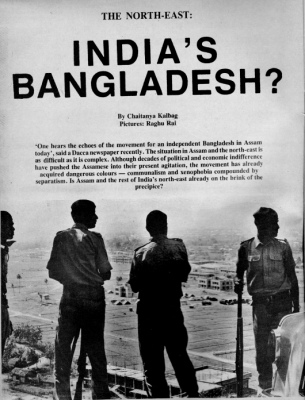
The North East- India’s Bangladesh
Published date: 12th May 1980, New Delhi
View PDF‘One hears the echoes of the movement for an independent Bangladesh in Assam today’, said a Dacca newspaper recently. The situation in Assam and the north-east is as difficult as it is complex. Although decades of political and economic indifference have pushed the Assamese into their present agitation, the movement has already acquired dangerous colours — communalism and xenophobia compounded by separatism. Is Assam and the rest of India’s north precipice?
On the outskirts of Gauhati city stands the gleaming Sarai-ghat Bridge across the Brahmaputra. It was at Saraighat that the legendary general of the Ahoms, Lachit Barphukan, repulsed wave after wave of Mughal attack in the 18th century. But in 1820 the Burmese defeated the Ahoms and six years later handed Assam on a platter to the British, by the Treaty of Yandaboo. That ‘sell-out’ has never been forgotten or forgiven. Saraighat has festered. Today, the ‘deshbhaktas’ (patriots) of the Assam movement swear by that spot. “This is the last struggle,” they say. “This is going to be the last battle of Saraighat.”
The Prime Minister visited Assam on 12 April. Exactly a week later came the Army ‘crackdown’ that fizzled out so ignominiously. During that week, newcomers looked in vain for signs of a struggle in Gauhati. Everything flowed as languidly as the giant river that lends Gauhati and much of Assam its character.
Gauhati was peaceful, but any person with some sensitivity would have felt under currents of unease. The picketers at Narengi were certainly not possessed by fervour. Leaders of the All Assam Students Union (AASU) harangued placid squatters, trying to work up morale. Picketing had once been fun; now there was a sullen, low-density crackle to it.
The AASU delegation emerged from the meeting with Mrs Gandhi in very visible anger, By that evening, however, AASU’s president Prafulla Mahanta and general secretary Bhrigu Phukan, who otherwise got by in English, chose to answer correspondents’ questions in Assamese. Their interpreter, K N Sarma, who is also dean of the faculty of law at Gauhati University was accused at one point by an Assamese journalist of misinterpreting both the questions and AASU’s answers. The event was studiedly low-key.
Were things as innocuous as they seemed? The Assam movement had undoubtedly acquired gigantic proportions. It was no longer confined to the cities and towns, to the literate and conscious citizenry. Bhagavati prasad Barua Bhavan in Gauhati, which headquarters the Gana Sangram Parishad, the Assam Sahitya Sabha, the Jagrata Mahila Parishad and other movement affiliates, was not a-buzz with activity. GSP leaders, Asam Jatiyotabadi Dal (AJD) leaders, and Purbanchaliya Lok Parishad (PLP) leaders all echoed each other in almost exact detail. Their interpretations of the history, the logic, and the aims of the movement rarely differed.
What did they have to say? Assam had never been subjugated by the Mughals, the Burmese had sold the Ahoms down the river to the British and the British had inaugurated the rot. They brought in the outsiders — Bengalis, Biharis, Nepalis — to man the administration, the tea estates, every nook and cranny that held long-term exploitative potential. By 1900 the Assamese had begun to view this tide of lemmings with growing alarm. That was when the influx of the Muslims from East Bengal began. And to the Assamese this was the most voluminous and ominous.
Was the movement only directed against the illegal immigrants from East Pakistan and later Bangladesh? This was what all the leaders reiterated. But on 12 April, the very evening of Mrs Gandhi’s visit, a small and select audience was invited to a preview of a 25-minute colour documentary’ of the movement. It was at the Vandana cinema hall in Gauhati. Obviously, the evening show of the regular film had been cancelled to accommodate the documentary. And the documentary, for those with nagging doubts, said a lot, a little too much.
It began with statistics of population growth, showing how the non-Assamese, particularly the Bengali Muslims, had proliferated. It went on to show how the agitation had mushroomed in strength and popular support. There followed pictures of the ‘martyrs’ of the movement and descriptions of their martyrdom. Even the cover of a Bombay weekly, whose editor is one of the few senior journalists in the country to write glowingly about the movement, was flashed on to the screen and a lengthy except from the editor’s article read out by the commentator. At the end, a map of United’ Assam consisting of the entire north-eastern region (Assam, Arunachal Pradesh, Manipur, Meghalaya, Mizoram, Nagaland and Tripura) glowed on in gaudy red. A tune was played, we were all asked to stand at attention. Later. my neighbour told me it was the ‘national anthem’ of Assam, Amar apanor desh, written by Laxminath Bezborooah, a timber merchant turned nationalist poet.
It was all quite disturbing. A man sitting in the row before mine in the cinema hall had handed me a cyclostyled sheet containing statistics of Assam’s natural resources, their quantum, and how much Assam was paid for them. The man was the PRO not of the movement, but of the Assam State Electricity Board.
That night, sitting in a storm-lashed hotel room, two other leaders of the movement, Prabin Gogoi of the Jatiyotabadi Yuva Chhatra Parishad and Girin Barua of the AJD, opened up a little more. Gogoi had been extensively touring Upper Assam to ‘organise’ the people there. After accusing local politicians of amounting to little else except ‘wearing khadi’, he said crushing the Assam movement would not be possible. Gogoi admitted that “village organisations exist” to preserve the identity of the Assamese and to “protect” land from the foreigners and to resist a crackdown.
Barua was more explicit. He said the Bengalis had never tried to assimilate them selves into Assamese language and culture. He said the British had written in 1946 to Suren Buragohain, a descendant of the prime minister of the Ahoms, Purnananda Buragohain, asking him whether Assam wanted to merge with India or Pakistan or whether it wanted to remain independent. Barua said Nehru had intercepted the letter, persuaded Suren Buragohain to join his cabinet as a deputy minister, and thus betrayed the Assamese people’s interests.
Barua is a very theatrical person, prone to dramatise most of what he says. He said his forefathers had been forced for 40 years from 1836 to learn Bengali (“the Bengalis took over everything: the courts, the jobs, and called Assamese a dialect of Bengali”) until in 1876 Assamese was reintroduced as the official language. After that, he said, the Bengalis “have always been afraid we will educate ourselves. So whenever they get the chance they kick us.” Barua is convinced the Bengalis want to combine Tripura, Assam and West Bengal into a vast Bengali homeland. “Bengalis dressed as military men came and took away our men in North Kamrup, and Major-General ‘Ash’ Dutt, that Bengali actor Utpal Dutt’s elder brother, came to the Nalbari area one night and told his men to arrest all the local male villagers and to rape all the women next morning. The Chinese army in 1962 never touched a hair on our mothers and sisters, but the Indian army was instructed to rape them earlier this year!”
“If Indira Gandhi is a woman she should know what it means if a woman is raped! “Barua said. “It is doubtful if she is a woman.” He said West Bengal had driven Bangladeshi refugees out of Dandakaranya and Marichjhapi but was now fighting for their rights in Assam. “If they can prove in the 1981 census that Bengalis constitute a large percentage in Assam’s population they will demand that Assam be made a bilingual state,” he said.
Where is the Assam movement headed? An idea can be gathered if one realises how passionate the Assamese become when they talk about things Assamese— oil, tea, jute, rice, timber, and land. “We get only Rs 42 per tonne of oil as royalty from India,” they say. ” Is it fair, when so much more is being paid to OPEC?” All tea companies’ offices are located in Calcutta , the ‘Calcutta press’ is distorting the movement’s aims. A strong consciousness exists of how much should ‘rightfully’ belong to the Assamese and how much is being exploited from outside.
Assam is a different place, and the rest of India does not know it well enough. People talk in miles, not kilometres (“Only in India do you calculate distances in kilometres”). The roads are bone-jarringly bad in the ‘interiors’ (“The Indian government has never bothered to repair them”). Trains run on metregauge tracks (“In India all railways are on broadgauge”). There is very little of smoke-spewing industry, but the lack of “native capitalists” is keenly felt. In Upper Assam people follow ‘garden time’, which is one hour ahead of Indian Standard Time. In spite of all this, however, the villages are very neat and clean, pictures of contentment, and the soil is fecund, the vegetation thick. Everywhere, from the air or on the ground, the Brahmaputra looms in its grandeur.
The long-term reasons for the movement are clear, and largely justifiable. Like any other thinly populated and potentially rich region that is adjacent to an over-populated area, large-scale inmigration was inevitable. But inmigration into Assam was also encouraged, initially by the British. By the 1930s, the ‘outsider’ presence was very clearly large, and the Assamese approvingly quote a British census official’s fear in 1931 that “in another thirty years Sibsagar district will be the only part of Assam in which an Assamese will find himself in Assam.”
During World War II, the Muslim League ministry in Assam, led by Mohammed Saadulla, actively encouraged further immigration of East Bengali Muslims into the lush and rich Brahmaputra valley. Saadulla’s aim was to ‘colonise’ and ‘develop’ the huge stretches of uncultivated but fertile land on the north and south banks of the Brahmaputra so that he could aid the ‘grow more food’ campaign during the war. His motives acquired sinister proportions for the Assamese when Partition came and there was a demand that all of Assam be merged with East Pakistan; later, after a referendum, only Sylhet district was given to East Pakistan.
In independent India too. Assamese charge, Muslim politicians like Moinul Haque Chaudhury and Fakhruddin Ali Ahmed connived at further and illegal immigration of Muslims into Assam.
Assam has been neglected for far too long. The Assamese did not organise protests until the early 60s. But in the 19th and early 20th centuries, immigrant Bangladeshis, Biharis, Nepalis, and Bengalis ventured into vocations that were either newly developed or unattractive to local Assamese. The communities that entered Assam were among the most mobile ones in India, whereas only around 60,000 Assamese live outside Assam today. Assamese immobility is even more localised — unless compelled by extreme economic necessity, an Assamese born in a particular district is usually reluctant to move out of it.
Only recently has the Assamese middle class begun to search for and demand its identity. This has brought it into conflict with the ‘outsiders’. Considering the professions or work-patterns of the ‘outsiders’, which would influence their lifestyles, a certain amount of clannishness is bound to exist. But to the Assamese, the spectre of land shortages, the awareness of Assamese natural resources that contribute to India’s self-sufficiency, and the fear of shrinking employment opportunities have amounted to a peculiar xenophobia.
The ‘outsider’ problem will not be solved easily. It is also apparent that the ‘outsider’ problem will remain even if the illegal Bangladeshi immigrants are deported. Between 1951 and 1971, for instance, the number of Assamese-speaking people grew by 79.6 per cent-the largest such growth in any linguistic group in India! Obviously, this figure includes numberless people who are actually ‘outsiders’ but consider themselves ‘Assamised’.
Substantial numbers of immigrants from East “Bengal were settled on 5,967,000 acres between 1930 and 1940 and on 8,926,000 acres between 1940 and 1950. Population counts among the immigrants are at best unreliable. There is another sore point: the immigrants grow cash crops like chilli, jute, mustard, while the Assamese usually grow rice. Even in the tea gardens, aside from a few white-collar jobs, all labour is non Assamese. Barbers, grocers, or the important wine-shop owners in tea gardens are usually Marwaris.
Local patrons obviously would be reluctant to reveal the presence of illegal entrants. Understandably, the Assamese allege that these illegal residents constitute ‘vote banks’ for local politicians. Char settlements are more or less impenetrable and controlled block-wise by headmen or matabbors.
It is easy, when the reasons for the present tension have grown in dimension over many years, and when the movement itself has gained in strength over the last year, to perceive why the agitation is now no longer confined only to anti-foreigner demands. Psychologically, the Assamese people feel increasingly frustrated, driven to the wall. Aside from the anti-foreigner sentiment, the movement has developed other dangerous strains – anti-Bengali, anti-Left, anti-Muslim, anti-non- Assamese, and slowly but discernibly, even anti-Indian.
Why has this happened? First of all, the Assamese have always been intensely conscious of their regional identity. Dozens of little pinpricks have become a gigantic thorn in their flesh. They have never recovered from their ‘sell-out’ to the British. They have felt that the reorganization of the north-east into smaller states was another anti-Assam conspiracy, although it is common knowledge that the vivisected areas desired separation. Also, phobias about attacks on Assamese culture, language and ethnicity have grown.
Secondly and most importantly, the government of India has compounded 30 years of neglect with indecision when the agitation could have been reasonably settled late last year. Delay has led to a hardening of postures on the Assamese side, added to the conviction that the central government is deliberately intransigent, and enabled the movement to snowball.
Thirdly, the local administration, both at the state and district levels, has either openly participated in or encouraged the agitation, or turned a tolerant or blind eye to it. The result is a powder-keg set to explode at any moment.
The Assamese press, both in the English and Assamese languages, has contributed a lot to this process of deterioration. Assam is not highly literate (in 1971 only 28.72 per cent of Assam’s population was educated). In remote towns and villages, the power of persons like school teachers in disseminating and interpreting news is immense. Day after day, week after week for months on end, the papers have carried reports that can at best be termed shrilly chauvinistic and at worst incendiary. ‘Nationalism’ has been a recent trend in Assamese *reportage’ – for instance, how much Assam contributes to the ‘Indian exchequer’, which natural re- sources of Assam are being exploited by “outsiders’ – and this has helped whip up emotions.
News of attacks on Bengali Muslims and Hindus, and the violence in the Barpeta and Nalbari subdivisions in early January this year, was ignored or glossed over. In all of Assam, only two small tabloid Assamese-language newspapers, Kalakhar and Nagarik, have tried to report news objectively. Significantly. the Assamese press grew muted twice-once when President’s rule was imposed last December, the second time when Mrs Gandhi won the elections in January. Many people feel that if there had been some sort of control then, or if the authorities had appeared more determined to check the drift, the press would not have become so emboldened.
The hate-the-Army hysteria, the statement of a senior civil servant explaining his involvement (“Five years from now will my young daughter be snatched away by a Bengali or a Muslim?”) and Purbanchaliya Lok Parishad president Nibaran Bora’s assertion that “Mrs Gandhi has pushed us into a secessionist frame of mind” – all this indicates the direction in which Assam is headed, where emotion smothers logic.
The colour documentary I saw in Gauhati on 12 April was the sort that would incite any Assamese. It had cost at least Rs 15 lakhs to make. Where had the money come from? The literature distributed by various agitation bodies is very slickly put together – good. English, good production, replete with maps and even pictures. When there is hardly a single movement leader who can converse in grammatical English, who is writing the literature, putting it together, and paying for its cost? Movement leaders are surprisingly naive. Their distinctions often blur, their priorities change to suit the occasion. Their pomposity, boastfulness and indiscretion is appalling. Who then is providing policy guidelines and mapping out strategy? Agitation leaders enjoy immense mobility; demonstrators and picketers are transported ‘willingly’ by bus owners. Are such services voluntary and, if not, where is the money coming from? These questions remain unanswered, and are sought to be brushed aside with the catch-phrase “The Assamese people’s contribution to the cause”.
Again, considering the agitation is supposed to be anti-Bangladeshi, here is an excerpt from the weekly Ittehad of Dacca of 21 February, 1980, a report that was reproduced in the Jugaberi of Sylhet on 29 February.
“The nationalist movement in Assam is gradually turning into a movement for autonomy, reminding one of the events that converted East Pakistan of 1969 into Bangladesh of 1971 . It is most surprising that in 1980 one should hear the echoes of that movement for an independent Bangladesh in Assam today. Will the satraps of Delhi be able to strangle the yearning for independence of eastern and north-eastern India by inciting communal violence? History does not lend support to such a view.”
Despite antagonisms between Assam and neighbouring north-eastern states and union territories, the agitation has brought about a surprising commonality of demands in the north-east. Talk about the “United States of Assam” (consisting of all seven north-eastern entities) and jokes about how ‘Indians’ might need visas the next time they visit the region, are often heard nowadays. Is the north- east on the brink of becoming India’s Bangladesh?
The similarities between the north-east and East Pakistan before 1971 are startling. Riots followed the imposition of Urdu as the national language in East Pakistan in 1952; in Assam, the imposition of Bengali also brought about violence. Both decisions were revoked later. East Pakistan consistently felt it received a disproportionate share of the national income; Assam and the north-east too have always held this grouse. East Pakistan’s jute and cotton helped vastly in balancing the Pakistani budget; Assam feels that its jute, tea, oil and rice have been unduly exploited by India. Just as East Pakistan felt that it was industrially retarded in spite of its high population, Assamese feel that industrial development in their region is poor, that Assam is forced to depend on ‘imports’ of many things from India, and that their state is fast becoming over populated.
These pressures led to Bangladesh’s declaration of independence on 26 March 1971. The question is, will history repeat itself in India’s north-east?
The Assam agitation itself has reached a high-strung stage. However much of a moral triumph satyagraha may be, the economy of the state is in animated suspension. Kerosene, diesel, petrol, aviation fuel and most essential commodities are painfully scarce. Work in government offices has come to a standstill. How long can this impasse continue without conflagrating?
A harsh clampdown now will only boomerang on the government in Delhi. 19 April and the events that followed only illustrate this. There is nothing more humiliating for an administration than to withdraw the curfew, allow picketers to re-capture targets, and allow itself to be besieged. Things took a nasty turn in the week following the clampdown. Will events, as one intelligence expert feels. take the course that a British counter- insurgency expert, Major-General Frank Kitson has outlined? Kitson, a veteran of movements similar to that in Assam in Malaya, Cyprus and Kenya, delineates three phases: the preparatory period, the non violent (non-cooperation, civil dis-obedience) phase, and finally the open insurgency phase.
Even if there is no open revolt, it is clear that the Assam agitation has reached a point of no return. It has travelled far beyond a mere settlement of the cut-off year. Increasingly, there is the long-term danger of hostility between Assam and the rest of the country, and between communities within Assam. Whichever side moves first, a step forward now will only mean, in real terms, two steps backward, The big question now is: which side will emerge victorious from the last battle of Saraighat?
The Fifth Columnists
No movement like the Assam agitation can balloon in strength unless it enjoys the encouragement or indifference of officialdom. In Assam, the true story will be a sordid one. A few examples:
Governor Lallan Prasad Singh: Governor Singh’s jurisdiction extends over Assam, Manipur, Meghalaya, Nagaland and Tripura. Sixty-six-year-old Singh’s career covers posts like the Chief Secretary of Bihar in the late ’40s (the youngest at 36 then), 14 years in the Home Ministry in Delhi, the last six of which were as Home Secretary, a two-year Ambassadorship to Nepal in the early ’70s, and the governorship of the North-East since 1973. Younger civil servants who remember Singh’s legendary efficiency and ability wonder why he has remained in this sensitive and thankless post for so long. Knowledgeable sources say he has often expressed a desire to quit but has been asked to continue by the Union Government. Although Singh’s achievements include the historic Shillong Accord in November 1975, which settled the Nagaland imbroglio, he has clearly been unable to cope with the endless tensions in his region. Observers feel that the situation in Assam would not have become so bad had Singh put his foot down at the proper juncture. Significantly, agitation leaders, except for a few who call him “Madam’s agent”, think his “sympathy and understanding” helped prevent a “counterproductive crackdown” from the Centre.
R S Paramasivam: Chief Secretary Paramasivam’s role in the Assam agitation appears to extend beyond mere sympathy. Last year, after he and agitation leader Nibaran Bora “independently” arrived at almost identical figures of “aliens” in the Mangaldoi parliamentary constituency (40,000 ‘objection slips’ were filed at Dispur, the capital, reportedly after coercing village headmen into falsely declaring many old inhabitants as ‘outsiders’) Paramasivam, 52, was asked to go on long leave. Barely two months later, after President’s rule was imposed on Assam, he was reinstated, reportedly at the behest of agitation leaders.
Paramasivam is also accused of allowing the student leaders another astonishing privilege—that of instructing magistrates as to which dealers should be issued permits for lifting diesel and kerosene stocks. Many ‘unsympathetic’ dealers are out in the cold, and Indian oil officials complain that many bogus dealers have thus cornered scarce diesel and kerosene stocks. Paramasivam’s role seems to have been belatedly recognised: he was asked to go on long leave again on 25 April, and was replaced by Ramesh Chandra, Meghalaya’s chief secretary.
Hiranya Bhattacharjee: Deputy Inspector-General in the Border Security Force, Bhattacharjee has allegedly done a lot besides maintaining law and order. Reported to enjoy close links with both movement leaders and agitationists and underground figures from neighbouring regions, Bhattacharjee is spoken of in whispers in Gauhati. He has also gone on long leave.
Jyoti Prasad Rajkhowa: Rajkhowa, 35, was Deputy Commissioner of the key Kamrup district when its Nalbari and Barpeta subdivisions were rocked by violence, arson, loot and rape early this year. Minority groups in this area were allegedly then were attacked by Assamese Hindu villagers. Rajkhowa then failed to turn up or pretended to remain ‘neutral’ spectator. Yet, he is known to have helped inflate the horror stories of Army atrocities on Assamese women. Sentiment against Rajkhowa grew so acute that he was quickly removed from the job as managing director of a public sector undertaking in Gauhati. He has refused to go on leave.
Prafulla Sarma: Sarma was Additional Deputy Commissioner in charge of Barpeta subdivision and was later posted as DC of Kamrup. He is alleged to have been directly involved in the cover-up of the large-scale arson, loot and other incidents in Barpeta early this year. Tainted by such partiality, Sarma was transferred to Silchar in the Barak Valley. Tainted by such partiality, Sarma was transferred to Silchar in the Barak Valley. On arrival in Cachar district, he was refused to go on duty.
Hirendran Kumar Barua: Barua is presently Home Secretary in Gauhati. Pulled out for his “efficiency”, he was sent on temporary posting to Barpeta to take over from Prafulla Sarma. In March this year he asked his subdivisional information and PR officer, Haran Dey, to take a month’s leave. In the latter’s absence Barua proceeded to compile two voluminous files of ‘information’ on the Barpeta subdivision. On 14 April at the Circuit House in Barpeta Barua insisted on giving an 1½-hour ‘briefing’ on the subdivision and the events that occurred in the area. He showed maps and charts seemed to indicate an over-assessment of the ‘illegal Muslim immigrants’; yet his figures of victims of arson, loot and ‘panic’ made amazing reading: out of 1,200 families affected, Barua claimed, 665 were Assamese Hindu, 85 Bengali Hindu, and immigrant Muslims 16; out of 430 looted/affected families, 328 were Assamese Hindu, 25 Bengali Hindu, and 77 immigrant Muslim (a total of 272 ‘panic-stricken’ families. 199 were Assamese Hindu, 70 Bengali Hindu, and only 3 immigrant Muslims). Considering that district officials are normally chary to divulge the ‘true facts’, was to say the very least, curious. Barua’s eagerness to divulge the ‘true facts’, was to say the very least, curious. He said the new Superintendent of Police of Kamrup, Harikrishna Deka, was not interested in detecting illegal immigrants.
Kamaleswar Bora: Bora, 51, took over from Rajkhowa as DC of Kamrup after the latter was shunted. Reluctant to take over, Bora said he would only join if there was no agitation and no non-Assamese in the area. He would only return to the headquarters if administration could run at full swing. “We have given affected families what compensation and relief we could” said the mild-mannered Bora, as well as issued permits to many dealers.
Most incredible was the manner in which he dealt with the question of 41 protesters who were on fast unto death at the Barpeta District Jail. Asked what steps he had taken, Bora said he would allow himself to be locked in if he had to lift curfew orders and permit picketers to re-enter Narengi?
These are only a few names and instances. In all of Assam, only Dibrugarh district has a non-Assamese DC, Bira Kishore Misra; and this area has been, save from the Duliajan incident in mid-January, free of major trouble. It is well known that members of the Assam Civil Service (ACS), who man many key posts in the state’s administration, have been often openly chuffed out or ignored blatant breaches of the peace and of agitators.
Official complicity also extends to intelligence-gathering and policing operations. Discreet movement leaders allege that since most intelligence officials are non-Assamese, they are responsible for informing Delhi that the agitation is not non-Assamese. The indiscreet leaders are openly contemptuous of Delhi’s intelligence-gathering machinery and boast that their network is better than “Madam’s”. It is not inconceivable that wrong information may have consequently been conveyed to Delhi.
Police complicity is far more blatant. In many villages scattered over the Barpeta and Nalbari subdivisions, victims of arson, loot and violence, when asked them, reiterated and pointed: that the Assam Battalion (the armed wing of the Assam Police) has on each occasion come first with rifles and scared villagers with a few warning shots, followed by Assamese youths being egged on by the All Assam Students Union (AASU) and Janata Dal (Jal) who had set fire to and looted the dwellings of Bengali Muslims and Hindus. One police official who is also suspected of notoriety is Sub-Inspector Singh who is now posted at the Kikripuri police outpost in Gauhati.
Reserve INSF is manned mostly by Bengali Muslims and is always late in reaching the scene. The alleged ‘slow strike’ by Assamese low-level police who ‘allowed’ leaders in Janmarg House in Gauhati to have a silent spectator to the attack.



e2w4cv