

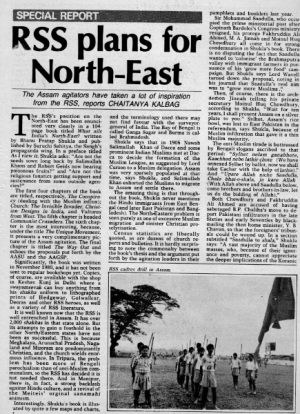
RSS Plans for North-East India
Published date: Mixed Paper Article
View PDFThe Assam agitators have taken a lot of inspiration from the RSS, reports Chaitanya Kalbag
The RSS’s position on the North-East has been enunciated very clearly in a 104-page book titled What ails India’s North-East? written by Bhanu Pratap Shukla and published by Suruchi Sahitya, the Sangh’s propaganda wing. In a preface titled As I view it, Shukla asks: “Are not the seeds sown long back by Salimullah Khans and Robert Geids now bearing poisonous fruits?” and “Are not the religious fanatics getting support and sustenance from some outside agencies?”
The first four chapters of the book are titled, respectively, The Conspiracy (dealing with the Muslim influx); Church: The Invisible Invader, Christian Designs in India, and Vultures from West. The fifth chapter is headed Communist Crusaders. The sixth chapter is the most interesting, because, under the title The Unique Movement, it presents a very complimentary picture of the Assam agitation. The final chapter is titled The Way Out and echoes the proposals put forth by the AASU and the AAGSP.
Significantly, the book was written in November 1980, and it has not been sent to regular bookshops yet. Copies, of course, are available with the shop. in Keshav Kunj in Delhi where a swayamsevak can buy anything from his shakha uniform to lithographed prints of Hedgewar, Golwalkar, Deoras and other RSS heroes, as well as a variety of RSS literature.
It is well known now that the RSS is well entrenched in Assam. It has over 2,000 shakhas in that state alone. But its attempts to gain a foothold in the other North-Eastern states have not been as successful. This is because Meghalaya, Arunachal Pradesh, Nagaland and Mizoram are predominantly Christian, and the church wields enormous influence. In Tripura, the problem has been more of Bengali parochialism than of anti-Muslim communalism, so the RSS has decided it is not needed there. And in Manipur, there is, in fact, a strong backlash against Hindu culture, and a revival of the Meiteis’ original sanamahi animism.
Interestingly, Shukla’s book is illustrated by quite a few maps and charts, and the terminology used there may not find favour with the surveyor-general of India. The Bay of Bengal is called Ganga Sagar and Burma is called Brahmadesh.
Shukla says that in 1906 Nawab Salimullah Khan of Dacca and some prominent Indian Muslims met at Dacca to decide the formation of the Muslim League, as suggested by Lord Curzon to a Muslim delegation. Assam was very sparsely populated at that time, says Shukla, and Salimullah Khan exhorted the Muslims to migrate to Assam and settle there.
The amazing thing is that through-out the book, Shukla never mentions the Hindu immigrants from East Bengal (and later East Pakistan and Bangladesh). The North-Eastern problem is seen purely as one of excessive Muslim migration and sinister Christian proselytisation.
Census statistics are liberally quoted, as are dozens of church reports and bulletins. It is hardly surprising to note the commonalty between the book’s thesis and the argument put forth by the agitation leaders in their pamphlets and booklets last year. Sir Mohammad Saadulla, who occupied the prime ministerial post after Gopinath Bardoloi’s Congress ministry resigned, his protege Fakhruddin Ali Ahmed, M. A. Jinnah and Moinul Huq Chowdhury all come in for strong condemnation in Shukla’s book. There is no disputing the fact that Saadulla wanted to ‘colonise’ the Brahmaputra valley with immigrant farmers in pursuance of his ‘grow more food’ campaign. But Shukla says Lord Wavell turned down the proposal, noting in his journal that Saadulla’s real aim was to “grow more Muslims.”
Then, of course, there is the arch demon Jinnah telling his private secretary Moinul Huq Chowdhury, according to Shukla, “Wait for ten years, I shall present Assam on a silver plate to you.” Sylhet, Assam’s rice bowl, was lost to East Pakistan in the referendum, says Shukla, because of Muslim infiltration that gave it a thin Muslim majority.
The anti-Muslim tirade is buttressed by Bengali slogans ascribed to that period: “Sylhet nelam ganabhote, Kaachhad nebo lathir chote (We have annexed Sylhet by ballot, now we shall take Cachar with the help of lathis).” And “Upare Allah niche Saadulla, Chalo bhai-o-shala, ja kare Allah (With Allah above and Saadulla below, come brothers and brothers-in-law, let us do the bidding of Allah).”
Both Chowdhury and Fakhruddin Ali Ahmed are accused of having sabotaged B.P. Chaliha’s move to de port Pakistani infiltrators in the late Sixties and early Seventies by black-mailing the then home minister, Y. B Chavan, so that the foreigners’ tribunals could be wound up. In a section subtitled “Saadulla to shala,” Shukla says: “A vast majority of the Muslim masses, who, because of their ignorance and poverty, cannot appreciate the deeper implications of the Koranic injunctions, can be easily beguiled by scheming politicians into believing that they would be serving Islam by migrating to the land of the kafirs and subsequently converting it into a land of Islam, Dar-ul-Islam.”
Even Mujibur Rehman and Zulfikar Bhutto are quoted as espousing the integration of Assam into East Pakistan. And in a remarkable conclusion (remarkable because it strongly resembles a similar conclusion reached by Myron Weiner in his book Sons of the Soil, which has become the Assam agitation’s gospel) Shukla tries to calculate what Assam’s population would have been if its population had grown at the same speed as the rest of the country. Shukla says that he estimates the total ‘foreigner’ population to be 45 lakhs, out of which 35 lakhs are Muslims. “The number of Muslim MLAs which was only 6 in 1952, increased to 28 in 1977 and…on September 1979 they decided to increase this number to 60 so that the next chief minister (Mrs Taimur) would be a Muslim.” The church is also accused of encouraging “the underground terrorist movements (in the region) by giving them ideological and monetary support.”
Shukla presents doomsday pictures of Manipur and Tripura. Manipur, he says, surrounded as it is by Christian states, is in danger of losing its Vaish navite base. The Tripura carnage last year is ascribed to Christian missionaries working on the Tripura Upajati Juba Samiti (TUJS). Not only that, the CPI(M) government in Tripura is accused of directly aiding the TUJS.
The attack on the Christian “invaders” is much more sustained. “Christian proselytisation is not that innocent,” writes Shukla. “It not only affects a change of faith or way of Iso tries to give them a worship but also worship but also tries to give them a separate nationality.
The Christian ‘conspiracy is ascribed to a diverse collection of devils: Britain, the USA, the World Council of Churches (WCC), the United Nations, the Gospel Literature Society, etc.
Pointing out that the third assembly of the WCC held in 1961 in Delhi is of special significance because it suggested an amendment to the definition of ‘freedom of religion to read: “It includes freedom to practise religion or belief, whether by performance of acts of mercy or by the expression in word or deed of the implications of belief in social, economic and political matters, both domestic international. Shukla says that it was for this reason that the Tyagi bill on freedom of religion (mooted during the Janata regime) was “so vehemently opposed by the Christian missionaries in our country and abroad.
Accepting the theses of British census commissioners S.A. Banes and Sir Herbert Risely that Hinduism and animism were divided by a very blur red line (thus arguing for the inclusion of the North-East’s tribals among Hindus) Shukla criticises Hutton’s categorisation in 1931 of tribal religions as distinct from Hindus, thus leading to a decline in Hindu population. “In consonance with their policy of ‘divide and rule,” he writes, “the Britishers tore away the tribal people from the Hindu society with the ultimate design of carving a separate Christian state on the same lines as Pakistan.”
Shukla also details the “Reid plan,” mooted by Sir Robert Reid, the governor of Assam in the early Forties, for carving out a ‘crown colony’ which was to include the hill areas of the N.E. region, going right up to Sadiya in Upper Assam, taking in parts of Bur-ma, most of the North-East, and parts of East Bengal. A similar conspiracy was also behind the plan, he writes, to carve out an ‘Adivasistan’ from Chota Nagpur, Santhal Parganas, Udaipur, Sarguja, etc.
Statistics and graphs are given to prove that the Christian population in the North-East has shot up after independence. The Adivasistan plan is purported to be mooted by Mr Emery, the then secretary of state for India, and detailed in an Urdu letter written on 14 August 1944 by the Muslim League, with the eventual aim of integrating Adivasistan with East Pakistan.
The Assam agitation is treated with kid gloves, and called “the unique movement.” Suffice it to say that almost all that this chapter says has been already said, ad infinitum, by the agitators themselves. Ever the descriptions, like “..stained by the blood of innocent victims of brutal police…” is strongly reminiscent of agitation literature.
The RSS’s double standards are amply borne out on page 85 where Shukla writes: “Hindus coming from East Pakistan, now Bangladesh, will have to be found a place in India… uprooted and displaced Hindus throughout the world have no other place to go to except India…because of our weakness, even Ceylon, Burma, Uganda, Kenya, etc., have simply pushed their citizens of Indian origin out… On the other hand when Burma tried to push back Muslim infiltrators in Arakan from Bangladesh, the Muslim world as a whole rose to their succour and ultimately forced Burma to take them back.”
The All-Assam Minority Students’ Union (AAMSU) is directly, and without convincing evidence, accused of receiving foreign Muslim help. According to the “nationalist” Assamese weekly Alok, says Shukla, “diplomats from Bangladesh, Libya and Saudi Arabia took part in a big Muslim conference in Goalpara district in March 1980 incognito dressed as maulvis. (How do maulvis dress? The charge is silly.) It was at this conference that the decision to form AAMSU was taken.” A list of Assamese Muslim politicians who attended is also given and Mr Afzalur Rehman of the Congress(I) is quoted as having said, Assam is being ruled by brahmins and kalitas and their rule must be brought to an end.”
Separatist and anti-Bengali sentiments are ascribed to the Jatiyatabadi Dal and the Purbanchaliya Loka Parishad, whereas the AASU and AAGSP elements are called nationalists, Shukla says the Muslim infiltrators “also are getting large amounts of money from Arab countries…Saudi Arabia has donated 15 million dollars for the renovation of about 125 mosques situated in Assam. A plan is also afoot to construct a university complex on the pattern of Aligarh Muslim University at Now gong…A number of Urdu madrassas have been started recently all over Assam and lands are being purchased by the Muslims in large numbers.” While writing all this unsubstantiated stuff, Shukla omits mentioning how many shakhas the RSS has in Assam. Not very surprisingly, all violent aberrations in the agitation are ascribed to “foreign elements.
Significantly, in the chapter titled The Way Out, Shukla supports the formula put forward by the Gandhi Peace Foundation (a proposal for settlement of infiltrators between 1951 and 1961, disenfranchisement and dispersal of infiltrators between 1961 and 1971, and deportation of post-1971 infiltrators) that has been touted as the proposal that will be adopted ultimately by the centre. Arguing for a “permanent arrangement” to stem the flow, Shukla says: “Recently, in the wake of the riots in Moradabad, even government spokes. men have complained that $2,000 Pakistanis have not gone back after coming to India with valid documents.” He advocates a complete ban of foreign missionaries and their institutions. “When Egypt, Saudi Arabia. and many other Arab countries have totally banned conversion from Islam, into any other religion, why should they be allowed to send money to India for even normal conversion work? Saudi Arabia has even banned the entry of Sikhs into their country. In all these matters we must have reciprocal relationships.” Surely not an argument for a secular nation. But then Mr Shukla has neither any concept of secularism, nor will his RSS-backed, BJP-run state allow the country to remain secular.






[7018]Irish Casino Login: Register for Irish Luck Real Money Slots & App Download. Irish Casino Login: Play top Irish Slots Online and Irish Real Money Slots. Easy Irish Luck Register. Get the Irish Casino App Download and win big in the Philippines! visit: Irish
[2954]PHP777 Online Casino Philippines: Easy Login, Fast Register, and Official App Download for the Best Slot Games. Experience the best at PHP777 Online Casino Philippines. Easy php777 login, fast php777 register, and official php777 app download. Play top php777 slot games now! visit: php777
[5289]mrphl Philippines: Best Slot Online & Casino Games. Easy mrphl Login, Register, and Official App Download for Premium Gaming. Experience the best mrphl slot online and casino games in the Philippines. Fast mrphl login and register. Get the official mrphl app download for premium gaming! visit: mrphl
[6076]jili88ph: The Best Online Slots Philippines & Premier GCash Online Casino Experience world-class gaming at **jili88ph online casino**, the **best online slots Philippines** platform. Secure your **jili88ph login** today to explore a wide array of **jili slot games PH** and enjoy fast, secure payouts at the premier **GCash online casino Philippines**. Join jili88ph for the ultimate slot experience and big wins! visit: jili88ph
[1197]Ninogaming: Official Philippines Slot Online – Login, Register & Download APK via Link Alternatif Join Ninogaming, the official Philippines slot online platform. Access easy ninogaming login, register today, or download apk via link alternatif for premium gaming. visit: ninogaming
[8244]37jl Online Casino Philippines: Register & Login to Play 37jl Slots. Download the 37jl App Today for the Ultimate Gaming Experience! Join 37jl Online Casino Philippines! Easy 37jl login & 37jl register to play top 37jl slot games. Get the 37jl app download for the best mobile gaming experience. visit: 37jl
[5505]kkkjili Casino Philippines: Your Premier Destination for kkkjili Slot Games. Quick kkkjili Register, Easy kkkjili Login, and Fast kkkjili Download for the Ultimate Gaming Experience! Experience kkkjili Casino Philippines! Quick kkkjili register & easy kkkjili login for top kkkjili slot games. Fast kkkjili download for the ultimate gaming experience. Join now! visit: kkkjili
[4126]lodi777 register|lodi777 app|lodi777 casino|lodi777 slots|lodi777 login Join lodi777 casino, the Philippines’ premier gaming hub! Complete your lodi777 register, access your lodi777 login, and enjoy top-tier lodi777 slots. Download the lodi777 app for a seamless mobile experience and start winning today! visit: lodi777
[7554]The Philippines’ premier online casino and sports betting destination with fast GCash payments. visit: philucky
[7459]7signs Casino Philippines: Quick Login & Register Online. Download the 7signs App for Top Slot Games and Exclusive Casino Bonuses. Experience the best at 7signs Casino Philippines! Quick 7signs casino login & 7signs register online. Download the 7signs app for top 7signs slot games and claim your exclusive 7signs casino bonus today. visit: 7signs
[6158]WinZir Official Site Philippines: Secure WinZir Login, Easy Register, and App Download for Top Online Slots. Experience the WinZir official site Philippines! Enjoy secure WinZir login, fast WinZir register, and top WinZir online slots. Get the WinZir app download today! visit: WinZir
Looking for the tc lottery apk download. Hope it’s easy to find and install. Let’s get this party started! You can find it at tc lottery apk download.
Just grabbed the winexch app, super easy to download and get started. Loving the mobile experience so far, betting on the go is now a breeze! Check it out: winexch app download
Tried 101gameloginbet the other day. Interface is pretty smooth and registration was straightforward. Lots of games! Give it a shot here: 101gameloginbet
Продвинутые специалисты используют seo xrumer, чтобы добиться высокой эффективности.
Для достижения максимальной эффективности важна правильная работа с xrumer, учитывающая алгоритмы поисковых систем.
**back biome**
Backbiome is a naturally crafted, research-backed daily supplement formulated to gently relieve back tension and soothe sciatic discomfort.