

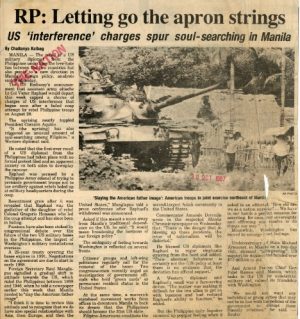
Letting go the apron strings – US ‘interference’ charges spur soul-searching in Manila
Published date: 30th Oct 1985, Mixed Paper Article
View PDFUS ‘interference’ charges spur soul-searching in Manila
MANILA —The recall of a US military diplomat from the Philippines underlines the love-hate ties between the two countries but also points to a new direction in Manila foreign policy, analysts said Wednesday.
The US Embassy’s announcement that assistant army attache Lt Col Victor Raphael would depart this week capped a chorus of charges of US interference that began soon after a failed coup attempt by rebel Philippine troops on August 28.
The uprising nearly toppled President Corazon Aquino.
“It (the uprising) has also triggered an unusual amount of soul-searching among Filipinos,” Western diplomat said.
He noted that the first-ever recall of a US diplomat from the Philippines had taken place with no formal protest filed and an apparent anxiety on both sides to downplay the rancour.
Raphael was accused by a Philippine Army colonel of trying to persuade government troops not to use artillery at military headquarters during the coup.
Resentment grew after it was revealed that Raphael was the godfather of the daughter of rebel Colonel Gregorio Honasan who led the coup attempt and has since been in hiding.
Passions have also been stoked by congressional debate over the future of the two US military bases in the Philippines, the largest of Washington’s military installations overseas.
A 25-year treaty covering the bases expires in 1991. Negotiations on the agreement are due to start in early 1988.
Foreign Secretary Raul Manglapus signalled a gradual shift in attitude towards the US, which ruled the Philippines between 1898 and 1946, when he told a newspaper earlier this week that Manila needed to “slay the American father image.”
“I think it is time to review this attitude and to recognize that we do have also special relationships with Asia, then Europe, and then the United States,” Manglapus told a press conference after Raphael’s withdrawal was announced.
Asked if this meant a move away from Manila’s traditional dependence on the US, he said. “It would mean broadening the horizons of our foreign policy.”
The ambiguity of feeling towards Washington is reflected on several fronts.
Citizens’ groups and left ad left-wing politicians regularly call for the removal of the bases. Two congresswomen recently urged an investigation of government officials who held green cards” or permanent resident status in the United States.
At the same time, a maverick statehood movement works from offices in downtown Manila to back its dream that the Philippines should become the 51st US state,
Filipino-Americans constitute the second-largest 1-largest Asian community in the United States.
Commentator Amando Doronila wrote in the respected Manila Chronicle newspaper on Wednesday that: “There is the danger that in blowing up these incidents, the blowing up these incidents, the issue of national distorted.”
He likened US diplomats like Raphael to rogue elephants straying from the herd and added: “Their aberrant behaviour is certainly not the (US) policy at least there is no evidence that the there is no evidence that the deviation has official support .”
A Western diplomat said Raphael’s recall was a face-saving device. “The matter was making it difficult for the two allies to get on with business and had reduced Raphael’s ability Raphael’s ability to function.” he added.
But the Philippine daily Inquirer summed up popular feeling when it asked in an editorial: “How old are we as a nation anyway? … We have in our hands a perfect occasion for asserting, for once. our sovereignty and affirming our resolve to do and affirming our resolve things our way .”
Mean while, Washington has moved to assuage hurt feelings.
Undersecretary of State Michael Armacost, in Manika on a four-day visit, stressed “unwavering” US support for Aquino and handed over $75 million in aid.
And Armed Forces Chief Gen Fidel Ramos said Manila, which looks to the US for substantial military aid, valued its friendship with Washington.
“We would not want any individual or group action that may not be in line with the policies of the government to disrupt these friendly relations,” he said.— Reuter


[3100]Official FG777 Link: The Best GCash Online Casino and Slot Games in the Philippines. visit: fg777link
[4704]911jl Casino: The Best Online Casino Philippines with GCash. Secure Login & Fast App Download for Top Gaming. Experience the best online casino Philippines at 911jl casino. Secure your 911jl login today for premium gaming and seamless transactions with the top GCash online casino PH. Start winning now and get the 911jl app download for fast, secure access to your favorite games anytime, anywhere. visit: 911jl
[2258]PHJOY Login & Register: Download the App for the Best Philippines Online Slots & Casino Sign Up Experience Join PHJOY for the best Philippines online slots! Complete your PHJOY login or PHJOY register today. Get the PHJOY app download for an elite casino sign up experience. visit: phjoy
[1674]Tayabet: The Philippines’ Premier GCash Online Casino for Best Slots and Gambling. visit: tayabet
[8032]Best Online Casino Philippines: Swerte Login, Fast Register, Top Slots, and Official Casino App Download for Big Wins. Experience the best online casino in the Philippines at Swerte! Enjoy a secure swerte login, fast swerte register process, and play the highest-paying swerte slots. Get the official swerte casino app and start your swerte download today for top-tier gaming and big wins at the country’s most trusted gambling platform. visit: swerte
[4071]J8jili Online Casino Philippines: Top J8jili Slot Games, Easy Login, Register, and App Download. Join J8jili Online Casino Philippines for top J8jili slot games. Enjoy easy J8jili login, quick register, and the J8jili app download. Play and win at J8jili today! visit: j8jili
[1725]Dito777: The Most Trusted Legit Online Casino Philippines – Your Best GCash Casino for Big Wins! Dito777 is the most trusted legit online casino Philippines. Join the best GCash casino PH for big wins. Dito777 login now for online gambling Philippines! visit: dito777
[3902]Pcsobet Official Site: Login, Register & Online Slots Philippines. Download the Pcsobet App for the Ultimate Casino Experience. Join the Pcsobet official site for the best online slots in the Philippines. Fast Pcsobet login & register. Start your Pcsobet app download for the ultimate casino experience! visit: pcsobet
[9961]JL999 Casino: Top Philippines Slot Games, Secure Login, Easy Register & Official App Download Experience JL999 Casino, the #1 destination for top Philippines slot games! Enjoy a secure jl999 login, fast jl999 register, and exciting jl999 slot titles. Get the official jl999 app download for premium mobile gaming and start winning today. visit: jl999
[2535]WinPH5 Online Casino: The Philippines’ Top Choice for Slots. Easy winph5 login, register, and winph5 app download for an elite gaming experience. Join WinPH5 Online Casino, the Philippines’ top choice for winph5 slots. Fast winph5 login, easy winph5 register, and winph5 app download for an elite gaming experience. visit: winph5
[4119]80jili Online Casino: Top Slot Games, Official App Download, Login & Register for PH Players Join 80jili Online Casino, the top choice for PH players! Get quick 80jili login, easy 80jili register, premium 80jili slot games, and official 80jili app download. visit: 80jili
Thanks for sharing. I read many of your blog posts, cool, your blog is very good.