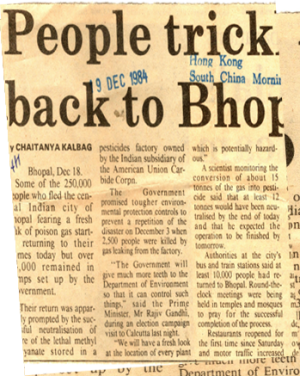
People trickling back to Bhopal
Published date: 19th Dec 1984, South China Morning Post
View PDFBy CHAITANYA KALBAG
Bhopal, Dec 18—Some of the 250,000 people who fled the central Indian city of Bhopal fearing a fresh leak of poison gas started returning to their homes today but over 12,000 remained in camps set up by the Government.
Their return was apparently prompted by the successful neutralization of more of the lethal methyl isocyanate stored in a pesticides factory owned by the Indian subsidiary of the American Union Carbide Corpn.
The Government promised tougher environmental protection controls to prevent a repetition of the disaster on December 3 when 2,500 people were killed by gas leaking from the factory.
“The Government will give much more teeth to the Department of Environment so that it can control such things,” said the Prime Minister, Mr. Rajiv Gandhi, during an election campaign visit to Calcutta last night.
“We will have a fresh look at the location of every plant which is potentially hazardous.”
A scientist monitoring the conversion of about 15 tones of the gas into pesticide said that at least 12 tonnes would have been neutralised by the end of today and that he expected the operation to be finished by tomorrow.
Authorities at the city’s bus and train stations said at least 10,000 people had returned to Bhopal. Round-the clock meetings were being held in temples and mosques to pray for the successful completion of the process.
Restaurants reopened for the first time since Saturday and motor traffic increased but only a few shops were open near the pesticides factory and troops continued to patrol almost deserted residential areas.
US congressman Mr Stephen Solarz, who heads a sub-committee on Asian and Pacific affairs, expressed hope that the Bhopal disaster would not be allowed to sour Indo-American relations.
Mr Solarz was met on his arrival in Bhopal by demonstrators shouting slogans against the United States and multi-national companies.
“I have come here to demonstrate the concern of my colleagues in congress over this tragedy and to determine whether there is anything our Government can do to help,” he said.
At 11 relief camps on the city’s outskirts thousands of people seemed likely to stay until the neutralisation was complete. One camp official said the 600 people in his care were gas victims who now had no sources of income.
The Home Minister, Mr P. V. Narsimha Rao, was quoted by PTI as saying that the Government did not succumb to any American pressure in the release of Mr Warren Anderson, chairman of Union Carbide. — Reuter.