Manmohan gets Gandhigiri
[Hindustan Times]
Published date: 1st Oct 2006
View PDFPrime Minister Manmohan Singh placed his seal of approval on Sunday on Lage Raho Munnabhai. In South Africa on a three-day trip long on history and symbolism, the prime minister said he was “heartened” to see that the latest Sanjay Dutt blockbuster “is a film about a young man’s discovery of the universal. and timeless relevance of the Mahatma’s message”.
But Gandhigiri aside, for a moment at Durban’s Kingsmead Stadium it began to look like a Congress party rally. The prime minister, Culture and Tourism Minister Ambika Soni, and Minister of State for External Affairs Anand Sharma sat stoically on one dais while a procession of dancers and singers kept the crowds entertained on another. But there was a difference.
South African President Thabo Mbeki was seated beside the prime minister, and the crowd was certainly far smaller than any the Congress can rustle up on a Sunday afternoon. In fact, Durbanites were distinctly underwhelmed by the celebrations of a century of Satyagraha, preferring to watch their favourite football teams at a nearby match. There were fewer than a thousand people in the 25,000-seat stadium.
Prime Minister Singh is an unusual politician, and he doesn’t let a small and inattentive crowd take away from his sense of history in coming to South Africa to breathe the air of incipient sainthood that greeted Mohandas Karamchand Gandhi in May 1893 when the young lawyer travelled from England on a year’s contract on behalf of a wealthy client.
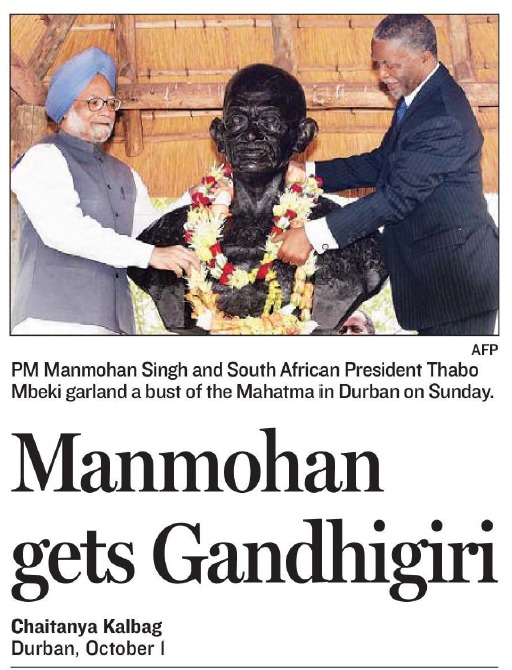
Earlier on Sunday the prime minister and President Mbeki celebrated the “umbilical cord” of Gandhian values that links their nations at a simple ceremony at the spot where, 102 years ago, Mahatma Gandhi set up a unique commune of people of all faiths and colours to put into practice, as the prime minister said, “the values that he followed and preached for the rest of his life — self-help, dignity of labour, community living and Sarvodaya”.
The Phoenix Settlement was nearly razed to the ground during riots in 1985, but has been largely re-constructed.
Gandhi set up Phoenix to house a community that initially published his paper, the Indian Opinion, in four languages, Phoenix quickly became a magnet for people who were drawn to Gandhi’s message of steadfast op position to injustice-a credo that led him to launch the concept of civil disobedience, or Satyagraha, two years later in 1906.
Singh said he could feel the Mahatma’s “compassion and serenity” permeating the simple, rough hewn commune that was to be the precursor to the Tolstoy Farm that he also set up in South Africa, and later Sabarmati Ashram in India.