Manipur – A State Of Siege
Published date: Jun 1st - 15th 1980, New Delhi
View PDFNothing seems to work right in Manipur, and a combination of corruption, misgovernment, and unemployment, compounded by the continuing presence of the Army and various paramilitary forces, is fuelling the people’s frustration and aiding their drift towards rebellion.
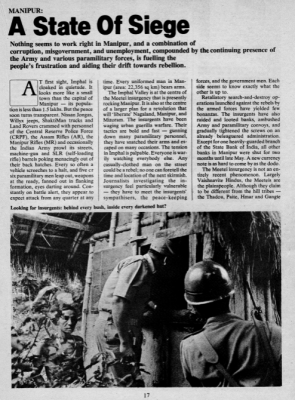
At first sight, Imphal is cloaked in quietude. It looks more like a small town than the capital of Manipur – its population is less than 1.5 lakhs. But the peace soon turns transparent. Nissan Jongas, Willyx jeeps, Shakti Man trucks and Land Rovers crammed with personnel of the Central Reserve Police Force (CRPF), the Assam Rifles (AR), the Manipur Rifles (MR) and occasionally the Indian Army prowl its streets, machine-gun and SLR (self-loading rifle) barrels poking menacingly out of their back hatches. Every so often a vehicle screeches to a halt, and five cr six paramilitary men leap out, weapons at the ready, fanned out in flanking formation, eyes darting around. Constantly on battle alert, they appear to expect attack from any quarter at any time. Every uniformed man in Manipur (area: 22,356 sq km) bears arms.
The Imphal Valley is at the centre of the Meetei insurgency that is presently rocking Manipur. It is also at the centre of a larger plan for a revolution that will ‘liberate’ Nagaland, Manipur, and Mizoram. The insurgents have been waging urban guerilla warfare. Their tactics are bold and fast— gunning down many paramilitary personnel, they have snatched their arms and escaped on many occasions. The tension in Imphal is palpable. Everyone is warily watching everybody else. Any casually-clothed man on the street could be a rebel; no one can foretell the time and location of the next skirmish. Journalists investigating the insurgency feel particularly vulnerable— they have to meet the insurgents’ sympathisers, the peace-keeping forces, and the government men. Each side seems to know exactly what the other is up to.
Retaliatory search-and-destroy operations launched against the rebels by the armed forces have yielded few bonanzas. The insurgents have also raided and looted banks, ambushed Army and paramilitary convoys, and gradually tightened the screws on an already beleaguered administration. Except for one heavily-guarded branch of the State Bank of India, all other banks in Manipur were shut for two months until late May. A new currency note is as hard to come by as the dodo.
The Meetei insurgency is not an entirely recent phenomenon. Largely Vaishnavite Hindus, the Meeteis are the plainspeople. Although they claim to be different from the hill tribes— the Thadou, Paite, Hmar and Gangte Kukis, and the Thangkhul and Kabui Nagas— racially they are first cousins. During British occupation of Manipur during the 19th century, the hill tribes frequently rose in revolt. Not far from Imphal is Moirang, where Netaji Subhas Chandra Bose set up his Indian National Army’s headquarters during World War II. The Indian Army was engaged in constant counter- insurgency operations in the hills ever since 1956.
Currently, the two ‘armies of liberation’ operating in Manipur are the People’s Liberation Army (PLA) and the People’s Revolutionary Party of Kangleipak (Prepak) – Kangleipak being the historical name for the region. Besides these, there are the United National Liberation Front (UNLF) formed in 1964, and the Manipur Revolutionary Party (MRP), formed in 1976 – as well as many smaller insurgent bands.
The insurgency has little in common with the agitation being waged by the All Manipur Students Union (AMSU) and the All Manipur Students Coordinating Committee (AMSCOC) against the ‘foreigners’ in the state. Compared with Assam, Manipur has a smaller number of ‘foreigners’; in 1971, out of a total population of 10,72,753, 15,014 were Bengalis and 26,495 Nepalis. The students have demanded that 1949 ought to be the ‘cut-off year, since that was when Manipur – which remained a constitutional monarchy until September 1949 – merged with the Indian Union.
There have been many instances of violence perpetrated against the mayanga (outsiders) and many of them have fled Manipur. Bihari tradesmen and hoteliers, Nepali hawkers and shop-keepers, and Punjabi lorry operators have packed up and left. Consequently, locals complain, there is a shortage of dhobis, barbers, and cobblers. But the anti-foreigner sentiment does not seem as emotionally surcharged as in Assam.
It becomes quickly apparent that one cannot look at the insurgency in isolation. The factors that have contributed to the rebellion are worth going into. It is not for nothing that the Manipuris speak in anger and anguish about the ‘colonial’ attitude of the rest of India towards their state. In almost every sphere government, economy, employment, social structure – Manipur has received a poor deal.
Manipur is riddled with such shameless corruption that hardened veterans of the greased palm elsewhere in India would pale in comparison. Bribery is rampant: one joke has it that one has to bribe even to sneeze in a government office. Since the government is the largest single employer in Manipur there is almost no industry, and trade and business are controlled by Biharis and Marwaris – the competition for white-collar jobs is fierce. Money almost always decides the list of successful candidates’.
Manipur’s economy is agricultural – rice is the major crop. In 1977, there were only 399 registered ‘factories’ in the state— most of them rice, oil and saw mills. There is no small, medium or large industry worth speaking about. Every item of consumption is in short supply – even salt has to be imported. Last month, petrol was rationed out, but large quantities smuggled in from Burma sold at Rs 8 a litre.
The public services are no better. A telegram sent from Calcutta on April 30 reached Imphal only on May 26 – by post. Communications with the outside world are shocking. The nearest railhead, Dimapur in Nagaland, is 215 km away. No rail tracks run in the state. The bus transport system is always in a shambles. In 1977, there were only 1,858 telephones in the state.
Unemployment is rampant. Although signs of abject poverty are rare – there is no beggar in Imphal, for instance – there are close to 1.5 lakh unemployed people, almost a tenth of the state’s population. And Manipur’s population is only one-fourth of Delhi’s. Because Manipuri rice has some of the highest protein content in India, and because they relish two other dietary wonders – a peculiar tree bean packed with nourishment that grows elsewhere only in a remote corner of Africa, and a health drink made of fermented soyabean – the Manipuris are generally quite healthy. But economic deprivation has led to many unsavoury things – including prostitution. “I weep every time I think of the hundreds of Manipuri women who have taken to prostitution in order to earn money for their families,” says a Manipuri government official. Another alleges that the Army and the other armed forces provide large numbers of willing customers.
Yet, a strange ambiguity exists. The tribals – largely Christian by faith – are geared to the jean-and-guitar culture. People dress nattily, and smuggled goods are in abundant evidence. Moreh, a small (pop. 10,000) town 110 km from Imphal on the Indo-Burmese border, thrives on smuggling. Bruce Lee is a demi-god, and even modestly-paid government employees smoke American cigarettes. In Manipur, the Border Security Force (BSF), which is supposed to guard the border with Burma, is referred to as the Border Smuggling Force.
The governmental machinery is also in tatters. Bureaucrats sent to Manipur are often on ‘punishment postings’ – they have fallen into dis favour in Delhi. Seven ministries have ruled the state since 1972, and President’s Rule has been imposed twice – the last time for two months on November 14 last year. The situation is so fluid that blank invitation cards for swearings-in at the beautiful Raj Bhawan in Imphal have been printed – the date and time being typewritten later. The present ruling coalition consists of the Congress (I), the Congress(U) and the Manipur People’s Party (MPP). It occupies 47 of the state’s 60 assembly seats.
The only major project in the state is the huge hydro-electric plant coming up at Loktak Lake, 45 km from Imphal. Designed to generate 105 MW of electricity (of which Manipur will consume 25 MW), it was begun in 1970. In 1975, after a huge explosion ripped through the partially built 6.65 km long Head Race Tunnel connecting the Imphal and Leimatak valleyes – methane gas was the culprit – work was held up for two and a half years. The project’s cost has shot from the initial Rs 10 crores to Rs 80 crores, and it is now slated for completion only in March 1982. Nobody in Manipur is ready to believe this.
There is intense resentment among the Meeteis about the special treatment accorded to the hill tribes by the government. Although Manipur has always been economically backward, it was not classified as such after Independence because the then government felt that being largely Hindu, and reasonably educated, Manipur did not qualify – thus denying the state many economic subsidies. Although Nagaland and Mizoram are barred to other Indians unless they hold Inner Line Permits which restrict their stay there Manipur is wide open for outsiders.
Tribal-Meetei rivalry is fiercest in regard to the coveted Indian Administrative Service (IAS). Tribal candidates are given reservations and concessions, with the result that there are dozens of tribal IAS officers. A tribal IAS officer, if posted in his home state, does not have to pay income tax. There is only one Meetei IAS officer, R K Phalguni – and he is posted in Karnataka. In addition, Manipuris have to contend with the joint Manipur – Tripura Civil Service (MTCS) which has many Bengali candidates from Tripura in the fray.
There are 30 degree colleges, one law college, and one regional medical college in Manipur, most of them affiliated to the distant Gauhati University. Recently; the Manipur Assembly passed a bill to set up a Manipur University that will replace the Imphal centre of the Jawaharlal Nehru University (which is affiliated to JNU, Delhi). Catholic, American Baptist, and other Protestant missionaries have contributed a lot to education in the hills. But the young people emerging with degrees have rarely found jobs, and this has fuelled their frustration. All these factors have helped turn Manipur into a state under siege. Nothing seems to work right, and no light is in view at the end of the tunnel. Manipuris speak well of their British administrators – India has, in 30 years, they say, undone everything the British did in a century. Although a Manipuri king – Pamheiba took to Hinduism in the early 18th century and took the name of Garib Nivas, a process that was strengthened by Maharaja Bhagya Chandra in the latter part of that century, there is a strong movement afoot to revive the pre-Hindu Manipuri faith – called Sanamahi, a pagan form of nature worship. The tribals themselves are harking back to their pre-Christian faith, Indei.
The Meeteis say that Hinduism has brought nothing but woe to them. They are gradually beginning to resent Hinduism’s costly ritualism, its dowry system, its stress on the caste system. The hill tribes largely American Baptist, and also Roman Catholic and Protestant (the last has Seventh Day Adventist and Episcopal Free Church of India adherents) are, strangely enough, with the plainsmen in the larger upsurge of Mongoloid consciousness now sweeping the region. The tribals say they are of Southern Chinese origin, the plains people claim Thai descent, but they are all agreed that they are a race apart from the Indians.
Manipuri belongs to the Sino-Tibetan family of languages. For many years now, the Manipuris have been agitating to have their language included in the Eighth Schedule of the Indian Constitution – to no avail. There is a distinct Manipuri script, but the one commonly used is Bengali – another point of resentment. The Mongoloid revivalism has contributed in large measure to the insurgency – which has as its aim the liberation and unification of all Mongoloid peoples. In many respects, the large and continuing presence of the Army and the other paramilitary forces has made Manipur a hotbed of vice, corruption, and brutal encounters between the local people and the armed forces. “Imphal today is like Saigon during the Vietnam war,” says an Army officer. Nobody can explain why so many paramilitary forces are stationed in such a small area.
This leads to widespread confusion. Intelligence-gathering, for instance, is pathetically clumsy and inadequate. The Army, the BSF, the CRPF, the Assam Rifles, the Manipur Rifles have each got an intelligence wing. Additionally, the Subsidiary Intelligence Bureau (SIB), the Intelligence Bureau (IB), and the Research and Analysis Wing (RAW) operate in the state. Lines are all too often crossed, and fake informants merrily sell Grade C (that is, virtually worthless) intelligence to half a dozen intelligence bodies. The result – New Delhi is fed with conflicting information, and peace-keeping becomes that much more difficult.
There is intense competition, too, between the various armed forces. One hes arguments that the government ought to station only one or two paramilitary forces there, and each force is contemptuous of the others’ capabilities. In early March, the Assam Rifles lost two of its men to insurgents. One suspect was captured by the Manipur Rifles. Eye-witnesses allege that the Assam Rifles men shot him dead when he was in the custody of the Manipur Rifles. Subsequently, the AR became very unpopular in the state in contrast with its old rapport with the people.
On April 26, after three CRP men were killed at Patsoi, an Imphal suburb, by insurgents, a ruthless search- and-destroy operation was launched. In the ensuing encounter between the rebels and the CRP, one insurgent and two innocent passers-by were killed – the latter in the crossfire. Immediately, rumours began to mount that no less than 12 local women had been raped by the CRP. Nobody has substantiated this charge, although one university professor claims that the gynaecological ward in the local hospital had to “stitch up” many women. As a result, the CRP has become as unpopular as the Assam Rifles had in March.
Significantly, although Governor LP Singh has promulgated the Disturbed Areas Act and the Armed Forces (Assam and Manipur) Special Powers Act in order to launch combing operations by the Army against the rebels, the Chief Minister, RK Dorendra Singh, has not yet issued a formal notification that would put the Governor’s order into effect. The chief minister has appealed to the rebels to lay down arms, which is unlikely to be heeded. Women have been demonstrating against the Army’s presence, adding to the tension. What happened on May 28 is illustrative.
That afternoon, a 2,000-strong women’s demonstration against the “armed forces’ atrocities” wound its way peacefully through Imphal’s streets. They were arrested by the police, taken to a distant ‘temporary jail’, and released there. Two women being taken away in a police truck, however, jumped off the speeding vehicle. One of them, pregnant, died of the injuries , she sustained.
Immediately there was tension. In April, one CRP jawan’s machine-gun had accidentally fired in Imphal’s Pauna Bazar, killing another pregnant woman. One of the people killed in the Patsoi incident later that month was a pregnant woman. In any case, after the women demonstrators removed their “martyred sister’s” body from the hospital on May 28 and marched through the streets shouting angry slogans, a visible pall of gloom settled over Imphal. A 24-hour curfew was imposed, people stopped in their tracks on the streets looking tensely at the trucks that roared in, bringing armed men to impose the curfew, and the fragile peace that had been built up for three weeks was shattered.
This is Manipur today – not the scenic, peaceful and happy “Switzerland of India” it was once called, but a land on an extremely short fuse, a fuse that is lit all too often and snuffed out only in the nick of time, a fuse that will one day burn to its end and set off an explosion that will shake the concept of India as a unified nation to its very roots.