

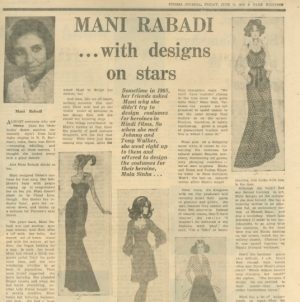
Mani Rabadi …with designs on stars
Published date: 11th June 1976
View PDFAlmost everyone who saw Sholay liked the ‘Mehbooba’ dance number immensely. Apart from Jalal Agha singing in R. D. Burman’s voice, there was Helen-swooping, whirling, and twirling all those scarves. I thought she looked every inch a gipsy dancer.
And Mani Rabadi thinks so too.
Mani designed Helen’s costume for that song. Her telephone’s busy with people ringing up to congratulate her on her job. Mani doesn’t climb on to Cloud Line, though. She thanks her industry ‘fans’, puts the receiver down, and thinks up a costume for Parveen’s next movie.
Ten years back, Mani Rabadi was just another average woman. And then, after a tiff with her folks, she moved out of home. Alone and with the wolves at her door, she began looking for a way to earn her bread. Mani had edited a Hindi magazine called ‘Gori’ for quite some time, and she was wondering whether to gо back to journalism. Then some friend suggested she learn tailoring. She attended Singer classes, and when she had learnt everything, an-other lady friend bought her a sewing machine, Mani began her tailoring business, and soon, she had a large clientele on and around Peddar Road (where she stays).
Sometime in 1968, her friends asked her why she didn’t try to design costumes for heroines in Hindi films. Her sister Shammi was a heroine some years back, and Mani had quite a few contacts in filmland. So “One fine day,” Mani says, “when I met my old friends Johnny and Tony Walker, who were producing a film called Dil Lagi, I offered to design the costumes for their heroine, Mala Sinha.” Costume-designing hadn’t come into prominence then, and the Walkers were not very enthusiastic. But Mani persisted, and finally got to meet Mala with a few of her sketches. Mala liked them. and so Mani got her first designing job for films in Dil Lagi, After that, she designed all of Mala’s costumes. Her work drew attention, and Sharmila, who was co-starring with Mala in Humaaya, asked Mani to design her clothes, too.
And then, like we all know, nothing succeeds like success. Mani soon had an enviable roster of heroines in her design files, and she closed her tailoring shop.
Two things contributed to Mani’s success at that times: the paucity of good costume designers, and the fact that colour films were just then coming into vogue, After Dil Lagi, she designed clothes for Jaal. Mani was a conscientious designer, and even today. she says, “I get to know what the director really wants. And then I get to know the cameraman: the colours he thinks he can photograph best, the shades he thinks will blend with the tone of the film. And finally, I meet the art director, and working in conjunction with him, I work out the colour schemes for my designs. My colours have to harmonise with the colour of the sets, the colour of the clothes the other characters wear, and most of all, the ‘mood’ of the film. I cannot have the heroine entering in a flaming red gown when the script calls for an emotional, low-key scene. I insist on listening to the story, and try to design clothes that go with the psychology of the character.”
A big job Mani landed recently was Zeenat’s costumes in Satyam Shivam Sundaram.
Her job here was a real challenge, she says, because Raj Kapor wanted Zeenat to look realistically poor-not filmily poor, “Most of the ‘poor’ characters in our films wear studiedly decrepit clothes,” Mani says. “The rents in the sleeves, the grime on the back, the missing button, all smack of theatrical poverty. I believe in studying the clothes the poor wear, and then incorporating them in my designs. There are compromises, of course. The industry is full of compromises,” she finishes wryly.
Sometime in 1968. her friends asked Mani why she didn’t try to design costumes for heroines in Hindi films. So when she met Johnny and Tony Walker, she went right up to them and offered to design the costumes for their heroine, Mala Sinha…
Wouldn’t the rise of the ‘realistic’ cinema make a dent in Mani’s business? No, she says, because even realistic films have to have some thought put into the costumes their characters wear. “We can’t have ‘realistic cinema in the true sense for quite some time,” Mani feels, “because, our people are not prepared to spend money to see the same misery they wallow in on the screen. Realism, therefore, is subtly touched up, given a couple of glamourised touches. And this is where I come in.”
Mani goes on a designing spree when it comes to visualizing the costumes for cabaret scenes, Sequins, jewellery, shimmering slit gowns, sexy plunging necklines-we’ve seen umpteen Bindu and Helen and Padma Khanna items in these costumes, Won’t the ban on cabaret scenes affect Mani’s scope?
Once more, she disagrees with me Our producers will certainly inject their quota of glamour and glitter, she says, because they cannot sell their film otherwise. Instead of cabaret scenes, they’ll have “mujras, she smiles wouldn’t be bothered if my bustiness went “phut,” she says, “Tm a fakir at heart I can accept anything.” And she raises her eyes to the ceiling.
A producer comes in, to ask Mani whether her design for Bindu in his forth-coming film is ready. Throughout the discussion, he keeps reminding Mani about the Centors, and begs her to keep the new strictures on sex and vulgarity in mind, Mani soothes his over-taxed nerves, promises to have everything ready for the shooting, and walks with him to the door.
Although she hasn’t had any formal training in art, Mani designs all the costumes she does herself. She has a tailoring section in an adjacent flat, an embroidery section at Bhendi Bazar, and also a workshop where fake jewellery is made to her specifications, to go along with her costumes. So the next time you see Bindu dancing on the screen, watch her jewellery closely. Chances are it was pasted together by Mani’s intrepid workmen.
Don’t the heroines prove very difficult, I ask. Don’t they change their minds often and throw Mani’s plans awry? “Which woman doesn’t keep changing her mind?” she replies. “The heroines I design for are entitled to their moods—they work under tremendous stress.”
Mani has a lot of assignments on hand—Chor Ke Ghar Chor, Dharmveer, Maha Guru, and Mama Bhanja are films in which she’s designing for Zeenat, apart from Satyam…… She’s also designing Hema’s costumes in Aap Ke Khatir, Aap Beati, and Dream Girl. She designed all the clothes Dimple and Sonia Sahni wore in Bobby (and she saw the film only in the 18th week). She designs often for her favourite male model, Pran. And she’s designing the clothes for the cast of Chamatkar. Even those worn by Rajesh Khanna!
Publicity-shy, Mani rarely appears at parties, and funnily enough, rarely sees the movies in which her designs grace the female stars. She’s full of verve and Ideas, And she respects her three competitors— Bhanu Athayya, Leena Daru, and Shalini Shah, Altogether, Mani Rabadi is a very nice person, not at all the type that would have designs on you.


Your point of view caught my eye and was very interesting. Thanks. I have a question for you.
**aqua sculpt**
aquasculpt is a premium metabolism-support supplement thoughtfully developed to help promote efficient fat utilization and steadier daily energy.
**neuro sharp**
Neuro Sharp is an advanced cognitive support formula designed to help you stay mentally sharp, focused, and confident throughout your day.
[2985]Winph8 Online Casino Philippines: Secure Winph8 Login, Fast Register & App Download for Premium Slot Games. Join Winph8 Online Casino Philippines for premium Winph8 slot games. Enjoy a secure Winph8 login, fast Winph8 register, and easy Winph8 app download. Experience the ultimate gaming platform and start winning today! visit: winph8
[8326]Superking: The Best Legit Online Casino Philippines for Real Money GCash Slots Experience the ultimate gaming thrill at Superking, the best legit online casino Philippines for real money GCash slots. As a premier destination for real money online gambling Philippines, Superking offers secure transactions, massive jackpots, and a wide variety of games. Use your Superking casino login PH today to access the best GCash casino PH and start winning big! visit: superking
[6081]jii747: The Philippines’ Best Legit Online Casino & Official GCash Slots Welcome to **jii747**, the **Philippines’ best legit online casino** and the official home for high-payout **GCash slots**. Secure your **jii747 login official** today to experience **top-rated online gambling** featuring live dealers, sports betting, and the **best online slots Philippines GCash** integration. Join the most trusted **jii747 legit casino PH** platform for a safe, fair, and thrilling gaming experience with instant withdrawals. visit: jii747
[5759]The Philippines’ Leading Online Casino for Premium Slots and Secure Gaming visit: phwin25
[4288]PHDream: The Best Online Casino in the Philippines. Register, Login, and App Download for Premium Casino Slots. Experience PHDream, the top online casino in the Philippines. Register & login to play premium PHDream casino slots. Get the PHDream app download for elite mobile gaming today! visit: phdream
[23]Luckybet Official Site: Best slots in the Philippines. Fast luckybet login, easy luckybet register, and secure luckybet app download for premium casino gaming. Experience the best slots in the Philippines at the Luckybet official site. Fast luckybet login, easy luckybet register, and secure luckybet app download for premium casino gaming. Join now and win! visit: luckybet
[9166]Inplaycasino Online Casino Philippines: Fast Inplaycasino Login, Easy Register, and Official App Download for the Best Inplaycasino Slots Experience. Join Inplaycasino Online Casino Philippines! Experience fast inplaycasino login, easy inplaycasino register, and official app download for the best inplaycasino slots. visit: inplaycasino
[9207]PHBuwenas Online Casino: Register and Login for Top Slot Games & Official App Download in the Philippines. Join PHBuwenas Online Casino! Easy phbuwenas login & phbuwenas register for top phbuwenas slot games. Fast phbuwenas app download available for the best gaming in the Philippines. visit: phbuwenas
[4755]MPLBet Official Site: Best Philippines Slot Online. Fast MPLBet Login, Register, & App Download. Join the MPLBet official site for the best Philippines slot online experience. Enjoy fast mplbet login, easy mplbet register, and the latest mplbet app download. visit: mplbet
[9706]Jililive Online Casino Philippines: Top Slot Games, Easy Login, Register & App Download Join Jililive Online Casino Philippines for the best jililive slot games. Experience fast jililive login, easy jililive register, and a secure jililive app download for non-stop gaming action today! visit: jililive
[1319]jl10 Online Casino Philippines: Quick jl10 Login, Register & jl10 Slot Games. Get the jl10 App Download for the Best Gaming Experience! Join jl10 Online Casino Philippines for the best gaming! Fast jl10 login, easy jl10 register, and huge jl10 slot wins. Get the jl10 app download and start winning today! visit: jl10
Remember ‘bayvip 2022’? Still a classic! This link is the place to get it. Good times ahead! bayvip 2022
‘rong bạch kim’ is a pretty popular choice for lotto folks. Give it a try – maybe it’s your lucky charm! rong bạch kim
Hey guys, gotta check out sx bac lieu on này! Fingers crossed for some good luck today! Let’s go! sx bac lieu
Оптимизированный сервер для хрумера помогает избежать технических проблем при работе.
**prodentim**
ProDentim is a distinctive oral-care formula that pairs targeted probiotics with plant-based ingredients to encourage strong teeth, comfortable gums, and reliably fresh breath.