Jayaprakash Narayan
[Trans India]
Published date: Aug 1977
View PDF“Mrs Gandhi Should disappear From The Political Scene”
Jayaprakash Narayan today occupies a place in the hearts of his countrymen not unlike the one allotted to Mahatma Gandhi after Independence. How does the ailing ‘Father’ of the Second Liberation take to his new role? With his usual calm, discovered Chaitanya Kalbag and Shobha Kilachand when they met him in Bombay a day before he left for Patna in mid-July.
The appointment is at 9:45 a.m. at Express Towers—the ugly concrete skyscraper in Bombay’s busiest business zone—Nariman Point. Home of the gutsy Express group of newspapers. An untidy hard-leathered sign propped up on a bare desk reads ‘Visitors of J.P. queue here’. After we check with the security staff who ask us to take the elevator up to the 24th floor—the Penthouse Suite of the Goenka’s—J.P.’s local hosts and the Express bosses.
Upstairs; more security checks, and we walk into a drawing room which resembles a slightly plush railway platform. J.P.’s secretary Mr. Parshuraman, immaculate in his white khadi lungi and kurta, inspects us and says: “You will get only five minutes. He is not well. He has woken up late. We still haven’t begun our first appointment which was at 9 a.m. It’s now nearly 10.” We request for some extra time. He stares at us. “Why don’t you press people come and interview him in Patna? He will give you as much time as you want there. You want him to accommodate you— even when he’s in no physical condition to do so.” We look suitably crushed and guilty and crawl as inconspicuously as possible to the nearest chairs. A group of Gujarati ladies walks in. The leader assumes an important air and asks to see J.P.’s secretary. He strolls up indifferently. She starts on her little speech. “I spoke to you yesterday. We have an appointment…” He doesn’t give her a chance to continue. “Yes, yes, yes. But I am cancelling all his appointments. You can have one minute with him.” She hears ten. and is indignant. “Only TEN minutes?” . Her voice is rising : “But we’d asked for time!” He snorts and says sharply : “I said ONE minute. madam. not ten.” She is speechless. He has clearly scored a knock-out.
A lot of activity all round. Khadi-clad barefooted men go stiffly around carrying trays of tea in and out of a room, we presume is J.P.’s. In an adjoining room, a group of women drift around: involved in some domestic chores. One of them is striking woman: thirty-ish. who one feels instinctively is “in charge”. From time to time she emerges from the room to survey the visitors. imperiously. She is Janaki Pandey. J.P.’s “adopted” daughter. who only a couple of weeks back has been married to Kumar Prashant. another Sarvodaya worker and a protege of J .P .’s
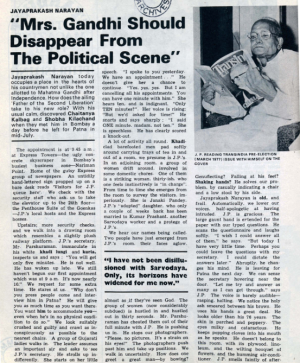
We hear our names being called. Two people have emerged from J.P.’s room. Their faces aglow, almost as if they’ve seen God. The group of women (now considerably subdued) is hushed and hustled off. The most eminent householder man has cheated them out of their audience with J.P. He is upstairs in an armchair propped up in a severe tilt. The photographers rush into the room like star-struck Spanish journalists in a cathedral. How does one greet a great man—by bowing? Genuflecting? Falling at his feet? Shaking hands? He solves our problem, by casually indicating a chair and a towel by his side.
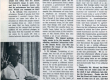
Jayaprakash Narayan is old, and frail. Automatically, we lower our voices, half-apologetic at having intruded. J.P. is gracious. The large gaunt hand is extended for the paper with our typed questions. He scans the questionnaire and laughs softly. “I wish I could answer all of them,” he says. “But today I have very little time. Perhaps you could leave the questions with my secretary. I could dictate the answers later.” Abruptly, he changes his mind. He is leaving for Patna the next day. We can sense the secretary hovering near the door. “Let me try and answer as many as I can get through,” says J.P. The voice is barely audible—rasping, halting. We notice the holy ash smeared between his brows. He uses his hands a great deal. He looks older than his 76 years. The skin is parched and peppery. The eyes milky and cataractous. He keeps popping cloves into his mouth as he speaks. He doesn’t belong to this room, with its plywood, linoleum, and the wilting bouquet of flowers, and the humming air-conditioner. J.P. smells faintly of after shave. We notice a bottle of Old Spice on the dressing table, alongside a framed portrait of a young J.P. with his wife Prabhavati Devi—he is obviously comfortable with the press, the photographers with their flashbulbs pouncing, the tape-recorder, and the inevitable notepad and pad. He has barely run through four questions when the secretary interrupts: “Please make the next question your last one.” We look imploringly at J.P. He holds up his hand to Mr. Parshuraman, and continues. The words come out unhesitatingly, fluently. He gestures, pauses, gives you an eye as you would “me” look. Suddenly, we can understand the J.P. magic, and realize how he moved the students in Bihar so much.
More questions. Once again Mr. Parshuraman interrupts, this time a little more resolutely. “Sir, a lot of people are waiting outside. Lady Jeejeebhoy is here.” The last name is pronounced loudly to stress how important the visitor is. We promise to ask our last and final question. The secretary stalks off and escorts Lady Jeejeebhoy in—he’s not taking any chances this time. J.P. takes his time to answer. Once again, he repeats his offer to dictate the remaining replies. We decline. We don’t trust the secretary.
We are firmly escorted to the elevator. The interview is over.
Transindia: How does it feel to be labeled the Mahatma of 1977, the father of the “second liberation?”
Jayaprakash Narayan: I hate this label “Mahatma of 1977”! I have no claim to be a Mahatma at all. I was a humble fighter for freedom, and tried to serve the people to the best of my capacity. I don’t know why this title “Mahatma” should be attached to me! I have no spiritual claims to it!
T.I.: Your political career has puzzled many observers. At one point, you were a committed Marxist. Later, you gave up Marxism and graduated to Gandhism. Your years with Sarvodaya however did not produce many tangible results. Were you disillusioned with Sarvodaya?
J.P.: Outwardly, my career seems to be a puzzle, but inwardly I have been pursuing the same goals which I had set before me when I was young, and that is, (a) the achievement of our country’s freedom and (b) the establishment of a socialist society. Socialism differs from country to country, but here, the socialism that I have in view has a great deal of mixture with Gandhism, particularly in the means it adopts. I don’t think socialism can be brought about merely by legislation, by nationalization and that kind of thing. Socialism has something to do with life, how one lives one’s life. And that means leading a simple life, leading one’s own life, not exploiting others, not taking advantage of others. That sort of mean one shouldn’t try to profit if one is in business or some such profession. But it should be tempered with justice.
I have not been disillusioned with Sarvodaya. The Sarvodaya movement has great prospects now. Only, its horizons have widened for me. You see. Sarvodaya means “uplift of all”, the good of all. Now, how can the disillusioned with such objective? That objective remains. Some people think it can be brought about by capitalistic development. Some think it can be brought about by socialism. Some think it can be brought about by communism. All these have been tried, and have failed. Now, Sarvodaya depends mostly on voluntary action, voluntary abnegation, voluntary distribution of property, and acceptance of a non-exploitative attitude. These objectives sound very idealistic, but it is not difficult to do; at least in India it can be done. So I am not disillusioned; I am still pursuing the goal, in different ways.
T.I. : What exactly made you return to active politics in 1972?
J.P. : Well. In 1972 when the firings took place (in Bihar) and I found that innocent boys had been injured and shot dead. I was ill at the time. in bed. I couldn’t resist it. I said I must now come forward, and plunge into the movement, and do what I can to help these young people. It started with a students’ movement, and then it developed into a people’s movement, and finally I gave it a name—the People’s Revolution. I was never in retirement. I was more active than when I had been in politics. Only, the field of activity was different at that time. I was busy at my Ashram: we had constructive programs there of cultural development and rural industries development. I think, when I look back, that I have no reason to be disappointed with what was achieved then. That movement is still going on.
T.I.: Had you visualised at the time of the Bihar agitation in 1974 that the movement initiated by you would one day lead to such a repressive counter-attack as the Emergency?
J.P.: I had never thought, during the Bihar agitation, that the reaction of the declaration of Emergency would come about. I do not think there was any reason for Mrs. Gandhi to believe that it was against her. The question of her resigning came about only after the Allahabad High Court judgement in June 1975. When the judgement was announced, we all said she ought to resign, and wait until the Supreme Court decided her appeal. She did a very wrong thing by not letting go of her office. She would have risen in the estimation of the people if she had bowed before the judgement, and had taken her chance at the Supreme Court.
T.I.: Do you foresee a comeback for Mrs. Gandhi, politically?
J.P.: Personally I think that her political career is over. I don’t foresee any comeback. And if the Congress Party doesn’t remove her from leadership, then I don’t think the Congress also will have a chance. They must have new leaders and must move forward. And Mrs. Gandhi must be made to realize that she has done enough harm, and that it’s better she disappears from the political scene.
T.I.: Do you think that it’s fair that Mrs. Gandhi is being given a preferential status? Why should she, an ordinary citizen, be treated above the law?
J.P.: I think the inquiry will lead to some conclusions. I don’t know. You see, once you know a person who has done you personal harm. But when it’s a question of the leader of a nation making a mistake, there should be no forgiving—of him or her. I think this idea of “forgive and forget” shouldn’t apply to a situation like this.
T.I.: Did the Emergency give you cause for frustration, for a sense of defeat, of having lost the battle before it had really begun?
J.P.: No. I didn’t experience a feeling of frustration when the Emergency was clamped down. In fact, there was a redoubled determination to fight against that as soon as I was freed from prison. I think the fact that our people voted for freedom, for democracy, was an inspiration for the whole world. I was in the United States recently for treatment, and people there were full of praise. President Carter also made public statements expressing his admiration for the rebirth of democracy in India.
T.I.: Are you satisfied with the manner in which the Janata Party has been functioning?
J.P.: I am satisfied with the formation of the Janata Party, and with the manner in which it has been functioning. At one time, I did feel disappointed at the failure of the (then) Opposition parties to unite. Now I think this unity will stay.
T.I.: Do you foresee a military takeover here in India on the lines of the recent coup in Pakistan?
J.P.: Why should there be a military takeover? That situation can never arise here.
T.I.: People are beginning to lose faith in the Janata Government because of the chaos, and the infighting in the party. There have been prophets of doom who predict that the Government won’t hold together for more than six months.
J.P.: I don’t think they need to be worried about the Janata Government or the Janata Party cracking up. There are differences, what you call infighting. But there is no fight for leadership of the Janata Party. Nobody wants to displace Morarji bhai from the leadership of the Party and the Government. That was a very good choice (the Morarji choice) and I take pride for making that choice, because the choice was given to me. and I felt it was good
to choose Morarjibhai to lead the country.
T.I.: During the time of the choice of the Prime Minister in March, it is said you imposed your choice (Morarji) on the Janata Party, and that there was a lot of resentment over this, leading later to bitter wrangling between Charan Singh and Jagjivan Ram for the No. 2 post.
J.P.: I don’t want to comment on this. I really don’t know what wrangling took place.
T.I.: What about our nuclear policy? There seems to be a contradictory statement in the newspapers today — the Prime Minister has declared that he is not in favor of testing nuclear devices even for peaceful purposes.
J.P.: Well, that is a slight deviation from the national policy so far. But personally, I approve of what Morarjibhai has said. I’m glad he has said this. Because you know the difference between peaceful use and warlike use of a potential weapon like nuclear power is not very great — it can be very easily turned into a dangerous weapon. Therefore we must keep away from this dangerous game.
T.I.: Don’t you think the only time India was taken seriously as a world power was when we exploded our nuclear device at Pokharan in 1974?
J.P.: I think we would be taken more seriously if we solved the problem of our poverty, and showed that we are making progress in education and standards of living. I don’t think the world is going to be impressed by our manufacturing a nuclear bomb. You see, in order to become a nuclear power, exploding only one bomb is not enough. One has to have resources which India just doesn’t have. This (bomb) is a plaything that India has produced: a dangerous plaything. We have no need for it, we should get out of that race completely. What constructive use can be made of nuclear power?
T.I.: The Nandini Satpathy case must have been a big rebuff to you from the Janata Party; apparently the people have rejected you (in the recent Assembly elections); and also your opposition to their candidate. Nor did the Janata Party agree with your views.
J.P.: I don’t want to concern myself with that incident !
T.I.: There is a trend to demythify Nehru these days; there have been several critical comments on him, there has been a digging up of the past. Do you think this trend should be encouraged, of attacking old national leaders?
J.P.: You see the role of historians and social scientists is to probe into the truth, and if it is not done with any malicious intent, to throw light on the past, and to understand our old leaders, there is no harm in it. There is of course anti-Nehru attitude in some quarters these days. But to understand Nehru better we should know what his virtues were, what his faults were. We as a people are apt to deify our leaders. To idolize them. Nehru was idolized for a long time. A certain amount of cutting to size, if that is done without any bad motive, is all right.
T.I. : Do you approve of the proposal to scrap the Bharat Ratna award, and the Padma awards?
J.P. : Well, in the sense that it creates distinctions and discrimination. Some sort of public recognition of outstanding work should be there, whether it is the Bharat Ratna or anything else. But this sort of award can be misused for political purposes. These titles may have been conferred on people who are not probably deserving of them. But if such recognition is taken out of the ambit of politics, and if there is some kind of public institution, and it evaluates and then awards these titles, then it is all right. Like the Nobel Prize, for instance. There is nothing wrong about it. It is not a favor conferred on anyone, it is only a recognition. So something like that should be done.