

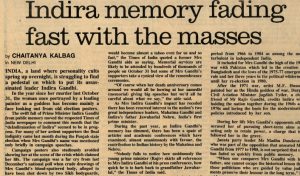
Indira memory fading fast with the masses
Published date: 30th Oct 1985, Mixed Paper Article
View PDFIn New Delhi
India, a land where personality cults spring up overnight, is struggling to find a pedestal on which to put its assassinated leader Indira Gandhi.
In the year since her murder last October 31, the woman once portrayed by a leading painter as a goddess has become mainly a face looking out from old election posters.
The swift fall of Prime Minister Indira Gandhi’s from public memory moved the respected Times of India newspaper to comment this month that “the “deIndiraisation of Indira” seemed to be in progress. For many of her ardent supporters the final indignity came last month during the Punjab state elections when Mrs Gandhi’s name was mentioned only briefly in campaign speeches.
Campaign posters also studiously avoided showing her at the scene of the crisis which claimed her life. The campaign was a far cry from last December’s national poll when crude drawings of Mrs Gandhi’s blood-spattered body, alleged to have been shot down by two Sikh bodyguards, helped elect her son Rajiv.
“Who could have imagined that her name would become almost a taboo even for us and so fast,” the Times of India quoted a former Mrs Gandhi aide as saying. Memorial services are likely to be attended by hundreds of thousands of people on October 31 but some of Mrs Gandhi’s supporters take a cynical view of the remembrance ceremonies.
“Of course when her death anniversary comes everyone would all be bowing at her samedhi (memorial) giving big speeches but we’d all be careful about what we say,” the aide said.
As Mrs Indira Gandhi’s impact has receded there has been renewed interest in the nation’s two great independence leaders, Mahatma Gandhi and Indira’s father Jawaharlal Nehru, India’s first prime minister.
During the past year, as Indira Gandhi’s memory has dimmed, there has been a spate of articles and academic conferences which have examined, almost unanimously with favour, the contribution to Indian history by the Mahatma and Nehru.
“Nobody fails to notice how assiduously the young prime minister (Rajiv) skirts all references to Mrs Indira Gandhi at his press conferences, how quick he is to hark back to grandfather Jawaharlal,” the Times of India said.
Mrs Indira Gandhi’s opponents judge her 15 years of rule — with a three-year gap — in the period from 1966 to 1984 as among the most turbulent in independent India.
It included for Mrs Gandhi the high of the 1971 war with Pakistan which led to the creation of Bangladesh and the lows of the 1975-77 emergency when her handpicked aides ruled virtually unopposed until her re-election in 1980.
After the 1971 war and Mrs. F. M. Hussain painted her as a Hindu goddess of war, Urban Civil Aviation Minister Jagdish Tytler, a close friend of Mr Rajiv Gandhi, eulogized her as one of the many Indian deities during the 1960s and 1970s and laying the base for the modernisation of the nation’s fight for her son.
During her life Mrs Gandhi’s opponents often accused her of pursuing a short-term aims and acting only to retain power, a charge that has followed het to the grave.
Janata party leader Mr Madhu Dandavate, who was part of the opposition that unseated Mrs Gandhi from 1977 to 1980, is not surprised that she has faded so quickly from public memory.
“When one compares Mrs Gandhi with her father, one cannot escape the historical lesson that those politicians who are guided by value judgments preserve their honour in the long term,” he said.
— Reuter







I don’t think the title of your article matches the content lol. Just kidding, mainly because I had some doubts after reading the article.
[5209]NN777 Casino Philippines: Best Slots, Fast Login, Register & App Download Experience the best of NN777 Casino Philippines! Play top-rated nn777 slot games with fast nn777 login and easy nn777 register. Get the nn777 download app now for 24/7 casino action. visit: nn777
[2459]188jili Online Casino Philippines: 188jili Login, Register, & App Download for Top 188jili Slots Experience 188jili Online Casino Philippines! Quick 188jili login, register, & 188jili app download. Play top 188jili slot games and win today. Join the best in PH! visit: 188jili
[2673]Experience the best of PHDream44: Easy login, register, and app download for top slot games and online casino action in the Philippines. Experience PHDream44: Easy phdream44 login, phdream44 register, and phdream44 app download. Play top phdream44 slot games at the best online casino in the Philippines. visit: phdream44
[808]666jili Online Casino Philippines: Top Slot Games, Easy Login, Register & App Download Experience the ultimate 666jili Online Casino Philippines! Play top-rated 666jili slot games with a seamless 666jili login and quick 666jili register process. Get the 666jili app download for mobile gaming on the go. Join the #1 online casino in the PH today for massive jackpots and secure betting! visit: 666jili
[5630]PH2: The Best Online Casino in the Philippines for Legit Slots and Seamless GCash Gaming Experience the ultimate gaming thrill at **ph2 online casino**, recognized as the **best online casino Philippines**. Offering a secure **ph2 login**, our platform features a massive selection of **legit online slots Philippines** and a wide variety of live dealer games. Enjoy the convenience of **GCash online gambling PH** for seamless, instant deposits and fast withdrawals. Join PH2 today—the most trusted destination for secure, fair, and high-paying casino action in the country! visit: ph2
[8166]Pinas777 Online Casino: Secure Login, Easy Register, Top Slots & App Download in the Philippines. Join Pinas777 Online Casino, the top choice for players in the Philippines. Experience easy pinas777 login, fast register, and premium pinas777 slot games. Get the pinas777 app download now for secure gaming and big wins! visit: pinas777
[1851]JILI178 Login & Register: Best JILI178 Slot & Casino Online in Philippines | App Download Experience the best JILI178 slot and casino online in the Philippines! Secure jili178 login and jili178 register for exclusive bonuses. Get the jili178 app download for 24/7 mobile gaming. Join the top-rated JILI178 casino online today and win big! visit: jili178
[4217]jii747: The Philippines’ Best Legit Online Casino & Official GCash Slots Welcome to **jii747**, the **Philippines’ best legit online casino** and the official home for high-payout **GCash slots**. Secure your **jii747 login official** today to experience **top-rated online gambling** featuring live dealers, sports betting, and the **best online slots Philippines GCash** integration. Join the most trusted **jii747 legit casino PH** platform for a safe, fair, and thrilling gaming experience with instant withdrawals. visit: jii747
[1608]100jili Casino: Secure 100jili Login & Register. Play Premium 100jili Slots and Get the Official App Download for the Best Philippines Gaming Experience. Experience 100jili Casino, the top choice for Philippines players. Secure 100jili login & register to play premium 100jili slot games. Get the 100jili app download today! visit: 100jili
[1891]PHDream: The Best Online Casino in the Philippines. Register, Login, and App Download for Premium Casino Slots. Experience PHDream, the top online casino in the Philippines. Register & login to play premium PHDream casino slots. Get the PHDream app download for elite mobile gaming today! visit: phdream
[8480]Experience the best at 777pnl, the top online casino in the Philippines. Easy 777pnl login and register process to enjoy premium 777pnl slots. Get the 777pnl app download now for 24/7 winning action! Join 777pnl, the top online casino in the Philippines! Enjoy easy 777pnl login and register access to premium 777pnl slots. Get the 777pnl app download for 24/7 wins. visit: 777pnl
Для бесперебойной работы программы необходим специальный хостинг хрумер https://www.olx.ua/d/uk/obyavlenie/progon-hrumerom-dr-50-po-ahrefs-uvelichu-reyting-domena-IDXnHrG.html с оптимизированными параметрами.