

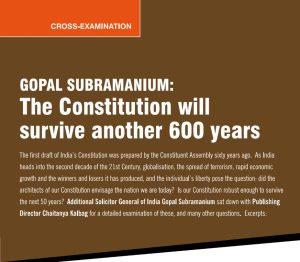
Gopal Subramanium – The Constitution will survive another 600 years
Published date: Halsbury's Law, Oct 2008
View PDFThe Constitution will survive another 600 years
The first draft of India’s Constitution was prepared by the Constituent Assembly sixty years ago. As India heads into the second decade of the 21st Century, globalisation, the spread of terrorism, rapid economic growth and the winners and losers it has produced, and the individual’s liberty pose the question: did the architects of our Constitution envisage the nation we are today? Is our Constitution robust enough to survive the next 50 years? Additional Solicitor General of India Gopal Subramanium sat down with Publishing Director Chaitanya Kalbag for a detailed examination of these, and many other questions. Excerpts:
HLM (Halsbury’s Law Monthly): Will the Constitution of 1950 endure until 2050?
Gopal Subramanium: Absolutely no doubt, it will survive. It is one of the most well-crafted constitutions I have read and it has lots of space, the dynamism to grow and the most fundamental and important principles have been enshrined in the document.
With fundamental principles such as republicanism, secularism, equality, fraternity, social, economic and political justice being the core values of the Constitution, it is not that we have to look for a new value or principle, which is outside the Constitution. These values will acquire different meanings at different points of time, but these values will still be governing values in any civilised country, even in 2050.
HLM: What are the three most likely reasons for radical constitutional change?
Subramanium: The most radical constitutional change which can happen is if terrorism continues unabated, so much so that the representatives of the people are compelled to revisit the Constitution, then it is possible that some provisions may have to be reviewed.
HLM: So are you talking of possible selective abridgement of personal liberty?
Subramanium: There may be a possible abridgement of certain liberties. It is possible to conceive of society adopting a slightly different model for its fundamental rights.
HLM: Do you think that the Directive Principles should become enforceable?
Subramanium: Directive Principles, even though they are not enforceable, are really the rules that inspire present governance and as long as governance is in accordance with those principles, I think it is more than adequate. The statement of Directive Principles is intended to see whether the conduct of government is normative and is based upon an underlying constitutionalism or a distinct principle which is relatable to the republican behaviour of governance.
HLM: Going back to the terrorism point, tell us what you think will have to happen in order to safeguard the safety and liberty of individuals, of law abiding citizens.
Subramanium: The view that I express is not as an Additional Solicitor General of India, I’m expressing my personal view as a constitutional lawyer. I do visualise that India may have to consider at some point of time moving towards the French model of pure republicanism, where religion is purely a private and a personal matter and nationhood or societal identity is primarily derived from being a member of a nation, a citizen of a nation and a part of a society. So the identity which the Indian Constitution has so carefully protected, namely the cultural identity, the religious identity, the religious beliefs of individuals, will now have to be reviewed in the light of the overall requirements of a republic and we may have to look at the French form of republicanism.
HLM: That does not necessarily mean curtailment of religious beliefs.
Subramanium: It does not mean curtailment of religious freedom, but it also will imply that there are no manifest ostentatious claims to identity based upon religion, the claim to identity will be based upon nationhood or based upon being a member of a society. It is important to note that the Indian Constitution permitted religious belief of whatever kind it be, so it is perfectly open to individuals to adopt scientific, rational, non-superstitious ways of life, and the scientific temper is one of the foundational values of the Directive Principles of State Policy. So we will have to see what is the scientific temper which our society will require to follow a few years hence, having regard to the fact that the ratio or the proportion between religious beliefs and practices and the good which it does to society may be severely distorted.
HLM: Would you recommend any changes to ensure that the Constitution remains in good shape until 2050?
Subramanium: I think politics will have to be converted into a proper, ethical and scientific profession, like many other professions are. The parliament may consider the amendment of the provisions of the Representation of the People Act to ensure that there are certain courses of instruction, study in the matter of political processes, political interaction and the degrees of transparency and accountability, which ultimately have to govern the relationship between those in power and members of civil society.
HLM: Would you recommend constitutional changes by amendment or incremental change through judicial interpretation?
Subramanium: I think the judiciary has gone the farthest in court and the time has come that the representatives of the people have to think it all out by themselves, and they have very serious positions of trust and responsibility. The future progress and the safety of a liberal, civilised democracy like India cannot depend upon clichés of the past. It will have to depend upon the dynamics of a new future and the future which belongs not only to those living, but the future of who are going to arrive.
HLM: How should the courts enforce social and economic rights to ensure social justice?
Subramanium: Social justice is indeed still a very primary concern for courts and I think that even now in relation to the areas of fundamental rights, access to education, access to employment, equality, de facto equality in terms of opportunity, the intervention of courts is not only justified but would be increasingly justified until we reach certain goal posts. For the purpose of understanding whether we have reached any goal posts, there will have to be logical methods of computing growth, access to opportunity, access to justice, access to employment and all the facilities that the State can offer. But this postulates that the State will be responsible for more than a modest offer in terms of basic facilities of health, safety, welfare and progress towards a constitutional way of life of its citizens. This is the fundamental point, which the State will have to take into account when it frames its educational policies, when it opens up educational institutions.
HLM: How do you see federalism evolving to accommodate centrifugal forces like secessionist or independence movements?
Subramanium: I think secessionist movements have to be psychologically and sociologically analysed and unless and until there are sufficient analyses of crime, of terror and about such secessionist movements, it will not be possible to tackle these problems as purely management problems or [by seeking] short term solutions. This again requires a very serious think. Any government, for the purpose of taking forward the Constitution, or keeping the Constitution as well as the Indian society alive, will have to be always a “thinking government”.
“It is not that we have to look for a new value or principle which is outside the Constitution, the existing values will acquire different meanings at different points of time, but will still be governing values in any civilised country, even in 2050”
HLM: How do you think the courts should Interpret secularism in the Constitution to ensure inter-communal harmony?
Subramanium: This is a fairly debatable area, but I would say that till now courts have always defined secularism as a proactive philosophy by which people who espouse one religious faith, respect the religious freedoms of other individuals, groups and denominations. But secularism also postulates, in a certain sense, that the government will be a-religious and would be religiously neutral. That is the fundamental assumption of secularism in a republican society governed by the Constitution. And I visualise that between the two quotients of individuals respecting each others’ rights, which has been the upper quotient of the court’s reasoning, may have to progress towards the other quotient, which is that the State is completely a religious and is religion neutral. It is really from that point that the State will be in a better position to know what the needs are that require subordination of individual beliefs to social requirements in terms of productivity, in terms of efficiency and above all in terms of occupational outlook. So I do visualise that the quotient may change.
HLM: You talked earlier about terrorism, but we also have Articles in our Constitution which enshrine individual freedom. Do you feel that Right to Property was justifiably taken out of the Fundamental Rights?
Subramanium: Yes, I think given the time and the need for our society to be taken forward, it was a correct dispensation of legislative will. We also have to bear in mind that our society has two extremes; it has the Forbes and Fortune billionaires and it has those who live below the poverty line. And those who live below the poverty line are no less than 40 percent of India’s population and for those living below the poverty line, the balance 60 percent of Indian society have a very high degree of responsibility. And it is in the way in which the 60 percent deal with the 40 percent that will measure India as a civilised, mature and forward-thinking society, even more forward than other societies, which have allowed capitalist and free market influences as the main staple of their economic activity.
HLM: Do you believe affirmative action on the basis of caste was the right way to go in terms of eliminating differences of caste in our society?
Subramanium: If the affirmative action based on caste was not taken by the government at the time when it was done, there could have been a very serious outburst of repression and feeling of anger that marginalised segments of society were not getting a fair share of recognition and honour in the constitutional scheme of equality of opportunity in governance. But this should never be a never-ending process. This must also be repeatedly reviewed, computed by objective criteria and decisions must be taken thereafter.
HLM: How should the Constitution be reinterpreted to ensure a more effective separation of powers between the organs of a State?
Subramanium: The separation of powers is in fact real in Indian democracy, there is no doubt. I do not think that any organ misunderstands the powers which it has or tries to usurp or trespass upon the powers of the other. My own belief is that if 50 years of the Indian Constitution have shown anything, it is that the judiciary has not trespassed into the authority of the legislature or the executive. While many of its decisions are criticised and invite comment that they are trespassing in other fields, I think this needs to be examined somewhat more closely because the criticism is completely specious, according to me. Where executive governance, as well as legislative activity is not sufficiently normative to deal with contemporary problems of society, then the judiciary, particularly the judiciary at the highest level, like the Supreme Court, which has plenary constitutional power, must intervene and has an obligation to protect the lives of citizens and enhance their lives and assure their dignity and quality. They have to speak for the people who are not able to directly speak. They actually have dual responsibility. They have to visualise what is the best which can be said in favour of the citizens and they then have to transpose themselves as judges and see what is the best which can be offered to the citizen and they have to achieve that through their directions. And I think that the judiciary is extremely conscious, but this is a very sensitive responsibility. It is not possible in today’s India…particularly where. sometimes executive apathy and [poor] governance can reach and assume frightening proportions. It is because of the Supreme Court’s intervention in many vital cases in this country that the social fabric has been preserved.
The judiciary is a sociological watchdog in my view; it is the sociological conscience of the collective civil society. So the judiciary is now no longer a mere interpreter of laws. It has I think a higher sanction from civil society to speak for it because civil society feels that this organ identifies itself with people more closely, It identifies itself with a fundamental human aspiration of every citizen that there must be some honesty, purity, rectitude and a feeling of aspiration in a civilised world. And once the court is able to show that it has connected itself to that momentum and that aspiration of people, of society at large, it has a moral sanction of society to be able to discharge its duties under the Constitution in a very unorthodox and somewhat special way…I think it is most welcome. The judiciary has access to all forms of knowledge and it is fully empowered to utilise different knowledge modules for arriving at conclusions which may be relevant for Indian society. This is the most exciting aspect which I see about the Indian legal profession and the judiciary, which is that in today’s world it is the courts which should be encouraged to have open-minded liberal thinkers as judges and the fact that many of the present day judges are liberal and broadminded in their approach and allow themselves to be influenced by contemporary, modern, scientific knowledge, including knowledge of non-legal subjects, is the greatest assurance that this is the safest way forward.
“The most radical constitutional change which can happen is if terrorism continues unabated, so much so that the representatives of the people are compelled to revisit the Constitution, then it is possible that some provisions may have to be reviewed.”
HLM: Do you have any other observations on the Constitution in general after 60 years of independence?
Subramanium: The Constitution in my view has survived 60 years; it will survive another 600 years, it is a very capable Constitution. The amendments have not robbed the Constitution of its basic structure. Fortunately the Supreme Court evolved this theory of basic structure, as a result of which today the legislatures respect that the Constitution cannot be mutilated. No amount of political legitimacy can offer legitimacy to mutilate the Constitution. Having said that, I must say that the sense of awareness of constitutionalism as the guiding principle for all the three institutions has to be stepped up. This would require conscious education; this would require transparency by the executive and the legislature, as well as by the judiciary. It is only when you promote these principles of transparency and accountability that you would find that the Constitution then becomes the testing barometer for any person to be able to assess how well the institutions have performed. Have they taken forward the rights or have they trampled on rights. Have they taken forward Directive Principles of State Policy or have they acted in regression of those Principles.
Gopal Subramanium, Additional Solicitor General of India, has been practising law for twenty-eight years. A former Standing Counsel for the Union of India in the Supreme Court, he has appeared in a large number of landmark cases, among them Counsel for the Justice Varma Commission on the Rajiv Gandhi assassination, Counsel for the Justice Wadhwa Commission on the Graham Staines murder, and Counsel for the Justice Venkataswami Commission on the Tehelka Tapes. He was appointed ASG in August 2005 and in the past three years has appeared for the Union Government in a string of important matters. He is also a member of the Advisory Panel on “Effectuation of Directive Principles” for the National Commission to Review the Working of the Constitution. He is an Adviser to the National Human Rights Commission, Member of the Governing Council of the Indian Law Institute, in 2007 he was also appointed a Member of the Committee for the Revision of Supreme Court Rules.



100jili Casino: Secure 100jili Login & Register. Play Premium 100jili Slots and Get the Official App Download for the Best Philippines Gaming Experience. Experience 100jili Casino, the top choice for Philippines players. Secure 100jili login & register to play premium 100jili slot games. Get the 100jili app download today! visit: 100jili
[8574]ff777 Online Casino Philippines: Quick Login, Register & App Download for the Best Slots Experience Experience ff777 Online Casino Philippines! Quick ff777 login, easy ff777 register, and top ff777 slot games. Get the ff777 app download now and win big today! visit: ff777
[2293]fill777 Online Casino Philippines: Official Login, Register, and App Download for Premium Slot Games Join fill777 Online Casino Philippines! Secure fill777 login, easy register, and premium fill777 slot games. Get the fill777 download for mobile app. The #1 fill777 online casino! visit: fill777
[4442]Jilibay Online Casino Philippines: Top Jilibay Slots, Easy Login, Register & App Download for the Ultimate Gaming Experience. Join Jilibay Online Casino Philippines for top Jilibay slots! Quick jilibay login, easy jilibay register, & fast jilibay app download. Play and win big today! visit: jilibay
[1593]Taya777: The Most Trusted Legit Online Casino and Best Slots in the Philippines visit: taya777login
[9601]8jl: Top Online Casino Philippines – 8jl Login, Register, & App Download for Best 8jl Slot Games Experience 8jl, the top online casino Philippines. 8jl register now for premium 8jl slot games. Easy 8jl login & 8jl app download for the best 8jl casino online action. Play & win today! visit: 8jl
[6626]Slotgo Philippines: Easy Slotgo Login & Register, Slotgo App Download, and the Best Online Slots & Casino Experience. Experience the ultimate gaming at Slotgo Philippines! Enjoy easy Slotgo login, fast Slotgo register, and the Slotgo app download. Play top-tier Slotgo online slots and access your Slotgo casino login for the best rewards and big wins today! visit: slotgo
[6913]88jili Online Casino Philippines: Fast 88jili Login & Register, Official App Download, and Premium 88jili Slot Games. Experience 88jili Online Casino Philippines! Fast 88jili login & register to play premium 88jili slot games. Get the official 88jili app download & start winning today! visit: 88jili
[3479]Pin777 Official: Secure Login, Register & Pin777 Slot App Download for Philippines Players. Experience premium online gaming at Pin777 Official. Access your secure pin777 login, complete a fast pin777 register, and explore the best pin777 slot games today. Enhance your experience with the pin777 download app, designed specifically for Philippines players seeking safe and exciting casino action. visit: pin777
[4507]Jili90: The Best Online Casino Philippines for Jili Slot Games and Easy GCash Cashouts. Jili90 is the best online casino Philippines for top-tier Jili slot games. Enjoy fast GCash online casino PH cashouts and the best online gambling Philippines experience today! visit: jili90
[4603]hay88 giris|hay88 download|hay88 register|hay88 slots|hay88 casino Experience the ultimate online gaming at hay88, the premier casino platform in the Philippines. Complete your hay88 register today to explore premium hay88 slots and live dealer games. Use hay88 giris for secure access and get the hay88 download for the best mobile hay88 casino experience. Join now for exclusive rewards and big wins! visit: hay88
[1789]jili777 app|jili777 casino|jili777 register|jili777 login|jili777 slots Experience the ultimate online gaming at Jili777 Casino, the Philippines’ premier destination for high-paying Jili777 slots and classic table games. Quick Jili777 register and seamless Jili777 login allow you to start winning instantly. Download the official Jili777 app today for a secure, mobile-optimized casino experience anytime, anywhere! visit: jili777
eyxwax