

Economy seen to continue growth, but political stability necessary
Published date: Mixed Paper Article
View PDFChaitanya Kalbag, Reuters
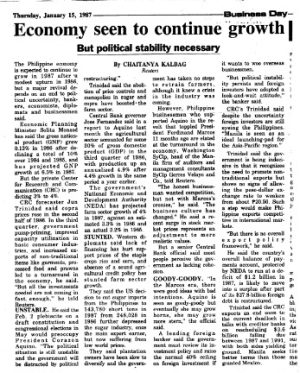
The Philippine economy is expected to continue to grow in 1987 after a modest upturn in 1986, but a major revival depends on an end to political uncertainty, bankers, economists, diplomats and businessmen said.
Economic Planning Minister Solita Monsod has said the gross national product (GNP) grew 0.13% in 1986 after declining a total of 10% over 1984 and 1985, and has projected GNP growth at 6.5% in 1987.
But the private Center for Research and Communication (CRC) is predicting 3% to 4%.
CRC forecaster Jun Trinidad said copra prices rose in the second half of 1986. In the third quarter, government pump-priming, improved capacity utilization in basic consumer industries, and increased exports of non-traditional items like garments, processed food and prawns led to a turnaround in the economy, he said. “But all the investments needed are not coming in fast. enough,” he told Reuters.
UNSTABLE. He said the Feb. 2 plebiscite on a draft constitution and congressional elections in May would preoccupy President Corazon Aquino. “The political situation is still unstable and the government will be distracted by political restructuring.”
Trinidad said the abolition of price controls and monopolies in sugar and copra have boosted the farm sector.
Central Bank governor Jose Fernandez said in a report to Aquino last month the agricultural sector accounted for some 30% of gross domestic product (GDP) in the third quarter of 1986, with production up an annualized 4.9% after 4.4% growth in the same period a year earlier.
The government’s National Economic and Development Authority (NEDA) has projected farm sector growth of 4% in 1987, against an estimated 3.3% in 1986 and an actual 3.2% in 1985.
STUNTED. Western diplomats said lack of financing has hurt support prices of the staple crops rice and corn, and absence of a sound agricultural credit policy has stunted farm sector growth.
They said the US decision to cut sugar imports from the Philippines to 143,780 short tons in 1987 from 248,028 in 1986 further depressed the sugar industry, once the main export earner, but now suffering from low world prices.
They said plantation owners have been slow to diversify and the government has taken no steps to retrain farmers, although it knew a crisis in the industry was coming.
However, Philippine businessmen who supported Aquino in the revolt that toppled President Ferdinand Marcos 11 months ago are elated at the turnaround in the economy, Washington SyCip, head of the Manila firm of auditors and management consultants SyCip Gorres Velayo and Co., told Reuters.
“The honest businessman wanted competition, but not with Marcos’s cronies,” he said. “The business culture has changed.” He said a recent surge in stock market prices represents an adjustment to more realistic values.
But a senior Central Bank official said most people perceive the government as lacking cohesion.
GOODY-GOODY. “In the Marcos era, there were good ideas with bad intentions. Aquino is seen as goody-goody but eventually she may grow horns, she may grow more stern,” the official said.
A leading foreign banker said the government must review its investment policy and raise the normal 40% ceiling on foreign investment if it wants to woo overseas businessmen.
“But political instability persists and foreign investors have adopted a look-and-wait attitude,” the banker said.
CRC’s Trinidad said despite the uncertainty foreign investors are still eyeing the Philippines. “Manila is seen as an ideal launching-pad for the Asia-Pacific region.”
Trinidad said the government is being indecisive in that it recognizes the need to promote non-traditional exports but shows no signs of allowing the peso-dollar exchange rate to weaken about 20.50. a step would make Philippine exports competitive in international markets.
“But there is no overall export policy framework,” he said.
He said the country’s overall balance of payments account, protected by NEDA to run at a deficit of $1.2 billion in 1987, is likely to move into a surplus after part of its $27.8-billion foreign debt is restructured.
Trinidad said the CRC expects an end soon to the current deadlock in talks with creditor banks on rescheduling $3.6 billion falling due between 1987 and 1991, with both sides yielding ground. Manila seeks better terms than those granted Mexico.







**mounja boost official**
MounjaBoost is a next-generation, plant-based supplement created to support metabolic activity, encourage natural fat utilization, and elevate daily energywithout extreme dieting or exhausting workout routines.
[6761]COD Slot Login & Register: Best Slot Gacor in the Philippines. Access COD Link Alternatif and Download APK for the Ultimate Casino Experience. Experience the best slot gacor in the Philippines at COD! Use our secure COD slot login or COD register today. Access COD link alternatif and the COD download apk for the ultimate casino experience and big wins. visit: cod
[3747]9sapp giris|9sapp casino|9sapp slots|9sapp login|9sapp app Experience the ultimate online gaming at 9sapp, the premier casino platform in the Philippines. Secure your 9sapp login today to explore a wide variety of 9sapp slots and live dealer games. Download the 9sapp app for a seamless mobile experience and enjoy fast 9sapp giris access to start winning anytime, anywhere! visit: 9sapp
[5338]42vipph Online Casino Philippines: Easy Login, Register & App Download for Top Slot Games Experience the best at 42vipph Online Casino Philippines! Quick 42vipph login & 42vipph register to play top 42vipph slot games. Get the 42vipph app download now! visit: 42vipph
[8166]Experience the Best Online Casino in the Philippines with Phtaya 63 Slot Games and More. visit: phtaya 63
[9841]Cashwin Philippines: Register & Login for top slots, exclusive casino bonuses, and the official Cashwin app download for the ultimate mobile gaming experience. Join Cashwin Philippines for the ultimate gaming experience! Access your account via Cashwin login or complete your Cashwin register today to enjoy top Cashwin slots and exclusive casino bonuses. Don’t miss out—get the official Cashwin app download for seamless mobile play and win big anytime, anywhere! visit: Cashwin
[7461]Solaire Online Casino Philippines: Access Solaire Login, Register today, and get the Solaire App Download for the best Solaire Slots experience. Experience the thrill of Solaire Online Casino Philippines! Access your Solaire Login, Register today, and get the Solaire App Download for the best Solaire Slots. visit: solaire
[3566]SLVIP Casino: The Best Philippines Slot Games, Easy Login, Register & App Download Experience SLVIP Casino, the home of top Philippines slot games! Fast slvip register and slvip login to start winning. Try your favorite slvip slot or get the slvip download app now for the ultimate mobile gaming experience. visit: slvip
[6720]The Philippines’ Premier Destination for Legit Online Casino Games and Betting visit: nustar online
[1481]Phwen Casino Login: Secure Phwen Register, Top Phwen Slots & Official Phwen App Download for Philippines Players. Experience the ultimate gaming at Phwen! Secure your Phwen register and Phwen login to enjoy top Phwen slots. Get the official Phwen app download for seamless mobile play in the Philippines. Start your Phwen casino login journey today for big wins and secure payouts! visit: phwen
[3536]PinasGems Online Casino: Secure Login, Easy Register & Top Slot Games. Download the App Now! Experience the ultimate gaming at PinasGems Online Casino. Enjoy secure PinasGems login, fast PinasGems register, and top PinasGems slot games. Download the PinasGems app now for the best mobile casino experience in the Philippines! visit: pinasgems
[4275]9ph Online Casino: Fast 9ph Login, Register & App Download for the Best Philippines Slot Games. Experience the ultimate 9ph Online Casino! Enjoy fast 9ph login, easy 9ph register, and a secure 9ph app download for the best Philippines slot games. Join 9ph today! visit: 9ph
Если требуется автоматизированная работа, можно база форумов для хрумера скачать и протестировать ее.
**backbiome**
Backbiome is a naturally crafted, research-backed daily supplement formulated to gently relieve back tension and soothe sciatic discomfort.