The Needle’s Eye
Can India fashion a policy to weather the existential crisis it faces?
Published date: 30th Sep 2019, The Economic Times
View PDFGreta Thunberg’s emotional speech at the UN Climate Action Summit on Sept 23 was followed by Donald Trump’s mocking tweet: “She seems like a very happy young girl looking forward to a bright and wonderful future.” But we all know that the 16-year-old Swedish schoolgirl-activist is right. The warnings are crowding in, fast and ominous.
“What is at stake is the health of ecosystems, wildlife, and importantly, the world we leave for our children,” said Ko Barrett, vice-chair of the IPCC.
Currently only 18% of rural households have water on tap. This is a cart before the horse challenge – how can you ensure universal water supply without water? India consumes more groundwater than the United States and China combined. I wrote recently about our vanishing groundwater and also the shocking evidence of the speed at which Himalayan glaciers are vanishing– which will lead to flooded rivers and more landslides.
In policymaking, the longest distance is between how it is and what you want it to be. This is true of India’s efforts to keep its promise to limit its contribution to global warming and trim greenhouse gas emissions by 33-35% by 2030.
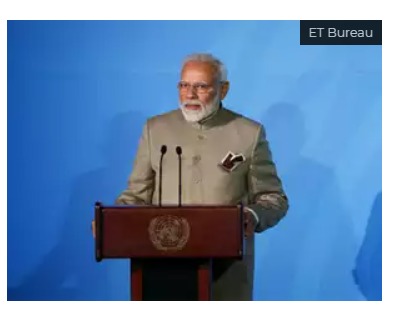
In his brief climate summit speech, Modi said India’s policy was need, not greed. “We believe that an ounce of action is worth more than a ton of preaching,” he said, adding that India was committed to expanding its non-fossil fuel renewable energy capacity to 175 gigawatts by 2022, and beyond that to 450 GW. He did not say by when, but industry experts say it is doable by 2030, if the government attacks it on a war footing.
Take solar panels. Last year, the Modi government abruptly imposed a 25% ‘safeguard’ duty on imports of solar panels from China and Malaysia; this is to be ‘diluted’ to 15% by March 2020. The duty has severely hit solar power providers. Then, the new Andhra Pradesh government headed by Y.S. Jaganmohan Reddy abruptly reneged on solar and wind contracts signed by his predecessor, asking for a halving of tariffs to Rs 2.44 per unit, making first-mover projects unviable. The AP High Court has set aside the swingeing cuts but ruled that the state regulator will have the final word. Tariff cuts should only go hand-in-hand with concessional loans for wind farms and solar parks– and the savings passed on to consumers. The trouble is, Vaibhav Chaturvedi of the Council on Energy, Environment and Water (CEEW) told me, 60% of a solar-power company’s costs now go towards servicing debt.
India urgently needs a robust, non-partisan, strategic framework for climate-friendly development; the mission should be headed by a powerful figure, possibly even a deputy prime minister said Leena Srivastava, Deputy Director-General designate of science at the Austria-based International Institute for Applied Systems Analysis.
Is Modi listening?