

Ajit Gulabchand – We create entrepreneurship against odds
[Business Today]
Published date: 19th Aug 2012
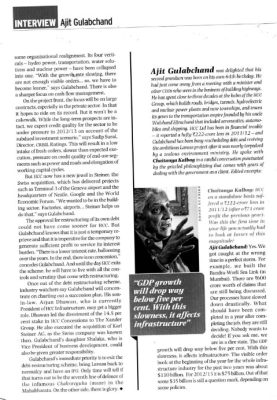
View PDFAjit Gulabchand was delighted that his second grandson was born on his own 64th birthday. He had just come away from a meeting with a minister and other CEOs who were in the business of building highways. He has spent close to three decades at the helm of the HCC Group, which builds roads, bridges, tunnels, hydroelectric and nuclear power plants, and now townships, and traces its genes to the transportation empire founded by his uncle Walchand Hirachand that included aeronautics, automobiles, and shipping. HCC Ltd. has been in financial trouble; it reported a hefty ₹222 crore loss in 2011/12, and Gulabchand has been busy rescheduling debt and reviving the ambitious Lavasa project after it was nearly torpedoed by a zealous environment ministry. He spoke with Chaitanya Kalbag in a candid conversation punctuated by the grizzled philosophizing that comes with years of dealing with the government as a client. Edited excerpts:
Chaitanya Kalbag: HCC on a standalone basis suffered a ₹222 crore loss in 2011/12 (after a ₹7 crore profit the previous year). Was this the first time in your life you actually had to look at losses of this magnitude?
Ajit Gulabchand: Yes. We got caught at the wrong time in a perfect storm. For example, we built the Bandra-Worli Sea Link (in Mumbai). There are ₹600 crore worth of claims that are still being discussed. Our processes have slowed down drastically. What should have been completed in a year after completing the job, they are still deciding. Nobody wants to decide! If you ask me, we are in a dire state. The GDP growth will drop way below five percent. The year for the whole infrastructure industry for the past two years was about $110 billion. For 2012713, it is $75 billion. Out of that, some $35 billion is still a question mark. Depending on some policies.
Are you still planning the Lavasa IPO, or is that permanently on hold?
Of course, it is not on permanent hold. Now, what we have done is look at various ways to restructure HCC’s debt because we couldn’t pay it back. So, we got that restructured through the Reserve Bank’s corporate debt restructuring process. Then we also got the Lavasa debt restructured and refinanced (in principle). In both cases, apart from restructuring, we have additional financing.
Are those numbers available?
Yes, all the numbers will be available. So, as a result, we don’t talk too much about it. In today’s atmosphere, everybody makes a noise about this. So, we decided not to discuss CDR (corporate debt restructuring).
What tenure has the CDR been done for?
Nine years. We will get out of it faster. We will then monetize some assets. We will collect some of these claims and pay them back. It should be possible. (Around the time the Lavasa clearances came through in November 2011) Indian banking went into a tizzy. So, getting your refinancing sorted out became a longer process than we imagined. To be very honest. Luckily, we could do this CDR in three months.
But you didn’t go for any FCB (external commercial borrowing) or foreign borrowing.
I didn’t want to. We returned our FCCB {foreign currency convertible bonds} just a year ago in 2011. We were not going to go for any additional funding. We were afraid of the currency risks. Wisely, as it turned out. We wanted rupees. And we found that there is no way out of this. This money that the government owes us is not coming in a hurry. There was no way to repay. So, looking at a way to realign the debt was very important. So, we got the restructuring of the Lavasa debt done. Now the formalities in this are being done. We don’t like to talk because every little thing becomes a big issue in the (news) tickers. “This has been done. Why was this done?” Then, 1 refused and said it’s a five-day story. I am going to recommend a ticker tax.
Are you selling any core assets to get more cash?
No. There are two issues. One is obviously, whether there was a DR or not, given the lean period that we are in, we have trimmed down. We had developed four or five verticals in the hope that each vertical would become the size of a company. Now, with the growth rate slowing down, there are not enough visible orders, so we have to become leaner.
What is your order book right now?
It is 15,500 crores.
What have you done to tighten cost management?
We have collapsed these verticals (into one) and made our organization lighter. We will focus on all large projects. The other cost-saving we are bringing about is in engineering. projects, large projects, and expand more into the private sector, doing the same thing in a more humble and concentrated way.
So, what advice do you have for those who come into this sector?
I say if anybody wants to invest in this country for the short term, six months, one year, two years, go home, go elsewhere. For those who want to look at this in the long run, stay here. It is not bad; it is tough initially. Look at JCB, the construction equipment company. They are the largest in India. They will go through this trouble.
What keeps you going?
See, this is the business I know. The most important thing is that I believe both these businesses, engineering construction and concession, as well as urban development, are the dire needs of Indian society, so they are bound to expand. So, you marry the ability to meet the need as well as to make money for your shareholders, but the public trust destroys it.” Ave heritage Walchand Hirachand. He was the founder of the transportation industry. He founded Hindustan Aeronautics, Hindustan Shipyard. He built Scindia Shipping. Automobiles. Construction. So, you come from a stock that has, against certain odds, created entrepreneurship and passion; it will start seeing that prosperity has to be brought in with speed if these people have to be kept satisfied.
Outside of Lavasa, what are the big things you are looking at
Lavasa is a very large project. The ultimate investment in it is 50,000 crores. HCC builds, construction or EPC, is a service industry. Concession is another way you own and manage assets. We now have about 37,000 crores worth of assets under management. These are roads in different stages of construction and operation.
There is a perception that the 2000s, when several huge infrastructure projects were launched, also triggered very large-scale corruption,
I do not dwell on the word corruption too much for one reason: are we having policies that go forward? When you see the word corruption, it is everywhere. The jails all over the world are increasingly filled with white-collar crime. I am not saying, therefore, that I support corruption; I am only saying that it doesn’t seem to be the reason why progress does not happen. Progress happens because of good policies and the creation of a market economy. The sad part about corruption is not the money that is lost, but the public trust it destroys. And therefore, it stalls decision-making. Because every time trust is destroyed, every decision maker wants to be sure that he is above board; “so I took my time,” time to tell the world he is kosher. And yet the public does not believe him because it has lost trust. This is the biggest danger of corruption, in my opinion.
However, a lot of policies lead to corruption. For example, the solution to certain types of corruption is to have plenty. When we were kids, we used to have a terrible time with milk. We used to stand in queues for milk. Milk adulteration was a daily occurrence. There was a shortage. The moment ‘Operation Flood’ started, India has been throwing away milk every day. Have you heard of milk adulteration? We don’t anymore. There is no price rigging of milk because it is so plentiful.







[5511]phmaya casino|phmaya app|phmaya download|phmaya slots|phmaya login Experience world-class gaming at phmaya casino, the premier online destination in the Philippines. Secure your phmaya login to access a massive variety of phmaya slots and exclusive rewards. For gaming on the go, complete your phmaya download and get the official phmaya app today for a seamless, mobile-optimized casino experience. visit: phmaya
[6917]patokbet download|patokbet register|patokbet slots|patokbet login|patokbet casino Experience the ultimate gaming at Patokbet, the #1 online casino in the Philippines. Register today for easy login access to premium Patokbet slots and live games. Secure your Patokbet download now and start winning big with the most trusted platform! visit: patokbet
[7744]711bet Official Site: The Leading 711bet Slot Online in the Philippines. Fast 711bet Login, Easy 711bet Register & Secure 711bet App Download. Experience the 711bet official site, the #1 711bet slot online in the Philippines. Enjoy fast 711bet login, easy 711bet register, and secure 711bet app download. visit: 711bet
[1187]Superwin Casino Philippines: Easy Login, Register & App Download. Play the Best Online Slots Today! Experience Superwin Casino Philippines! Enjoy easy superwin login, register, & superwin app download. Play premium superwin slots & enjoy the best superwin casino login. visit: superwin
[7168]Sinagph Online Casino Philippines: Easy Register, Login & App Download for the Best Slot Games. Experience the ultimate gaming at Sinagph Online Casino Philippines! Enjoy a seamless Sinagph register and Sinagph login process to play the best Sinagph slot games. Get the Sinagph app download today for secure, fast, and exciting casino action anytime, anywhere. Join the top-rated platform for Filipino players now! visit: sinagph
[1178]The Philippines’ Leading Official Online Slots and Casino Gaming Platform. visit: 98jili
[8344]PHL777 Online Casino Philippines: Easy Login, Register & App Download for the Best Slot Games Experience. Join PHL777 Online Casino Philippines for the best PHL777 slot games! Quick PHL777 login, easy register & secure app download. Play now and experience big wins! visit: phl777
[4963]ph789 app login&download visit: ph789 login
[5226]PHBingo Online Casino: Register, Login & App Download for the Best PHBingo Slots in the Philippines. Join PHBingo Online Casino for the best PHBingo slots in the Philippines. Easy PHBingo login & register. Get the PHBingo app download to start winning today! visit: phbingo
[5652]37jl Online Casino Philippines: Register & Login to Play 37jl Slots. Download the 37jl App Today for the Ultimate Gaming Experience! Join 37jl Online Casino Philippines! Easy 37jl login & 37jl register to play top 37jl slot games. Get the 37jl app download for the best mobile gaming experience. visit: 37jl
[5120]Newjili Login & Register: Best PH Casino Slot Games & Official App Download Experience the ultimate gaming at Newjili, the top PH casino! Complete your Newjili register to play premium Newjili slot games. Use Newjili login or Newjili casino login for secure access. Secure your Newjili app download and start winning big today! visit: newjili
Оптимизированный vps под хрумер https://www.olx.ua/d/uk/obyavlenie/progon-hrumerom-dr-50-po-ahrefs-uvelichu-reyting-domena-IDXnHrG.html значительно ускоряет процесс работы и снижает нагрузку на сервер.
Your point of view caught my eye and was very interesting. Thanks. I have a question for you.