

Aftermath of disastrous gas leak: doctors say thousands of survivors may never fully recover
Published date: Mixed Paper Article
View PDFChaitanya Kalbag, one of Reuter’s New Delhi-based correspondents, has returned to Bhopal to assess the long-term effects of December’s poison gas leak on the city and its population. Kalbag, aged 28, and a former award-winning writer with India Today magazine, covered the original disaster story.
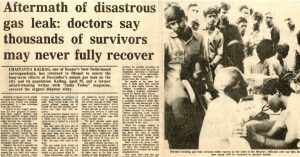
Hundreds of people stand outside the drab, white bungalow, clutching yellow X-ray folders and medical prescriptions, in a line stretching down the driveway.
A chorus of dry coughs punctuates the slow progress of emaciated men, ragged children, and ghost-like Moslem women covered from head-to-toe in veils and black robes, towards the verandah.
Half a kilometer to the east looms the reason for the setting up of this makeshift “hospital” in this central India city of Bhopal — the pesticide factory owned by the Indian subsidiary of the United States Union Carbide Company where a poison gas leak last December killed 2500 people.
Opposite the factory sprawls the shantytown of Jaiprakash Nagar where more than 800 people died among the huts built with canvas and wood from packing cases. Dozens of huts of owners who died or have fled stand empty.
Nearly four months after the world’s worst industrial disaster, the survivors are struggling to rebuild their lives, scarred by the lethal methyl isocyanate (MIC) gas that burst from a storage tank at the pesticide factory in December 3.
Gas victims trek in every day for medicine, X-rays, and urine and blood tests. It has become the centre of their lives since it was set up on January 13. There are always more victims needing attention than beds, and they rest on makeshift beds made of piles of red hospital blankets laid between the iron cots.
“Most of them stay for about two weeks and go away when they feel better,” says Dr. Shrinath Aggarwal. “But they have to return when the effects of the medicine wear off.”
Dr. M. M. Nanda, who oversees the hospital, says that about 600 people are treated in outpatient clinics every day. “More Victims and they all complain of major respiratory problems,” he adds. “They cannot walk even 100 meters without running out of breath. We can only continue medication and hope they will improve.”
In the hospital’s female ward a woman sits cross-legged, dressed in a white sari, her face drawn in agony as she is racked by a bout of coughing.
Bibi Jan, aged 30, says two of her five children died in the gas leak. “I have been in three hospitals since then and there is no improvement. I don’t know who will look after my other children if I die,” she says, with tears in her eyes.
The gas acted more slowly on other victims. In the next room a thin, dark boy lies fighting for breath as his parents stand by.
Gopal Khushwaha, aged 14, suddenly developed severe lung pains, his eyes reddened, and he could not walk. “Our lives have been destroyed by the gas,” says his father, Chhotelal.
The disaster has also disrupted the lives of survivors who do not go to hospital. In Jaiprakash Nagar’s dusty, fly-infested lanes, several men sit gloomily on the doorsteps of their huts as women and children wander listlessly under the fierce afternoon sun.
“I used to lift about 50kg of luggage at the railway station before the gas leak,” says a porter, Latif Khan, his cheeks covered with stubble. “Not now. So, I sit at home, selling firewood.”
Arvind Gupta, unable to return to his job as a construction worker, now sells ice on a nearby pavement. “My 11-year-old daughter Mamta was in hospital three times, but she has only got worse. She is at home now and only God can save her,” pointing to a little girl who lies covered with a blanket in the small one-roomed hut.
Most victims still suffer from …and cataracts, severe respiratory trouble, chronic loss of appetite, and severe damage to their windpipes and gastro-intestinal tracts. They have not been able to return to their old jobs as railway porters, construction workers or push-cart operators because their severely damaged lungs cannot cope with heavy manual work.
“We have already spent more than 10 million rupees ($1.75 million) on medical relief,” says Dr. M. N. Nagu, health services director of Madhya Pradesh state. “But hospitals have registered about 177,000 gas victims, and we do not know how many of them will be restored to normal health.”
The state’s Health Secretary, Dr. Ishwar Dass, says great anxiety is caused by about 3000 pregnant women. Doctors estimate about 500 of them were in the first three months of their pregnancies — the formative stage in which the fetus can suffer maximum damage when the leak occurred.
“A team of gynaecologists is carefully monitoring them to see if poisoned blood got past the placental barrier to cause genetic damage or lack of oxygen,” Dr. Dass says.
Dr. Abha Sahu, head of a new polyclinic near the pesticide factory, says that doctors face unforeseen problems with the mainly illiterate victims.
“We advise badly affected pregnant women to go in for abortions. Most of them refuse although they may already have other children,” she adds.
In the first weeks after the disaster, the victims were reported to have died as their lungs filled with fluids after they inhaled the methyl isocyanate gas. Now doctors say the deaths, and injuries to more than 177,000 people, may have been caused by cyanide released into their blood when they inhaled the gas.
Survivors have received injections Antidote for cyanide poisoning. In the clinic’s other room an array of equipment, including a blood-gas analyser and a urine spectrophotometer, monitors samples collected from the victims.
The results so far show that most of them have been rescued from a slow death, doctors say. “Sodium thiosulphate treatment has made a dramatic difference,” claims Dr. Suresh Bala Varma.
The drug reacts with cyanide deposits in the body to produce a harmless compound called thiocyanate that was discharged in the victims’ urine. “Even better results have emerged from our monitoring of blood samples,” Dr. Varma adds. “Before treatment most victims had alarmingly low oxygen levels in their arterial blood — between 30 and 50 per cent compared with the normal 90 per cent.
“Now, the oxygen content is slowly rising. At the same time, sodium thiosulphate is also bringing down the ratio of carbon dioxide in victims’ blood, which pre-treatment tests showed had shot up to twice the safe level.”
Each victim was given a daily injection of sodium thiosulphate for six days. The treatment is then spaced out to bi-weekly and weekly administrations.
“Our tests show that the gas victims’ blood was not sufficiently oxygenated,” she says. “People who could not walk even a few paces without stopping exhausted are showing signs of improvement.”
But Dr. Varma says that little hope is held out of repairing the tissue of the victims’ lungs, damaged when they sucked in methyl isocyanate as they fled from the poison gas on the night of the disaster.
Dr. Dass says the fight to save the lives of the survivors has been hindered by a lack of information on the reactions triggered by methyl isocyanate in the body. Other doctors agree.
Dr. Dass says that two days after the gas leaked on December 3, Union Carbide doctors said methyl isocyanate poisoning produced lung damage and acute respiratory distress and had recommended treatment with oxygen, cortisone steroids to revive tissue, and bronchodilators to re-open blocked lung passages.
“More victims did not improve.
“It was only when people continued to die days after the leak that we realised that something else was causing damage in victims’ bodies.”
The first suggestion of cyanide poisoning came from Dr. Hresik Chandra, head of the department of forensic medicine and toxicology at Bhopal’s Gandhi Medical College. His team performed autopsies on more than 300 gas victims. “Even autopsy surgeons were affected by methyl isocyanate trapped inside the bodies,” Dr. Chandra says.
“Every victim had unnaturally cherry-red coloured blood,” and the bodies themselves were pink and showed no signs of cyanosis — the bluishness commonly associated with death. They were signs that clearly pointed to cyanide poisoning.”
His suspicions were reinforced when survivors exhibited every symptom of chronic cyanide poisoning listed in toxicology manuals — dizziness, weakness, lung congestion, conjunctivitis, and weight and appetite-loss.
survivors with sodium thiosulphate started only in mid-February, two months after the gas leak.
Dr. S. Sriramachari, director-general of the Indian Council of Medical Research, says that in the absence of precise clinical data on methyl isocyanate, the only clues available were found in Union Carbide’s technical literature.
A manual on the lethal chemical issued by the company described a thermal decomposition, which occurred when methyl isocyanate leaked into a methyl isocyanate storage tank at the factory, “may produce hydrogen cyanide, nitrogen oxides, carbon monoxide and/or carbon dioxide.”
“We still do not know how methyl isocyanate is stored inside the body, where it is stored, and how it keeps refilling the ‘cyanogen pool’ leading to fresh respiratory attacks. We are conducting tests to find out.”
Dr. Varma says that about 2000 survivors have been treated with sodium thiosulphate over the past month but results so far do not guarantee a permanent cure. Dr. Dass says that Madhya Pradesh state estimates that about 10,000 people have permanent respiratory problems which will need long-term treatment.
The chairman of Union Carbide, Warren Anderson, said last month that sabotage, or serious safety lapses by the Indian subsidiary, could not be ruled out in the leak.
Indian authorities have rejected Mr. Anderson’s remarks, saying they appear designed to reduce the United States company’s liabilities.
Union Carbide faces dozens of lawsuits in United States courts claiming compensation worth billions of dollars for the gas victims. The lawsuits are scheduled to come up for a pre-trial hearing in a New York court on April 16.
India has said it is prepared to go in for an out-of-court settlement of Union Carbide offers generous terms. The Madhya Pradesh law secretary, Abdul Qureshi, says that law just passed by the Indian Parliament could aid an out-of-court settlement.
The law allows the Indian Government to take over all litigation on behalf of the gas victims and supervise the speedy distribution of compensation.
Mr. Qureshi says more than 2000 local lawsuits had been filed in Bhopal against Union Carbide’s Indian subsidiary. “Over 200,000 gas victims have registered with us for free legal aid.” he adds.
“The only way Union Carbide can buy peace is to quickly finalise the compensation issue directly with the Indian Government. That is the only way the survivors can start piecing together their shattered lives.”








PHDream: The Best Online Casino in the Philippines. Register, Login, and App Download for Premium Casino Slots. Experience PHDream, the top online casino in the Philippines. Register & login to play premium PHDream casino slots. Get the PHDream app download for elite mobile gaming today! visit: phdream
[4876]Jilimacao Casino Online Philippines: Quick Login, Register & App Download for Premium Slots Gaming. Experience premium gaming at Jilimacao Casino Online Philippines! Enjoy top Jilimacao slots, quick Jilimacao login, and easy Jilimacao register. Start your Jilimacao app download now for the ultimate mobile casino experience. visit: jilimacao
[8180]sbet77 slots|sbet77 app|sbet77 casino|sbet77 giris|sbet77 register Experience the ultimate gaming thrill at sbet77, the Philippines’ premier destination for online sbet77 casino action. Play a wide variety of sbet77 slots, download the official sbet77 app for mobile convenience, and enjoy seamless sbet77 giris access anytime. Don’t miss out—complete your sbet77 register today to claim exclusive bonuses and start winning big with the most trusted platform in the PH! visit: sbet77
[7527]lodi777 register|lodi777 app|lodi777 casino|lodi777 slots|lodi777 login Join lodi777 casino, the Philippines’ premier gaming hub! Complete your lodi777 register, access your lodi777 login, and enjoy top-tier lodi777 slots. Download the lodi777 app for a seamless mobile experience and start winning today! visit: lodi777
[5308]747ph Online Casino Philippines: Easy Login, Register & App Download for Top-Rated Slot Games. Join 747ph Online Casino, the top choice for players in the Philippines! Enjoy fast 747ph login, easy 747ph register, and 747ph app download. Play premium 747ph slot games today! visit: 747ph
[6721]7signs Casino Philippines: Quick Login & Register Online. Download the 7signs App for Top Slot Games and Exclusive Casino Bonuses. Experience the best at 7signs Casino Philippines! Quick 7signs casino login & 7signs register online. Download the 7signs app for top 7signs slot games and claim your exclusive 7signs casino bonus today. visit: 7signs
[8753]cow888: The Best Legit Online Casino Philippines for GCash Slots & Official Gambling. Experience cow888, the best legit online casino Philippines for premier online gambling with GCash. Access the cow888 official website for a secure login and the most popular Philippines online slot games. Join the top-rated cow888 online casino Philippines today for a safe and official gaming experience! visit: cow888
[5333]JiliLuck Online Casino Philippines: Official Login, Register & App Download for Top Slot Games. Experience JiliLuck Online Casino Philippines! Secure jililuck login and jililuck register for top jililuck slot games. Get the jililuck app download for big wins today! visit: jililuck
[7122]Jilicc Online Casino Philippines: Premium Jilicc Slot Games, Easy Jilicc Login & Register. Get the Official Jilicc App Download Today! Experience Jilicc Online Casino Philippines! Enjoy premium Jilicc slot games with a seamless Jilicc login and register process. Get the official Jilicc app download today for the ultimate gaming experience and big wins! visit: jilicc
[9551]The Philippines’ Premier Destination for Online Casino Games and Sports Betting. visit: okbet15
[3433]SS7777 Login, Register & Slot Games: Download the SS7777 Official App for the Best Casino Experience in the Philippines. Join SS7777 for the best casino experience in the Philippines! Quick ss7777 login & register to play ss7777 slot games. Download the ss7777 official app now and win big today! visit: ss7777
[5911]077pub Official Site: Best Online Slots in the Philippines. Quick 077pub Login, Easy Register & Official App Download. Join 077pub Official Site, the #1 platform for online slots in the Philippines. Experience fast 077pub login, easy 077pub register, and the official 077pub app download. Play premium 077pub slots and win today! visit: 077pub