A Nobel for Cancer Researchers – Prize Honors Discoveries on What Can Go Wrong in Cell Division
Published date: 9th Oct 2001, International Herald Tribune
View PDFCompiled by Our Staff From Dispatches
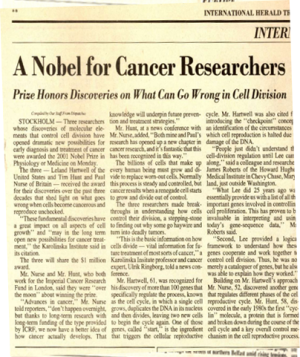
STOCKHOLM – Three researchers whose discoveries of molecular elements that control cell division have opened dramatic new possibilities for early diagnosis and treatment of cancer were awarded the 2001 Nobel Prize in Physiology or Medicine on Monday.
The three Leland Hartwell of the United States and Tim Hunt and Paul Nurse of Britain received the award for their discoveries over the past three decades that shed light on what goes wrong when cells become cancerous and reproduce unchecked.
“These fundamental discoveries have a great impact on all aspects of cell growth” and “may in the long term open new possibilities for cancer treatment, the Karolinska Institute said in its citation.
The three will share the $1 million award.
Mr. Nurse and Mr. Hunt, who both work for the Imperial Cancer Research Fund in London, said they were “over the moon” about winning the prize.
“Advances in cancer,” Mr. Nurse told reporters, “don’t happen overnight, but thanks to long-term research with long-term funding of the type provided by ICRF, we now have a better idea of how cancer actually develops. That knowledge will underpin future prevention and treatment strategies.
Mr. Hunt, at a news conference with Mr. Nurse, added, “Both mine and Paul’s research has opened up a new chapter in cancer research, and it’s fantastic that this has been recognized in this way.
The billions of cells that make up every human being must grow and divide to replace worn-out cells. Normally this process is steady and controlled, but cancer results when a renegade cell starts to grow and divide out of control.
The three researchers made break-throughs in understanding how cells control their division, a stepping-stone to finding out why some go haywire and turn into deadly tumors.
“This is the basic information on how cells divide vital information for future treatment of most sorts of cancer,” a Karolinska Institute professor and cancer expert, Ulrik Ringborg, told a news conference.
Mr. Hartwell, 61, was recognized for his discovery of more than 100 genes that specifically regulate the process, known as the cell cycle, in which a single cell grows, duplicates the DNA in its nucleus and then divides, leaving two new cells to begin the cycle again. One of those genes, called “start,” is the ingredient that triggers the cellular reproductive cycle. Mr. Hartwell was also cited for introducing the “checkpoint” concept, an identification of the circumstances in which cell reproduction is halted due to damage of the DNA.
“People just didn’t understand the cell-division regulation until Lee came along,” said a colleague and researcher, James Roberts of the Howard Hughes Medical Institute in Chevy Chase, Maryland, just outside Washington.
“What Lee did 25 years ago was essentially provide us with a list of all the important genes involved in controlling cell proliferation. This has proven to be invaluable in interpreting and using today’s gene-sequence data,” Mr. Roberts said.
“Second, Lee provided a logical framework to understand how these genes cooperate and work together to control cell division. Thus, he was not merely a cataloguer of genes, but he also was able to explain how they worked.”
Building on Mr. Hartwell’s approach, Mr. Nurse, 52, discovered another gene that regulates different phases of the cell reproductive cycle. Mr. Hunt, 58, discovered in the early 1980s the first “cyclin” molecule, a protein that is formed and broken down during the course of the cell cycle and a key overall control mechanism in the cell reproductive process.
Leland Hartwell, above, and Paul Nurse and Timothy Hunt, at right, on Monday shared a Nobel Prize for cancer research.
“Most biomedical research areas will benefit from these basic discoveries, which may result in broad applications within many fields,” the citation said.
The discoveries are of particular importance in understanding how normal cells can suddenly develop into cancer — the essence of defective control of the cell cycle.
“The findings in the cell-cycle field are expected to be applied to tumor diagnostics,” the citation said. “The discoveries may form the basis of new principles for cancer therapy,” and clinical trials related to the laureate’s research are already under way.
Mr. Hartwell currently works as the chief executive of the Fred Hutchinson Cancer Research Center in Seattle, Washington.
In a 1998 radio interview, he discussed his ground-breaking work and said he believed it could open both an exciting — and a bit of a scary — future.
“The exciting side is we’re going to have a lot better drugs and with a lot less side effects,” Mr. Hartwell said then.
“The scary side of it is that there’s going to be a drug for almost anything. And I’m a little concerned about our ability as a society to use the power of new agents that will become available in a wise way. We’re a relatively ill-prepared society.”
The three men will receive their prizes, along with the other Nobel laureates, from Sweden’s King Carl Gustaf at the official ceremony in Stockholm on Dec. 10, the anniversary of the death in 1896 of the prizes’ creator, the Swedish scholar and inventor Alfred Nobel.