The Big Squeeze
[Business Today]
Published date: 10th Dec 2012
View PDFFrom the Editor
Turkmenistan’s “President for Life” Saparmurat Niyazov erected a 50-ft gold-plated statue of himself in the centre of the capital Ashgabat, eight years before he gave immortality the slip in 2006. The statue rotated through the day, always pointing to the sun. We have noted the gold-plating stage yet, but we certainly know something about cults of personality in India, from the giant cut-outs of politicians in Tamil Nadu to the statuesque Mayawati. Not long after this edition of Business Today appears on news stands, Narendra Modi is likely to be voted back to power in Gujarat for the third time running. Modi has used the power of communication and the Internet to aggrandise himself in a manner unmatched in India. Whether it is his website, his blog, the NaMo television channel funded by the Bharatiya Janata Party, his constant national media visibility, or the Google+ hangout—you should see it to believe it!—and even his 3D holographic image appearing simultaneously in ghostly splendor at election rallies across the state, you will find a good story in anything Modi does. This week, as campaigning wound up in a dozen towns and cities, gold-plating is likely to take place! The Tush Pursuit (the rich man application borrowed by his swooning followers from Sardar Patel) becomes your prime minister. There is now a NaMo-clone of modest wealth and BJP’s third-term campaigner boots stuck in aching Converse shoes that give you the aura of a younger Modi, but not his achievements of the past 11 years. You could find yourself genuflecting towards Gandhinagar before you know it. Under assault from Modi’s relentless publicity machine, it is quite rare to see a state benefit from an economic sense. Associate Editor Sebastian P.T. tries to go beyond image to take a closer skin tone page 34. Gujarat’s economy, of course, is not a one-man show like Turkmenistan. Fifteen years ago, I was listening to Modi’s victory speech after he trounced wildly. Delhi Park friends talk about how he was investor-friendly. Adani Exports and the state government had just taken advantage of the Internet glut. Staff photographer Mandar Deodhar captures the khadi-kurta sharpness of a man who pioneered an IIT Internet campaign in the state. So yes! You got to remember that Gujarat did favor reform—the cows, not quite, but the milk. Modi’s fame also landed in New York and that is where it should stay when he said: “Whichever party wins power, we must identify the chief minister, industrialisation will happen,” and entrepreneurs will not be affected by change of leadership.”
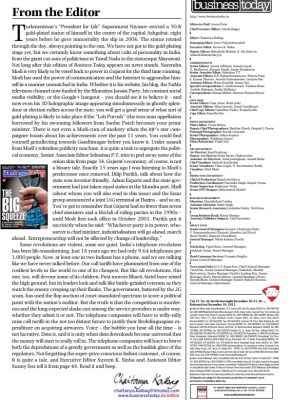
Some revolutions are violent, some are quiet. India’s telephone revolution has been life-transforming. Just 15 years ago we had 60 lakh telephones. Now, at least one in two Indians has a phone, and we are talking 1.000 million new users. Our call tariffs have plummeted from one of the highest in the world to the lowest. Entrepreneurs have walked across the hot, high ground, but its leaders look and act like warbled-jawed veterans they became in battles against old thinking. The government, Bharat and the 2G mess have tried to cap it. But the truth is that the competition is rudderless, like the ends of a shoelace. Our research and the new surge in policymaking is optimistic and action-fuelled. But while companies will use their 1.000 million users to woo those future to justify their Bloomberg activity, many will fall by the wayside. On the technological scale it is quite similar to a 3G sprint—more players, more expensive handsets and the usual mix of low-value and high volume. The action encapsulates the value of this fortnight’s cover package on the Indian telecom challenge with just a little bit of a satire, and Executive Editor Suveen K. Sinha and Assistant Editor Sunny Sen tell it from page 48. Read it and beep.