

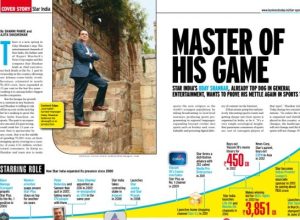
Master Of His Game
[Business Today]
Published date: 7th Jul 2013
View PDFStar India’s Uday Shankar, already top dog in general entertainment, wants to prove his mettle again in sports TV
There is a new spring in Uday Shankar’s step. The entertainment channels of Star India, the Indian unit of Rupert Murdoch’s News Corp empire and the company that Shankar leads as chief executive, are back firmly at the No. 1 spot by viewership in the country elbowing out Johnny-come-lately rivals. Revenues, estimated at nearly 6,400 crore, have expanded at 25 per cent in the last five years – vaulting it to among India’s biggest media companies.
But the hunger for growth is a constant in any business and Shankar is willing to risk all his success on the next big bet he’s making to grow the Star India franchise: on sports. The punt is an expensive one and, if it goes wrong, could crash his 23-year career that is spectacular by any count. Star is in the middle of spending `5,000 crore on bootstrapping sports viewing in a country of some 650 million cricket- crazed consumers. In doing so, Shankar and team aim to make sports the new religion in the world’s youngest population: by taking broadcasting to local-level tourneys; producing sports programming in regional languages; expanding beyond cricket into sports such as hockey and, even, kabaddi; and powering digital delivery of content via the Internet.
If that means going beyond passively telecasting sports events and getting deeper into how sports is organised in India, so be it. “It’s a very simple sociological insight, that passionate consumers of sports are, sort of, surrogate players of
that sport,” Shankar told Business Today during two extensive conversations. “So unless the way sports is organised and distributed and played in this country, unless that changes, the landscape of sports will not change and the business of sports will not change. We are hoping to work with the sports authorities and the boards, to make local sports popular. If we fail to do that, then our punt will be wasted.”
What’s in it for Star that runs 28 channels in India? Shankar concedes a big structural weakness in Star’s India success story is that a disproportionate share of its viewers is female. The female viewership on Star’s channels was as high as 70 per cent in 2010. “Sports was the offshoot of thinking about ways of getting the male audience,”
Shankar, 50, says. “Women like to consume drama, but for the male audience, their primary source of content consumption is movies, news and sports.” Star fixed its movies handicap in 2012 with the buy-out of Viacom 18’s movies library and a renewed push with the launch of its Movies Ok channel as well as a raft of regional channels for cinema.
Today, excluding sports, the composition of Star’s viewers is roughly 48 per cent female and 33 per cent male; the rest of the audience is children. With sports, say company insiders, it hopes to correct that ratio to 42 per cent female and 38 per cent male. A young male viewership adds appeal to advertisers selling to that audience. “Sports targets the young male group, a category which the automobile companies and the telcos prefer to target. By investing in sports, Uday has captured the entire TV watching universe as well as all kinds of advertisers,” says Shashi Sinha, CEO, IPG Media- brands, which buys space or airtime on be- half of its advertiser clients.
The hard-nosed drive into sports is expected to add fat revenues at Star I n d i a . T h e sports business of six channels, currently housed under a company called ESPN Software India and accounting for about 20 per cent of the Star Group revenues in the country, will be brought into the Star India fold soon. Sports revenues are expected to accelerate and grow about 30 per cent annually in the next two to three years.
To be sure, the increased spending on sports will dent profits at Star India. Vivek Couto, Executive Director of Media Partners Asia, a Hong Kong-based media consultancy, says Star India, which has in the past enjoyed operating profit margins of 30 per cent, will find profits under pressure for the next two-three years because of the additional investment in sports. Shankar keeps away from the numbers (Star India is not listed and it is not obliged to make financial numbers public) and is modest when he talks about breaking even on S t a r I n d i a ’ s sports bet: “It’s a long-term investment; it will take a few years.”
The Boy from Patna
Sussing up Shankar is important to understand the strategy he has crafted for Star and, while doing so, first discount his modesty. He’s won most of the battles since taking over the reins at Star India in May 2007. He’s lost a few, too: he talks about how he was worried about retirement when he travelled to New york for a review with Murdoch and other senior News Corp executives of the disastrous Kya Aap Panchvi Pass Se Tez Hain show in 2008. What he inherited was hardly something anyone could envy. “The top 170 people walked out with the two former stars of the system. He was left with a skeletal team and he has, to his credit, proven ground on many fronts,” says Paritosh Joshi, former CEO of Star-CJ Network, Star India’s home shopping channel. Joshi is referring to the exit of Peter Mukerjea, then Star Group CEO, and Sameer Nair, Star Entertainment’s CEO.
As Star India CEO, Shankar came into a market set to change: 2008 was a tough year for Indian television when a rash of entertainment channels such as NDTV Imagine, 9x and Colors were launched. One of them, Colors, stole the thunder pushing Star Plus, the flagship Star channel briefly to No. 2 by viewership. That was also the first summer when the Indian Premier League cricket tournament, better known as IPL, debuted. A big believer in regional markets, Shankar finalised the majority acquisition of Asianet Communications, a leading Kerala television company, in April 2008, and used it as a springboard into the Karnataka market. This was followed by the launch of Star Jalsha, in September 2008, to address the Bengali-speaking market and next in line was the Marathi general entertainment channel, Star Pravah, the same year. Virtually, all the launches and acquisitions hit pay dirt. Channel [V], too, climbed out of the morass it had slipped into, and staked its claim to the No. 1 spot in 2012. “He has re-arranged the deck very well,” says Mukerjea of his successor. What has emerged is a Star
India that is well diversified with revenues spread out among its channels. “Dependence on our flagship channel (Star Plus) has been reduced to 45 per cent from 74 per cent in the heydays of even the K-serials,” says Sanjay Gupta, Star
India’s Chief Operating Officer. By K-serials he is referring to the family drama programming – the popular ones were Kyunki Saas Bhi Kabhi Bahu Thi and Kahani Ghar Ghar Ki – that was the big draw on entertainment channels in the last decade until 2008, when Shankar decided to pull the plug on them because they made Star’s programming look dated. Regional advertising makes for about 25 per cent, Hindi movie channels 11 per cent, English entertainment channels 12 per cent, and other channels around seven per cent.
In the programming refresh, Shankar’s experience with content programming – he started his career as a reporter at The Times of India edition in Patna, a city he grew up in – shone through. Atul Phadnis, Founder and CEO of TV guide company What’s-On-India, says he admires “the ruthlessness or brutality with which (Shankar) threw out the K-serials… that had become impossible under former heads”.
As he went around dusting up the company, Shankar rejigged his team, bringing in top managers with backgrounds in telecom and consumer goods. Gupta worked with Hindustan Unilever for 16 years and then Bharti Airtel. Nitin Kuckreja, the head of the sports broadcasting business, comes from Morgan Stanley. Anita Maheshwari, who runs the human resources function in a company of 1,400 people, comes from the insurance sector.
Legal head Deepak Jacob is from eBay. Such a team has allowed Shankar to take many cutting-edge decisions such as being the first broadcaster to launch high definition (HD) feeds or offering regional content in the sports genre.
People who have watched Shankar say he is unafraid to experiment. An M.Phil in Economic History from Jawaharlal Nehru University, New Delhi, Shankar had a quick succession of jobs after his stint at The Times of India . “Anything new interests me. Television was just starting and I just decided to quit my job and explore this medium. My wife supported me for seven months, when I had no job and was struggling,” he says of his shift into TV in 1995 when he joined Zee. One of his sub-sequent jobs was with the Aaj Tak and Headlines Today channels, both part of the India Today Group that also publishes Business Today. He stepped into the News Corp. empire as Editor and CEO of Star News, which operated as a 26:74 joint venture between Star and the Kolkata-based ABP Group. Star exited that venture in 2012, selling its stake to ABP – a decision made by Shankar as Star India’s helmsman. “We are clear that if we have no say in the management and ability to determine the destiny of a venture, we will not stay in it,” he says.
Let’s Play
Star India’s strategy on sports shows its – and Shankar’s – obsession with being in control of its destiny. Even if it comes with an expensive tag: it is paying the Board of Control for Cricket in India (BCCI, the body that runs cricket in the country) `3,851 crore for broadcast rights until 2018, and it plans to invest `1,000 crore to develop its sports business. This doesn’t include the $335 million last year (about `1,675 crore then) that News Corp paid for Disney’s 50 per cent stake in the ESPN Star Sports joint venture – a key plat- form for its splash into sports. Nor the `100-crore Star paid for ground rights in the IPL tournaments.
Some context behind the strategy first: sports in most developed markets constitutes almost a quarter of the total TV viewing and revenues.
while in India it is just two per cent. “We realised that most channels merely put live content on television and then slept over it. There was no meaningful content created to keep the buzz alive,” says Star India COO Gupta. A school-level hockey player, he believes there is a sports fan in almost every Indian.
“This is make or break for Uday,” says an industry observer. Advertising on sports is worth about
`4,000 crore annually, of which cricket commands a 90 per cent share. The BCCI deal ensures Star will get a share of that pie – the rights to the popular IPL are with MSM India which broadcasts Sony and SET MAX channels – even if it forks out `42 crore a match starting this year. The deal, for six years to 2018, covers 96 matches, including
all the international matches India plays at home and local tournaments such as Ranji Trophy, Duleep Trophy and Irani Trophy. Barring that it also has rights for the International Cricket Council’s Champions League T20 until 2017 (it bagged this in 2008) and the ICC World Cup until 2015 (it won this in 2007).
Still, some professionals are sceptical. Only Indian matches played on home ground or in key markets get the desired viewership and life can be nightmarish for an ad seller if India doesn’t do well. Shashi Kalathil, who led the Neo Sports channel in the 2005 to 2006 period, recalls how tough it was to sell ads after India’s tour of South Africa in November 2006. “This series was followed by a double One Day International (ODI) home series, first against the West Indies then Sri Lanka. For the early matches, I could hardly sell any inventory because we lost in South Africa,” says Kalathil. “But as India won early against the West Indies, selling inventory for subsequent matches and for the following Sri Lanka series was not a problem.” Likewise, Sony lost some `1,500 crore in the ICC World Cup of 2007 when the Indian team didn’t even make the quarter finals.
Unlike other broadcast businesses, in sports, a bulk of the inventory is not pre-sold, and that’s where the Star ad sales team will face challenges. Digitisation could help a little. “There are three million Indians who watch tennis, 18 million who watch football. If I can get them to pay for the content that I give them, it will make more economic sense. If I wait for the advertiser to invest on the basis of ratings, it will never yield much money,” says N.P. Sathyamurthy, President & Head (Media), Mudra Max, a media-buying agency. The one difference for Star India, Kalathil says, is its deep pockets and the ability to weather losses for a longer period.
Not just that. There’s also a small yet fundamental shift in the sports consumption habits of Indians, especially in big cities. And this is reflected in Star rival MSM’s moves. It doesn’t want more cricket for its new sports channel, Sony Six. MSM has acquired the rights for Euro 2016 and the European qualifiers for both Euro 2016 and the 2018 FIFA World Cup They also have rights for the NBA till 2015. “The Indian youth is moving away from the traditional form of cricket. The ratings for ODI and Test matches are very low, even advertiser interest is dying out. The IPL has shown us that Indians are looking at the fast form of the game,” says Manjit Singh, CEO, MSM India. The ESPN acquisition, to be sure, gives Star access to properties such as the English Premier League and the Hockey India League.
Padding Up
How then does Star India team plan to monetise sports? The strategy, according to Nitin Kuckreja, President (Sports), Star India, is creating content around cricket. “We are going to experiment with innovative content – have interesting debates and analysis of various sports, do series of shows on the players, we may even try out sports- based fiction,” he says.
He gives the instance of the Hockey India League when Star unveiled a high decibel campaign a month before the tournament began across the network. It roped in actor Akshay Kumar as the brand ambassador and did around 1,000 promos around the event. “The time spent on each match increased from seven minutes in the first few matches to 14 minutes in the finals”, says Kuckreja. A 5,000-seater stadium at Ranchi was packed for the final match, he adds, and about double that number watched the match on a large screen outside the stadium. Similar packaging is at work in the ongoing ICC Champions Trophy T20 tournament. Star has launched two chat shows, Champion of Champions and Jai Ho, with commentators Navjot Singh Sidhu, Harsha Bhogle and Saurav Ganguly.
The plan to go upcountry in- volves creating a buzz around the Ranji Trophy and Deodhar Trophy as also introduce regional feeds of coverage to bolster the Hindi commentaries and analysis that was introduced last year. Next, “you may get to see cricket in Star Jalsha with Bengali commentary,” says Gupta. Adds Kuckreja: “We have realised that language is a big deterrent in getting eyeballs. The commentators speak in English and the analysis is also done in English. This has kept the masses away from sports channels.” India has about 125 million people speaking English and, at some 400 million, more than three times as many who understand Hindi; some 85 million people speak Bengali.
Another quiet push Star India is making is into content delivered on its website, starsports.com. Take a leaf out of the book of some content owners in the west, the website has a paywall. Coverage of the ICC Champions Trophy matches can be accessed for a fee of `110 a month. Star has tied up with broadband companies such as Bharti Airtel and Reliance Communications, and has also launched applications for the iPad, iPhone and Android. Gupta says starsports.com got 10 million unique visitors when the site was at the beta stage, which has grown to 12 million. To put that in perspective, the Rediff portal gets 16 m i l l i o n u n i q u e v i s i t o r s . Consultancy firm Mc Kinsey projects India will overtake the US by number of Internet users with at least 330 million online by 2015, only behind China. That growth is reflected in the digital ambitions of Star India. According to industry insiders, its sports digital revenues spread over six years will be around 650 crore.
Shankar’s plan on digital media is well founded. The same can’t be said unequivocally of Star India’s bet on sports, which is playing out at time when 21st Century Fox, a company with entertainment businesses hived off from parent News Corp, begins a life on its own; it be- gins trading on July 1. The number of “ifs” before Shankar’s and Star’s strategy are several – if Star India executes brilliantly, if it deepens the cricket market to regional and local levels, if viewership for non-Indian cricket matches jumps, if appetite for sports other than cricket grows, if its digital presence explodes… but this is all balanced by another if. If anyone can do it, Shankar is as good a bet as it gets.
There is a latent appetite for multiple sports, and it’s waiting to be unlocked
Uday Shankar, CEO of Star India, spoke about the company’s plans in sports broadcasting during two extensive conversations with Chaitanya Kalbag and Shamni Pande. Edited excerpts:
Do you plan to be as big in sports as you are in entertainment now?
Only time will tell, but yes that’s the objective. And that’s why we have shown very rapid commitment in deepening our position. So we have a lot of cricket.
India’s love affair with sports started with cricket… However, it has remained limited to India’s international encounters. It’s like a structure which is very tall, but very narrow. And that’s a challenge. There is almost no parallel anywhere in the world. In the US, the bulk of the crowd that comes in is on account of the domestic encounters. They have college basketball, football, they have state, they have city, all of that. Here the Ranji trophy doesn’t evoke any interest. There is nothing worth college cricket, let alone any other sport. And that is the problem…
If you look at the history here, the broadcast of sports, of cricket, started on Doordarshan. Around 20 years ago, the BCCI actually paid Doordarshan to carry cricket… But Doordarshan has its limitations. It used to broadcast only international encounters and we’ve remained steadfastly stuck on international encounters with the exception of the IPL (Indian Premier League)… But the funny thing is even the success of the IPL doesn’t seem to have changed anything.
I believe, IPL viewership has actually been dropping?
It’s dropped a little bit, but I’m not sure whether there is too much to read in that. I think it is seasonal. The format has worked very well for six years and people expect more. It’s due for some innovation, it’s due for some fresh blood in it. Once those things happen, the IPL will remain as strong.
Do you see Star using sports TV as means to not just transform viewing habits but also perhaps the way sports is organised in India?
We are hoping to work with sports authorities and the boards to make local sports popular. If we fail to do that, then our punt will be wasted… Unless the way sports is organised and distributed and played in this country, unless that changes, the landscape of sports will not change and the business of sports will not change. Neither for the broadcasters nor for the people that are organising it on the ground. That’s what we’re hoping to do.
So, it’s a long bet?
yes, it’s a long bet. I’m very fortunate to work for a company that only takes long bets… Today we have a very attractive and satisfying franchise in entertainment. But it took us 20 years to get to where we are today. And the commitment that News Corp shows to that kind of thing is quite phenomenal. The economic volatility and all that
we’re okay. That’s beyond your control. The real problem is the systemic leakages and distortions. They hurt. Because you don’t know how to fix it, even if the economy is booming.
What do you mean by systemic leakages?
The acquisition of cricket rights is expensive. And for very misguided reasons, several years ago, a law was passed that all sports (including cricket) of national importance would have to be mandatorily shared with Doordarshan. That was irrational… Now the problem is, that is played on all paid TV platforms – cable, DTH (direct-to-home), everything. So people are making money by providing content for which I have paid… We paid `32 crore per match to the BCCI and this value has gone up further to Rs.43 crore. And Doordarshan gets to relay it for free… My problem is that all Doordarshan channels must be carried by all cable operators. So as a result of that, we’re paying and we’re left holding the can. So that’s what I mean by systemic distortions, or leakages.
What are your issues with Television Audience Measurement (TAM)?
TAM measurement is nothing short of a scandal in this country. The data is not comprehensive enough – it only measures about one-third of the country… So, when I’m selling advertising on the basis of those ratings, they are reflective only of one-third of the TV universe. So two-thirds of the TV universe is being given free to the advertiser. As a result, advertising rates in this country are probably the cheapest in the world…
Really?
yes, absolutely. On a Hindi news channel, for instance, you can buy advertising for as low as a few hundred rupees, primarily because the data does not reflect the reach of those channels… And independently, the law of the land, which should get all business practitioners to submit the details of their business, audit their books, their sub- scriber numbers… that’s missing in the entire analog cable universe. So how do you know how much money people are making out of the content that you are delivering, which you bought at an exorbitant rate. So those are distortions and leakages.
But even the content providers are not exactly transparent, right?
Why would you say that?
For instance, they are not listed. You don’t know whether they are making money or losing money…
What you are raising is a very complicated issue. you’re right, you know, I’m not sure, in the lighter way, what is
worse, whether they are listed or whether they are not listed. Because a lot of them who’ve listed, their investors have lost money big time… A whole set of people are in the industry for a variety of reasons. Every builder today has an aspiration – to own a news channel. Because it keeps the taxman and the enforcement guys and everybody else out… Most political parties and a large number of politicians, the more tainted, the more keen they are, on owning a piece of media. And they are the ones who do not want transparency – because they are all in it.
What was your motive to get into the IPL as an associate sponsor?
We get the visibility. The IPL is a very big platform… It gets a lot of viewers, for a long period of time. As the biggest entertainment broadcaster, we were keen that we take our marketing messages to that audience and, hence, when the sponsorship opportunity arose we bid for it.
Sports broadcasting is highly unpredictable here, but not so much in other countries…
Sports throws surprises and people love those surprises. The problem here is the foundation is very narrow. Though we are supposedly a cricket-obsessed country, we show so little cricket… Also, we have not built the culture of native sport. That is something I am trying to correct. For instance, we worked to create a hockey league… We are now working to create leagues in some Indian sports, like Kabaddi… Unless you create a port- folio of sports and create enough volume of event in each of those sports, you cannot create a habit for it. That we think has been missing.
The other big thing that’s missing is the language. In a country where less than three per cent people can understand and speak English reasonably well, almost all sports commentary and graphics are in English. We hope to change that… There is no reason for India to be a one- sport country, and within that sport, an international encounters country. There is a latent appetite for multiple sports, and it’s waiting to be unlocked… The other thing we are saying is that people will pay for the content.
What about broadcasting content using the Internet?
Regardless of all the cynical expressions on poor Internet penetration and bandwidth challenge, this country is at an inflection point as far as Internet consumption is concerned. Online media consumption is very quickly going to blow in our faces and I don’t think the content community as a whole is ready for that… We have just launched our site called starsports.com… we were stunned by the response that we got on that site.
When did you start thinking about cricket?
I am not a big believer of looking at a business through the lens of ownership of the channel. I intuitively looked from the audience’s point of view. What does the audience consume?… Women like to consume drama, but for the male audience, the primary source of content consumption is movies and sports. And we were not a key player in either, so that is how we started thinking about it.
What percentage of your audience was male and female?
A disproportionate share came from the female audience.
Is it still the case?
It has changed significantly.
So thinking on sports started only after?
Sport was the offshoot of thinking about ways of getting a male audience. As things stood then, other movie, sports and news broadcaster were taking away large share of it. So we decided to become more relevant with them as well and accelerated the acquisition of movies… We bought the whole Viacom library… We realised that sports was something that drove big masses of the male audience.
Do you watch the Star Plus shows closely?
Yes! All the key shows are loaded to my iPad. I don’t have much of a social life. I go home and sit with my wife and dog and watch my channels. I never watch any other channel.








Your article helped me a lot, is there any more related content? Thanks!
[3543]56jilicasino: The Top Philippines Online Casino – Register & Login for Premium Slot Games and Fast App Download Experience 56jilicasino, the top Philippines online casino. 56jilicasino register now for premium slot games. 56jilicasino login or use the app download for fast wins! visit: 56jilicasino
[9427]Apaldo: The #1 Philippines Online Casino. Easy Apaldo Login, Register, and Premium Slot Games. Access the Apaldo App Download & Official Link Alternatif Today. Experience Apaldo, the #1 Philippines Online Casino. Fast apaldo login & register for premium apaldo slot games. Access the apaldo app download & link alternatif now! visit: apaldo
[1954]Slotvip Online Casino Philippines: Fast Slotvip Login, Register & App Download for Premium Slot Games. Slotvip Online Casino Philippines: Fast slotvip login, easy slotvip register, and premium slotvip slot games. Get the slotvip app download and start winning today! visit: slotvip
[1204]Official Pogo Slot Login & Register: Download Pogo APK for Gacor Slots & Link Alternatif Philippines Experience the ultimate gaming at Pogo! Access the official Pogo Slot Login, Register easily, and get the Pogo APK download for Pogo Slot Gacor. Use our Pogo Link Alternatif for secure, 24/7 access and big wins in the Philippines. visit: pogo
[9053]639jl slots|639jl giris|639jl login|639jl download|639jl app Experience premier online gaming at 639jl, the leading casino platform in the Philippines. Enjoy a wide variety of 639jl slots, secure 639jl login, and easy 639jl download options. Install the 639jl app or use our 639jl giris link to start your winning journey with top bonuses today! visit: 639jl
[2804]PH333F Official Site: Secure Login & Register. Download the PH333F Slot App and Casino for the best gaming experience in the Philippines. Join the PH333F official site for the best gaming in the Philippines. Use PH333F login & register to play. Get the PH333F slot app and ph333f casino download now! visit: ph333f
[5289]Slotland Casino Philippines: Claim Your Slotland Casino Bonus, Register & Login to Play Real Money Slots with Easy Mobile Download. Join Slotland Casino Philippines! Claim a Slotland casino bonus, use Slotland login for real money slots, or register for an easy Slotland mobile download today. visit: Slotland
[3072]Joyjili Casino Online Philippines: Play Top Slot Games, Easy Joyjili Login & Register. Get the Official Joyjili App Download for the Ultimate Gaming Experience! Join Joyjili Casino Online Philippines! Play top Joyjili slot games with easy Joyjili login and register. Get the official Joyjili app download for the ultimate mobile gaming experience today! visit: joyjili
[7345]OKJL Online Casino Philippines: Best OKJL Slot Games, Fast OKJL Login, and Easy OKJL App Download. Register Today! Experience the best OKJL Online Casino Philippines. Play top OKJL slot games with fast OKJL login & easy OKJL app download. OKJL register now for big rewards! visit: okjl
[9498]The Top Online Casino in the Philippines: Premium Slots and Fast GCash Gaming. visit: taya333
[4435]PHPopular Online Casino: Best Philippines Slots, Easy Login, Register & App Download Experience PHPopular Online Casino, the top choice for Philippines slots. Enjoy easy PHPopular login, register & app download. Play the best PHPopular slot games and win big today! visit: phpopular
qmzoi5
lz3xvp
x3sjmd
eq5nqu
xwude2