

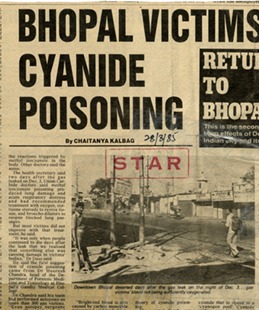
Bhopal Victims Had Cyanide Poisoning
Published date: Mixed Paper Article
View PDFBhopal: A small, red-painted build-in this central in Indian city has become the focus of a grim battle being waged against the after-effects of a poison gas leak that killed 2,500 people last December.
In the first weeks after the disaster, the victims were reported to have died as their lungs filled with fluids after they inhaled methyl isocyanate (MIC) gas leaking from a pesticide factory owned by the Indian subsidiary of the US Union Carbide Company.
But doctors here now say the deaths, and injuries to more than 125,000 people, may have been caused by cyanide released into their blood when they inhaled the gas.
Every morning survivors flock to the clinic where they receive injections of one gram of a colour less liquid called sodium thiosulphate, an antidote for cyan-ide poisoning.
In the clinic’s other room an array of equipment, including a blood-gas analyser and a urine spectrophotometer, monitors samples collected from the victims.
The results so far show most of them have been res-cued from a slow death, doctors said.
“Sodium thiosulphate treatment has made a dramatic difference,” said Dr Suresh Bala Varma at the clinic.
She said the drug was reacting with cyanide deposits in the body to produce a harmless compound called thiocyanate that was discharged in the victims’ urine.
“Even better results have emerged from our monitoring of blood samples,” Dr Varma said. “Before treatment most victims had alarmingly low oxygen levels in their arterial blood-between 30 and 50 per cent compared with the normal 90 per cent.
“Now the oxygen content is slowly rising. At the same time, sodium thiosulphate is also bringing down the ratio of carbon dioxide in victims’ blood, which pre-treatment tests showed had shot up to twice the safe level.”
Dr Varma said each victim was given a daily injection of sodium thiosulphate for six days. The treatment is then spaced out to bi-weekly and weekly administrations of the drug.
“Our tests show that the gas victims’ blood was not being sufficiently oxygenated,” she said. “People who could not walk even a few paces without stopping exhausted for breath are showing visible signs of improvement.”
But Dr Varma said doctors held little hope of repairing the tissue of the victims’ lungs, damaged when they sucked in methyl iso-cyanate as they fled from the poison gas on the night of the disaster.
Dr Ishwar Dass, health secretary of Madhya Pradesh State (Bhopal is the State capital), said the fight to save the lives of the survivors had been hindered by a lack of information on the reactions triggered by methyl isocyanate in the body. Other doctors said the same.
The health secretary said two days after the gas leaked on Dec. 3, Union Car-bide doctors said methyl isocyanate poisoning produced lung damage and acute respiratory distress and had recommended treatment with oxygen, cortisone steroids to revive tis-sue, and broncho-dilators to reopen blocked lung passages.
But most victims did not improve with that treatment, he said.
“It was only when people continued to die days after the leak that we realised that something else was causing damage in victims’ bodies,” Dr Dass said.
He said the first suggestion of cyanide poisoning came from Dr Heeresh Chandra, head of the Department of Forensic Medi-cine and Toxicology at Bhopal’s Gandhi Medical College.
Dr Chandra said his team had performed autopsies on more than 300 gas victims. “Even autopsy surgeons were affected by methyl isocyanate trapped inside the bodies,” he said.
“Every victim had unnaturally cherry-red coloured blood, and the bodies them-selves were pink and showed no signs of cyanosis – the blueness commonly associated with death,” he said. “They were signs that clearly pointed to cyanide poisoning.
Dr Chandra said his suspicions were reinforced when survivors exhibited every symptom of chronic cyanide poisoning listed in toxicology manuals dizziness, weakness, lung congestion, conjunctivitis, and weight and appetite loss.
But regular treatment of the survivors with sodium thiosulphate started only in mid-February, two months after the gas leak, after de-tailed tests conducted by experts from the Indian Council of Medical Re-search (ICMR) in New Delhi.
“Bright-red blood is also caused by carbon monoxide poisoning,” said Dr S. Sriramachari, ICMR’s director-general. “But that would have been cured by the heavy doses of oxygen we were giving victims, whereas they were suffering worsening respiratory problems.”
Dr Sriramachari said in the absence of precise clinical data on methyl isocyanate, the only clues available were found in Union Carbide’s technical literature.
He said that a manual on the lethal chemical issued by the company says thermal decomposition, which occurred when water accidentally leaked into a methyl isocyanate storage tank at the factory, “may pro-duce hydrogen cyanide, nitrogen oxides, carbon monoxide and/or carbon dioxide.”
Dr Sriramachari said he performed 22 post-mortems in Bhopal and the results supported Dr Chandra’s theory of cyanide poisoning.
“In normal death, our cells continue to process oxygen for some time after heart function stops, leaving unexpelled carbon dioxide which causes blueness,’ he said. “This was absent in Bhopal, indicating that something was blocking oxygenation.”
Dr Sriramachari said the cyanide theory was confirmed by a test performed under controlled conditions on gas victims between Feb. 4 and 12.
“Fifteen victims received injections of glucose solution and 15 others sodium thiosulphate,” he said. “Only one patient given glucose showed increased thiocyanate excretion in his urine.”
“But ten of the 15 victims given sodium thiosulphate excreted thiocyanate at seven or eight times the normal level,” he added.
“The methyl isocyanate appears to have split after it was inhaled, releasing cyanide that is stored in a ‘cyanogen pool’. spilling over from is flushed out by thiosulphate.
“But we still do not know how methyl isocyanate is stored inside the body, where it is stored, and how it keeps refilling the ‘cyano-gen pool’ leading to fresh respiratory attacks,” Dr Sriramachari added. “We are conducting tests to find out.”
He said the ICMR had also started a series of studies on other long-term effects of methyl isocyanate.
Dr Varma said about 2,000 survivors had been treated with sodium thiosulphate over the past month, but added that doctors could not guarantee a permanent cure.
Health secretary Dass said that Madhya Pradesh State estimates that about 10,000 people have permanent respiratory problems which will need long-term treatment as a result of the disaster. — Reuter.







**mitolyn**
Mitolyn is a carefully developed, plant-based formula created to help support metabolic efficiency and encourage healthy, lasting weight management.
[1512]777pub Online Casino Philippines: Login, Register, and App Download for Premium Slots Experience the best at 777pub Online Casino Philippines. 777pub login or 777pub register now to play premium 777pub slots. Get the 777pub app download for 24/7 mobile fun! visit: 777pub
[8959]jljl22 slots|jljl22 giris|jljl22 download|jljl22 app|jljl22 login Experience the ultimate online gaming at jljl22, the Philippines’ premier casino platform. Secure your jljl22 login today to explore a massive variety of jljl22 slots and enjoy fast jljl22 giris access. For the best mobile experience, jljl22 download the official jljl22 app and start winning anytime, anywhere! visit: jljl22
[2651]WJSLOT: Official Slot Gacor Site, WJSLOT Login & Register. Access Link Alternatif and Download APK for the Best Philippines Casino Experience. Experience the best Philippines casino at WJSLOT, the official slot gacor site. Easy WJSLOT login & register, access link alternatif, and download APK for big wins! visit: wjslot
[1434]Wagiplus Philippines: Best Online Slot & Casino – Login, Register, and App Download Official Link Join Wagiplus Philippines, the best online slot & casino site. Secure Wagiplus login, fast Wagiplus register, and official Wagiplus app download. Use our Wagiplus casino link for premium slot online games today! visit: wagiplus
[6758]BONS Official Site Philippines: Secure BONS Login & Casino Register. Play BONS Slots Online or Get the BONS App Download Today. Experience top-tier gaming at the BONS official site Philippines. Access a secure BONS login, fast BONS casino register, and the best BONS slots online. Enhance your experience with the BONS app download today! visit: BONS
[5187]fb777slot: The Top Online Casino in the Philippines. Register, Login, and App Download for the Best Slot Games Today! Experience the best slot games at fb777slot, the top online casino in the Philippines. Quick fb777slot register & login! Get the fb777slot app download and win today. visit: fb777slot
[3838]999pub Online Casino Philippines: Login, Register, and App Download for the Best Slots Experience. Join 999pub Online Casino Philippines for the ultimate gaming experience! Access your 999pub login, complete a quick 999pub register, and get the 999pub app download to enjoy the best 999pub slots and big wins. Experience the top-rated 999pub online casino today! visit: 999pub
[3439]PH488: The Best Online Casino Philippines for Real Money – Fast GCash Payouts & Secure Login. Experience PH488, the best online casino Philippines for real money. Enjoy a secure ph488 login and lightning-fast GCash online casino PH payouts. Sign up and win today! visit: ph488
[9412]SuperPH Online Casino: Your Top Destination for Slots in the Philippines. Login, Register, or Get the SuperPH App Download to Play and Win Today! **Meta Title:** SuperPH Online Casino: Best Slots in the Philippines | Login & Register
**Meta Description:** Welcome to SuperPH Online Casino, the Philippines’ top spot for SuperPH slots. Quick SuperPH login or register to start. Get the SuperPH app download and win big today! visit: superph
[1555]Fil777 Online Casino Philippines: Fast Fil777 Login, Easy Register & Fil777 App Download for the Best Fil777 Slots Experience. Experience Fil777 Online Casino Philippines! Get fast Fil777 login, easy register, and Fil777 app download options. Play the best Fil777 slots and win big today! visit: fil777
[3393]007jl Login & Register: Best Online Casino Slots in the Philippines | Download the 007jl App Today Experience the best online casino in the Philippines at 007jl! Complete your 007jl login or 007jl register to play premium 007jl slot games. 007jl download the app today for big wins on the go! visit: 007jl
Если требуется автоматизированная работа, можно база форумов для хрумера скачать и протестировать ее.
Стильная одежда играет важную роль в формировании образа.
Она помогает передать личный стиль и ощущать внутренний комфорт.
Грамотно подобранный образ создаёт впечатление окружающих.
В повседневной жизни одежда может придавать уверенность.
https://buyandsellhair.com/author/repuhouse/
Стильный образ облегчает повседневное взаимодействие.
При выборе одежды важно учитывать личные предпочтения и уместность ситуации.
Мода дают возможность находить новые решения.
Таким образом, умение стильно одеваться делает образ завершённым.
The updated app version is just amazing. The stats are updated in real time which helps me make better decisions. rotowireapp is a must have for sports fans.
The app is very stable and the graphics are amazing. I spend a lot of my free time here because it is just so addictive. Get the phbingoplusapp now
Customer support is actually helpful and quick to respond to my queries. Great service from phcahph.
Finally an app that actually works well on my phone. The download was easy and the gameplay is seamless. Big thumbs up for 5hbetbaixarapp.