

Legacy of the Bhopal gas tragedy
[Reuters]
Chaitanya Kalbag, Reuters
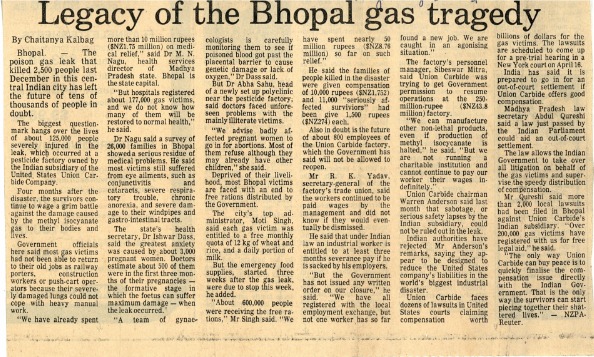
Bhopal — The poison gas leak that killed 2,500 people last December in this central Indian city has left the future of tens of thousands of people in doubt.
The biggest question-mark hangs over the lives of about 125,000 people severely injured in the leak, which occurred at a pesticide factory owned by the Indian subsidiary of the United States Union Carbide Company.
Four months after the disaster, the survivors continue to wage a grim battle against the damage caused by the methyl isocyanate gas to their bodies and lives.
Government officials here said most gas victims had not been able to return to their old jobs as railway porters, construction workers or push-cart operators because their severely damaged lungs could not cope with heavy manual work.
“We have already spent more than 10 million rupees (NZL 7.5 million) on medical relief,” said Dr M. N. Nagu, health services director of Madhya Pradesh state. Bhopal is the state capital.
“But postnals registered about 177,000 gas victims, and we do not know how many of them will be restored to normal health,” he said.
Dr Nagu said a survey of 26,000 families in Bhopal showed a serious residue of medical problems. He said most victims still suffered from eye ailments, such as conjunctivitis and cataracts, severe respiratory trouble, chronic anorexia, and severe damage to their windpipes and gastro-intestinal tracts.
The state’s health secretary, Dr Ishwar Dass, said the greatest anxiety was caused by about 3,000 pregnant women. Doctors estimate about 500 of them were in the first three months of their pregnancies — the formative stage in which the foetus can suffer maximum damage — when the leak occurred.
“A team of gynaecologists is carefully monitoring them to see if poisoned blood got past the placental barrier to cause genetic damage or lack of oxygen,” Dr Dass said.
But Dr Abha Shah, head of a newly set up polyclinic near the pesticide factory, said doctors faced unforeseen problems with the mainly illiterate victims.
“We advise badly affected pregnant women to go in for abortions. Most of them refuse although they may already have other children,” she said.
Deprived of their livelihood, most Bhopal victims are faced with an end to free rations distributed by the Government.
The city’s top administrator, Moti Singh, said each gas victim was entitled to a free monthly quota of 12 kg of wheat and rice, and a daily portion of milk.
But the emergency food supplies, started three weeks after the gas leak, were due to stop this week, he added.
“About 600,000 people were receiving the free rations,” Mr Singh said. we have spent nearly 50 million rupees (NZ$8.76 million) so far on such relief.”
He said the families of people killed in the disaster were given compensation of 10,000 rupees (NZ$1,752) and 11,000 “seriously affected survivors” had been give 1,500 rupees (NZ$274) each.
Also in doubt is the future of about 800 employees of the Union Carbide factory, which the Government has said will not be allowed to reopen.
Mr R. K. Yadav, secretary-general of the factory’s trade union, said the workers continued to be paid wages by the management and did not know if they would eventually be dismissed.
He said that under Indian law an industrial worker is entitled to at least three months severance pay if he is sacked by his employers.
“But the Government has not issued any written order on our closure,” he said. “We have all registered with the local employment exchange, but not one worker has so far found a new job. We are caught in an agonising situation.”
The factory’s personnel manager, Sibeswar Mitra, said Union Carbide was trying to get Government permission to resume operations at the 250-million-rupee ($NZ43.8 million) factory.
“We can manufacture other non-lethal products, even if production of methyl isocyanate is halted,” he said. “But we are not running a charitable institution and cannot continue to pay our worker their wages indefinitely.”
Union Carbide chairman Warren Anderson said last month that sabotage, or serious safety lapses by the Indian subsidiary, could not be ruled out in the leak.
Indian authorities have rejected Mr Anderson’s remarks, saying they appear to be designed to reduce the United States company’s liabilities in the world’s biggest industrial disaster.
Union Carbide faces dozens of lawsuits in United States courts claiming compensation worth billions of dollars for the gas victims. The lawsuits are scheduled to come up for a pre-trial hearing in a New York court on April 16.
India has said it is prepared to go in for an out-of-court settlement if Union Carbide offers good compensation.
Madhya Pradesh law secretary Abdul Qureshi said a law just passed by the Indian Parliament could aid an out-of-court settlement.
The law allows the Indian Government to take over all litigation on behalf of the gas victims and supervise the speedy distribution of compensation.
Mr Qureshi said more than 2,000 local lawsuits had been filed in Bhopal against Union Carbide’s Indian subsidiary. “Over 200,000 gas victims have registered with us for free legal aid,” he said.
“The only way Union Carbide can buy peace is to quickly finalise the compensation issue directly with the Indian Government. That is the only way the survivors can begin piecing together their shattered lives.” — NZPA-Reuter







[1180]KKJILI Casino Philippines: Easy Login, Register & App Download for Top Online Slots. Experience the ultimate gaming at KKJILI Casino Philippines! Quick kkjili login and register to play top-rated kkjili slot games. Get the kkjili app download for seamless mobile casino action and start winning today. visit: kkjili
[1575]776pub Online Casino Philippines: Best Slot Games, Secure Login, Register & App Download Today Join 776pub Online Casino Philippines for the best 776pub slot games. Fast 776pub register, secure 776pub login & easy 776pub app download. Play and win big today! visit: 776pub
[7187]WOWPH11 Casino Online Philippines: Easy Login & Register, Download App, and Play Top Slot Games. Join WOWPH11 Casino Online Philippines! Experience top WOWPH11 slot games with easy WOWPH11 login & register. WOWPH11 download app now to play and win big today! visit: wowph11
[2633]BingoPlus Official Site: Secure Login, Easy Register & App Download for Premium Slots in the Philippines. Experience premium gaming at the BingoPlus official site. Enjoy a secure bingoplus login, fast bingoplus register, and easy bingoplus app download to play the best bingoplus slots in the Philippines. Join today for 24/7 casino action and big wins! visit: bingoplus
[8078]Lucky88 Philippines: Official Link for Slot Online, Easy Login, Register & App Download. Access the Lucky88 official link in the Philippines. Experience top lucky88 slot online games. Fast lucky88 login, easy register, and lucky88 app download now! visit: lucky88
[1613]MNL63 Online Casino: The Best Philippines Slot Games. Easy MNL63 Login, Register & App Download for Big Wins! Experience the ultimate gaming at MNL63 Online Casino, the top destination for the best Philippines slot games. Enjoy a seamless mnl63 login, quick mnl63 register, and easy mnl63 app download to start playing today. Explore a wide variety of mnl63 slot titles and secure your chance for big wins at the most trusted online casino in the Philippines! visit: mnl63
[2680]TG77 Casino: The Best Online Casino in the Philippines for GCash Betting and Secure Login visit: tg77com
[2048]U8888 Login & Register: Best Philippines Online Casino, Slot Games & App Download Join u8888, the best Philippines online casino! Quick u8888 login & u8888 register for top u8888 slot games. Get the u8888 download for mobile play & win big today! visit: u8888
[3248]jljl9 app|jljl9 giris|jljl9 login|jljl9 casino|jljl9 download Experience top-tier online gaming at jljl9 casino, the premier gambling destination in the Philippines. Secure your jljl9 login, use the jljl9 giris for quick access, and download the jljl9 app to enjoy premium slots and live casino games anytime, anywhere. visit: jljl9
[1552]188JILI Online Casino Philippines: Quick Login, Easy Register, and App Download for the Best Slot Games. Experience the thrill of 188JILI Online Casino Philippines. Get quick 188JILI login, easy register, and fast 188JILI app download for the best slot games. Join the top-rated 188JILI online casino and start winning today! visit: 188JILICasino
[2605]Dragonslots Online Casino Philippines: Register & Login to Play Real Money Slots – Get the Dragonslots App Download Today! Play at Dragonslots online casino Philippines! Quick dragonslots login & register for the best dragonslots real money slots. Get the dragonslots app download today and win big! visit: dragonslots
[7876]Jilibet Online Casino: Easy Jilibet Login, Register & App Download for Best Jilibet Slots in the Philippines. Experience the best Jilibet Online Casino in the Philippines! Secure jilibet login & register to play top jilibet slot games. Jilibet app download available now for big wins on the go. visit: jilibet
Начинающим пользователям необходимо разобраться, как работать с хрумером, чтобы получить максимальный эффект.
ri2lko
i6vur6
oqh96i
gvf25e
li75do
s85383
qepsc6
0r2dcs
u9fzzb
85vur8
mwocj3
Thank you for your sharing. I am worried that I lack creative ideas. It is your article that makes me full of hope. Thank you. But, I have a question, can you help me? https://accounts.binance.com/ru-UA/register-person?ref=JVDCDCK4
I just finished setting up my account and the process was super smooth. Can’t wait to start winning big here. Check out jili95register for a quick start!
Signing up was a breeze. I was able to start playing in less than two minutes. If you are new, the 95jilisignup process is super simple and fast.