

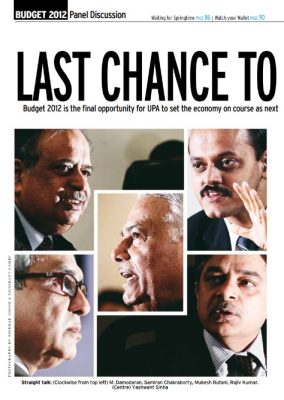
Budget 2012: Panel Discussion- Last Chance to Get it Right
[Business Today]
Published date: 18th Mar 2012
View PDFBudget 2012 is the final opportunity for the UPA to set the economy on as next years’ exercise will be influenced by the 2014 Lok Sabha elections
Five experts on the economy joined Business Today editor Chaitanya Kalbag to discuss Union Finance Minister Pranab Mukerjee’s options as he finalises the forthcoming Union Budget. Yashwant Sinha, former finance minister and Bharatiya Janata Party MP, currently Chairman of the Parliamentary standing Committee on Finance, Samiran Chakraborty, Research Head at standard Chartered Bank, Mukesh Butani, Chairman of BMR advisors, M. Damodaran, former chief of capital market regulator SEBI, and Rajiv Kumar, secretary General of the Federation of Indian Chambers of Commerce and industry, all agreed that Mukherjee’s task was challenging indeed. Edited excerpts:
Chaitanya Kalbag: Thank you very much for finding the time to join us today. Mr Sinha, where do you think we stand, and what do you feel are the options available?
Yashwant Sinha: Options are always available. The most important question is: Are we prepared to exercise those options? This is the last chance Budget, because after this, there will be an election Budget. The most important thing in this Budget is the fiscal stress.
The original sin was committed in 2008/09, when we gave a go-by to fiscal prudence and opened the treasury for all kinds of bonanzas. We very kindly described this as fiscal stimulus. My point has always been that this was more of an election strategy of the UPA than a fiscal stimulus to meet the global crisis.
The significant thing in the so-called stimulus is that over 80 per cent of the expenditure was revenue expenditure. And 90 per cent of people were saying that this kind of expenditure cannot be rolled back. And therefore, we are stuck. In this Budget, the most important question is: is the Finance Minister prepared to bite the bullet and take hard decisions in order to bring us back on the road to fiscal rectitude?
Kalbag: Do you think he has recognised that there is a serious crisis and we need to…
Sinha: I am not very sure. the manner in which fiscally imprudent schemes are taken up, there is not going to be any political opposition.
Let me tell you, if you come out with the Food Security Bill, no political party is going to oppose it. No political party is going to oppose the Mahatma Gandhi NREGS. No political party is going to oppose any other political measure that this government is going to take. And that is where the danger lies. Fiscal prudence is not an accepted political theology in India.
It is only the duty of the Prime Minister and the Fm to be sensitive to the fiscal stress and the economic consequences of fiscal stress. This is the most crucial challenge Mr Pranab Mukherjee is facing in this Budge,t apart from myriad other challenges. If we continue to be populist and uncaring about the fiscal stress, we are going to go deeper into the mess we see at the moment.
Kalbag: Dr Kumar, from an analytical point of view, what do you feel about these points?
Rajiv Kumar: I agree with Mr Sinha. This is a critical Budget. Since January, the market has given the benefit of the doubt to the government. You have seen the rebound of the rupee, but that will quickly disappear if the Budget does not meet the requirements.
Secondly, the government has to bite the bullet. And the onus of creating a consensus on necessary economic measures is always on the ruling government. I just want to take a few minutes to explain why I feel sceptical. not with the UPA, but with the political class as a whole. It is the complacency about India’s growth rate. There seems to be an assumption that a seven per cent growth rate is in our pocket and we will earn it despite all odds. Therefore, the government and the political parties think that their job is to take care of how to distribute the revenue, to take the best advantage of electoral prospects rather than try and ensure that the growth is achieved.
Kalbag: Dr Chakraborty, can I bring you in here?
Samiran Chakraborty: From an economic point of view, there is a lot of concern about many things for which we pat (ourselves) on the back: the demographic dividend, domestic demand, and so on. They are actually blinding us to the risks five years from now when there will be problems like job creation, skillset shortage. This means some domestic fundamentals are not working properly. I feel the demand side of the economy is still doing fine. But the supply side is a problem.
Unfortunately, most policymakers talk about demand management. There is not enough focus on the supply-enhancing reforms.
Kalbag: Mr Damodaran, what do you think is happening on the corporate side and on the regulatory side? We just don’t seem to move forward.
M. Damodaran: I sense that somewhere, maybe we have moved from denial to recognition that there are real problems. I think there is an understanding of what needs to be done. The missing piece is the willingness to do what you know needs to be done. I don’t see a single Budget addressing this.
Another thought, the numbers that are put out in the Budgets. With every passing year, they are becoming less reliable, less credible.
Now, you talked about what corporate India needs to do in this scenario. I might lose friends if I say this, but they have been projecting themselves as victims of a process of inadequate governance and they might like to look at how much they contributed. Was there contributory negligence involved in where we have reached now? It is unwillingness to do anything about it, that to my mind, describes the situation, and not inability to do anything about it.
Kalbag: Mr Butani, what do you think about the delay in the Direct Tax Code and Goods and Services Tax?
Mukesh Butani: As far as DTC is concerned, I would rather go back to the reforms that Mr Sinha initiated in 2002, when Dr Vijay Kelkar was appointed as advisor. At that point in time, the government not only looked at ways and means to expand the tax base, but it also looked at the functioning and efficiency of the tax administration. This has become a politically difficult exercise of how do you go and question the administration as to how effectively it is working. So, you have this tax administration, whose functioning and efficiency, in my view, are big question marks.
Kalbag: Dr Chakraborty, you have been out of the Delhi kind of environment. If you had to give the FM a few bullet points on what he needs to address right on top of the speech, what would you go for?
Chakraborty: I think we have to be realistic and distinguish clearly between the Budget numbers and policy thrusts. I am not too hopeful on the expenditure management side. A lot of it is extremely sticky. If there are some kind of headline measures– the right direction of subsidy reduction, the intent – then I’d be quite happy with that. Coming to the policy side, I think clearly the sector that needs some direction right now is power.
Kalbag: I am a bit of a sceptic on the theory that a nation of our size can keep going purely on domestic demand. We have to be global and become much more of a manufacturing and exporting nation.
Rajiv Kumar: I would like to distinguish domestic demand between investment demand and consumption demand. This time, we need a much sharper and smarter increase in investment demand. And the opposite is happening.
Consumption demand is being perked up, while investment demand is coming down. Second, we need to give a lot more attention to the savings side of it as well. While public sector dissaving has increased, growth has come down.
Damodaran: I have three key points: the bond market will not come into existence in any significant way as long as the BI is in charge of the responsibilities of the government securities market.
I would like to see the Finance Minister announce that states that are doing their bit for skill development should be incentivised. The last point is the rural infrastructure development fund– can we use this money meaningfully to see that rural infrastructure is created and the rural economy benefits?
Kalbag: Do you actually believe that if Mr Mukherjee were to reach out to all parties, there could be a sitting together in a best practices discussion where there is a consensus?
Sinha: There are two ways of doing it. One is that you have the National Development Council, consisting of the CMs and the Government of India. You have the inter-state council, where some of the issues can be tackled. These two bodies need to be utilised much more; then you can build a consensus across the border. You can’t reform state electricity boards by talking to political parties. You do this by talking to the state CM.
Kalbag: There is a feeling that Indians themselves and foreigners are investing in India, despite India.
Sinha: Most of the recent flows are for arbitrage purposes.
Damodaran: But they are also investing for other reasons: there is an amount of money globally that needs to be invested in some geographies, in some asset classes. There was a time when India gave the highest or the second-highest return. Money went out of India, not because markets were doing badly, but (because) those who needed money were scraping the bottom of the barrel in their countries. Wherever they had money, they were taking it out. Global majors did not take the money out because they lost hope in the market.
Sinha: Let’s be realistic, fiscal rectitude is not an accepted virtue in the Indian political system. How many people understand what fiscal rectitude is? Let’s be realistic, it is the prime responsibility of the government, and in the government, of the pm and the FM. Even your ministerial colleagues are not on the same page as you as far as fiscal rectitude is concerned. You are waging a lonely battle in government on this issue. But you must be prepared for a lonely battle.
If I ever become the finance minister again, I will be as irresponsible as the others. and i am saying this with a sense of sorrow that maybe I was single-handedly responsible for NDA losing the 2004 election.
This is the age of populism. If the great reformer of India, Dr Manmohan Singh, does not have the appetite for reforms anymore, why should you expect it from the BJP or from any other party? I would like to end by quoting Napoleon: ‘I am the revolution; I destroy the revolution.’ I could perhaps say the same thing for the Prime Minister.
Butani: I think our situation is precarious. There are a variety of reasons for that. We have become victims of the welfare politics of the current regime. I think we have gone beyond subsidies and are living in an era of entitlement. And it is human psychology that you cannot take an entitlement away. entitlement becomes a birthright. The only option for us is to raise the revenue, because the opportunity to curtail expenditure is very limited.
Kalbag: Are you optimistic things will change for the better, or do you think it will be more of the same?
Damodaran: I am optimistic because I think things have come to such a pass that they can only get better. There is recognition that we need tough decisions to be taken, and that you cannot pretend that problems don’t exist. The realisation is there, the problem is about summoning the courage and willingness to do what you know needs to be done.
Kumar: Isn’t there a clear stance within the government that things are not that bad? My fear of this complacency is perhaps a deeper one. And this is a real concern. Senior people in the government keep telling me: with a seven per cent growth rate, you guys are still cribbing. And that is what really scares me.
Butani: In the last ten weeks, the news headlines are: RBI acting in a way that inflation is behind us, rupee has strengthened; stock market is up 24 per cent – the highest return any emerging market anywhere can deliver. This is absolute rubbish! These three facts are making people believe we are right on track. We are ignoring fundamental issues.
Damodaran: I tell you why I make this statement. I see hope in the statement of the finance minister when he said I am beginning to lose sleep. When a finance minister begins to lose sleep, I think it is a good sign; it is a good recognition that he needs to fix a few things. I do not attach a lot of importance to stock market movement or the way the rupee has moved. Money is also coming into the stock market because of the exchange rate.
Sinha: I think it is quite clear that the direction is clear. We need to go back to the path of fiscal rectitude. It is good for the people of this country – you can’t have an uncontrolled fiscal deficit and people’s welfare side by side. I think this Budget is a good opportunity for systemic reforms. and third, to give a clear signal that the government means business. that the days of policy paralysis are over. Take steps that will ensure investments start flowing. The Government of India must work with the RBI. RBI has autonomy, but autonomy does not mean the absence of dialogue. I continue to be very optimistic about the future because domestic demand will continue to rise, and that is what has driven the economy and will drive it in the future. You make money affordable and available, and instill investor confidence, and people will start buying, and the industry will start investing.


[6593]JiliGames: Best Philippines Slot Online & Casino. Fast Login, Register, and Official APK Download. Experience the best Philippines slot online at JiliGames Casino. Enjoy fast jiligames login, easy jiligames register, and the official jiligames download apk. Join now! visit: jiligames
[7628]Wagibet: Trusted Philippines Online Casino. Access Wagibet Login, Wagibet Daftar, and Wagibet Slot Gacor. Use our Wagibet Link Alternatif or Download APK now! Wagibet: The most trusted Philippines online casino. Access Wagibet login, Wagibet daftar, and high-win Wagibet slot gacor. Use our Wagibet link alternatif or download apk for the ultimate mobile gaming experience today! visit: wagibet
[2945]PlusAce Casino: Top Online Slots in the Philippines. Access PlusAce Login, Register, and App Download for Exclusive Rewards. Experience PlusAce Casino, the #1 site for online slots in the Philippines. Quick PlusAce login, PlusAce register, and PlusAce download for rewards. Play PlusAce slot now! visit: plusace
[1454]Scatter Login & Slot Register: Download the Scatter App for Top Casino Slots in the Philippines Access the official scatter login link for the best scatter casino slots in the Philippines. Quick scatter slot register & easy scatter app download. Join now! visit: scatter
[295]phmacao Online Casino Philippines: Register, Login & App Download for the Best phmacao Slots Experience. Join phmacao, the premier phmacao online casino in the Philippines! 🎰 Secure your phmacao login or phmacao register today to play the best phmacao slots. Fast phmacao app download available for a seamless mobile gaming experience and big wins! visit: phmacao
[3049]Pisogame PH: Top Online Slots, Quick Login, Easy Register & Official App Download. Pisogame PH: Experience top online slots today! Quick pisogame login, easy pisogame register, and official pisogame download. Get the pisogame app and play now! visit: pisogame
[1408]777color Online Casino Philippines: Easy 777color Login, Register & App Download for Premium 777color Slots. Join 777color, the top Online Casino Philippines. Quick 777color login & register to play premium 777color slot games. Get the 777color app download and start winning! visit: 777color
[501]The Best Online Casino in the Philippines with Secure GCash Payments and Easy Okebet3 Login visit: okebet3
[6381]Wowph22 Online Casino Philippines: Quick Login, Register & App Download for the Best Slot Games. Experience top-tier gaming at Wowph22 Online Casino Philippines. Quick wowph22 login, easy register, and premium wowph22 slot games. Get the wowph22 app download for big wins today! visit: wowph22
[8072]VIPPH Online Casino: Top Philippines Slots, Easy Login & App Download Experience VIPPH Online Casino, the #1 hub for Philippines slots. Quick VIPPH login, easy VIPPH register, and fast VIPPH app download. Play VIPPH slots today! visit: vipph
Обращаться в клинику стоит не только в крайних случаях, когда человек уже не может встать с постели или запой продолжается неделями. Наоборот, чем раньше начата помощь, тем мягче и короче может быть программа, тем меньше риск тяжёлых осложнений и долгой реабилитации.
Детальнее – https://narkologicheskaya-klinika-dolgoprudnyj11.ru/narkologicheskaya-klinika-vyzvat-v-dolgoprudnom/
tadhx5
Your point of view caught my eye and was very interesting. Thanks. I have a question for you.
nnp6lu
i1nscg
5qqskl