

The Needle’s Eye
Two Years of Modinomics: Silk Purse or Sow’s Ear?
Published date: 2nd June 2016, The Economic Times
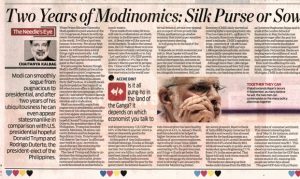
View PDFModi can smoothly segue from pugnacious to presidential, and after two years of his ubiquitousness he can even appear statesmanlike in comparison with U.S. presidential hopeful Donald Trump and Rodrigo Duterte, the president-elect of the Philippines.
When Prime Minister Narendra Modi speaks to a joint session of the U.S. Congress on June 8, he will represent the fastest-growing economy in the world. It will be a hard-won honour, twice over. For all our heat and dust, contradictions and weaknesses, we will have done a lot of things right economically And Modi will have travelled a remarkable road from Pariah to honoured guest in the Capitol.
It is not a singular honour, though. Modi is the fifth Indian prime minister to speak to a joint Congress session in the past three decades and the second from the Bharatiya Janata Party (BJP) to do so. It is worth recalling the trepidation that many of us felt when he took office in 2014 after a rancorous election campaign, so his last U.S. visit before President Barack Obama’s term ends will be both a celebration and a vindication.
Modi can smoothly segue from pugnacious to presidential, and after two years of his ubiquitousness he can even appear statesmanlike in comparison with U.S. presidential hopeful Donald Trump and Rodrigo Duterte, the president-elect of the Philippines. Trump has insulted women, Mexicans, call-center Indians, and his desperate Republican rivals. Dutertes says she will observe ‘bar hours’ in office and start work at 1 p.m.; he revels in shock therapy, like endorsing the killing of corrupt journalists.
The rise of Trump and Duterte underlines the rising popularity of abrasive, ultra-nationalist, protectionists and isolationist leadership in a world becalmed in uncharted economic waters.
Three weeks from today, Britons will vote in a referendum on whether to stay in the European Union or not. A Brexit vote will for sure roil world markets. to add to the uneasiness, the U.S. Federal Reserve is now seen almost certainly ratcheting up interest rates this month or in July.
Let’s get India’s 7.6% GDP growth in 2015/16 after a 7.9% rise in the same January-March quarter in perspective. China’s GDP rose 6.7% in the same quarter, which is seen as further enervation in the world’s second-largest economy. U.S. GFP rose 0.8% in the March quarter, which is seen as reasonably good in world’s largest economy.
At this point in time, India enjoys multiple blessings. It looks as though seven percent GDP growth is a new normal. Our numbers are humongous: over one billion Aadhaar cards have been issued so far, and over 291 million Jan Dhan bank accounts have been opened for the poor by the government. So, we have massive internal total demand, are not overly dependent on export-driven growth like China and have a huge shadow economy that is not hyper-sensitive to government steering.
Is it all gung-ho in the land of the Ganga?
It depends on which economist you talk to. Most I spoke with said the brighter data seem to stem from statistical discrepancies, and some expect the year’s number to be revised slightly downward. Manufacturing activity has slowed in the last quarter, alongside investment. Still, private consumption has been healthy and grew at 8.3% in January-March, and this is bound to be helped by higher incomes on the horizon for millions of government employees. Agricultural Gross Value Added was up 1.2% in 2015/16 after contracting 0.2% the previous year, and things will only get better this year with a good monsoon forecast.
How can we gauge the direction the wind is blowing? Last January, the Centre for Monitoring Indian Economy (CMIE) daily started calculating India’s unemployment rate That has risen to 9.6% up from 8.7% in January, three times the government’s estimate. CMIE’s sample is large–members of 158000 households. Every day, CMIE surveys 1,300 separate households and computes a daily unemployment rate based on a 30-day moving average, thus providing a real-time indicator.
Although more than 1,200 companies have announced their full year result and the numbers don’t look too grim, our banking system is under severe pressure, Reserve Bank of India (RBI) Deputy Governor S.S. Mundra said recently that stressed assets for the banking system as a whole rose to 14.5% end-December 2015 from 9.8% at end-March 2012, while stressed assets in public-sector banks shot up to a frightening 17.7% from 11% in the same period. That figure will only look worse once all full-year results are in.
The banks are cleaning up their books under duress from the RBI, but as Governor Raghuram Rajan said in a talk at the London School of Economics in May, the banks may emerge stronger after the pain but both activity and human capital are being driven towards the shadow economy, for instance less-regulated hedge funds. Not just that banks are lending less to the millions of small and medium enterprises that potentially generate the most employment.
How is all this affecting the common man? Not as much as you would think. Along with the University of Michigan, CMIE is also calculating a daily index of consumer sentiment. This reveals interesting data.
As of May 31, for instance, and calculated on a base of 100 in September-December 2015, overall consumer sentiment was 99.7. This number has two parts: sentiment about current economic conditions stood at 97.8 on the day the GDP data was released, and consumer expectations stood at 101, meaning that people see better days ahead.
The good GDP data will put Rajan under pressure to trim interest rates for the sixth time since January 2015, but will lower rates really help?
The world’s central banks are navigating these treacherous shoals in different ways. Rajan said some have resorted to unconventional monetary policy including negative interest rates. But with interest rates so low we are not getting enough exits of inefficient industries or capital. At the same time, there is no incentive to invest either, or investment is held back by the overhang of inefficient capital. An extreme example of this is in steel, where over-capacity continues to be financed by credulous banks.
“If I cut interest rates, the theory says you will go out and spend because, why save? I’m getting peanuts for saving; instead, let me go out and enjoy the new iPod or that new car. Turns out that we don’t seem to have been encouraging consumption,” Rajan said. Perversely, if you are 50, you feel you have got to save twice as much to have a comfortable old age. “So, you cut interest rates, I cut my spending.”
Cheered by the good economic data, Modi’s government has pledged to pump more money into infrastructure spending, Rajan said lower rates and more fiscal stimulus aim to boost asset prices, but huge government spending could encourage people to believe that prices might come down again so it would be better to save now and conserve their money
If Modi extends Rajan’s tenure in September, as many believe he will, the two men can contemplate these policy dilemmas together.







8js7hz
se8mqs
ctmc1y
7avmj2
dkptg6
skckom
2ivwsw
uvsrt9
h7rg2b
9lf5tn
q31cuw
1l9iyl
I don’t think the title of your article matches the content lol. Just kidding, mainly because I had some doubts after reading the article.