

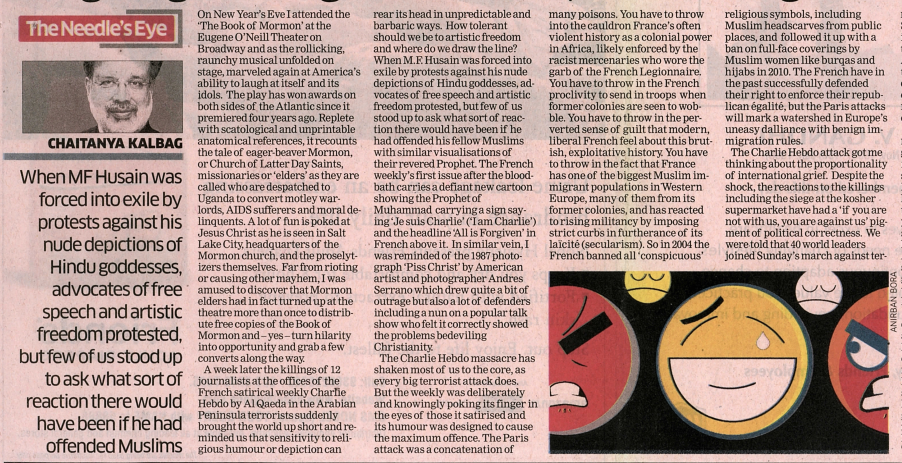
The Needle’s Eye
Laughing Through Our Tears, or the Wages of Deadly Humour
Published date: 15th Jan 2015, The Economic Times
View PDFOn New Year’s Eve I attended the ‘The Book of Mormon’ at the Eugene O’Neill Theater on Broadway and as the rollicking, raunchy musical unfolded on stage, marveled again at America’s ability to laugh at itself and its idols. The play has won awards on both sides of the Atlantic since it premiered four years ago. Replete with scatological and unprintable anatomical references, it recounts the tale of eager-beaver Mormon, or Church of Latter-Day Saints, missionaries or ‘elders’ as they are called who are dispatched to Uganda to convert motley warlords, AIDS sufferers and moral delinquents. A lot of fun is poked at Jesus Christ as he is seen in Salt Lake City, headquarters of the Mormon church, and the proselytizers themselves. Far from rioting or causing other mayhem, I was amused to discover that Mormon elders had in fact turned up at the theatre more than once to distribute free copies of the Book of Mormon and — yes — turn hilarity into opportunity and grab a few converts along the way.
A week later, the killings of 12 journalists at the offices of the French satirical weekly Charlie Hebdo by Al Qaeda in the Arabian Peninsula terrorists suddenly brought the world up short and reminded us that sensitivity to religious humour or depiction can rear its head in unpredictable and barbaric ways. How tolerant should we be to artistic freedom and where do we draw the line? When M.F. Husain was forced into exile by protests against his nude depictions of Hindu goddesses, advocates of free speech and artistic freedom protested, but few of us stood up to ask what sort of reaction there would have been if he had offended his fellow Muslims with similar visualizations of their revered Prophet. The French weekly’s first issue after the bloodbath carries a defiant new cartoon showing the Prophet of Muhammad carrying a sign saying ‘Je suis Charlie’ (I am Charlie’) and the headline ‘All is Forgiven’ in French above it. In similar vein, I was reminded of the 1987 photograph ‘Piss Christ’ by American artist and photographer Andres Serrano which drew quite a bit of outrage but also a lot of defenders including a nun on a popular talk show who felt it correctly showed the problems bedeviling Christianity.
The Charlie Hebdo massacre has shaken most of us to the core, as every big terrorist attack does. But the weekly was deliberately and knowingly poking its finger in the eyes of those it satirized, and its humour was designed to cause the maximum offence. The Paris attack was a concatenation of many poisons. You must throw into the cauldron France’s often violent history as a colonial power in Africa, likely enforced by the racist mercenaries who wore the garb of the French Legionnaire. You must throw in the French proclivity to send in troops when former colonies are seen to wobble. You have to throw in the perverted sense of guilt that modern, liberal French feel about this brutish, exploitative history. You have to throw in the fact that France has one of the biggest Muslim immigrant populations in Western Europe, many of them from its former colonies, and has reacted to rising militancy by imposing strict curbs in furtherance of its laicity (secularism). So, in 2004 the French banned all ‘conspicuous’ religious symbols, including Muslim headscarves from public places, and followed it up with a ban on full-face coverings by Muslim women like burqas and hijabs in 2010. The French have in the past successfully defended their right to enforce their republican egalite, but the Paris attacks will mark a watershed in Europe’s uneasy dalliance with benign immigration rules.
The Charlie Hebdo attack got me thinking about the proportionality of international grief. Despite the shock, the reactions to the killings including the siege at the kosher supermarket have had a ‘if you are not with us, you are against us’ pigment of political correctness. We were told that 40 world leaders joined Sunday’s march against terror in the French capital. US Secretary of State John Kerry, paying homage of a different kind at the Vibrant Gujarat summit in Ahmedabad, was forced to promise to fly to Paris later this week to underline America’s solidarity, because US participation in the Paris rally had been seen as not high-level enough.,
Four days before the Paris outrage, the Boko Haram Islamist group slaughtered more than 2,000 innocent townspeople in Baga and surrounding villages in northern Nigeria. Since 2009 Boko Haram has unleashed a ruthless campaign to enforce Sharia law. In April last year the group kidnapped 276 schoolgirls in Chibok town; its leader and self-proclaimed ‘caliph’ Abubakar Shekau dismissively said late last year that most of the girls, still missing, have been converted to Islam and married off to his fighters.
Have you heard of any huge solidarity march in any world capital against Boko Haram’s atrocities? Have you seen a global outpouring of grief after 134 students were methodically killed by the Pakistani Taliban in a Peshawar school on December 16? I don’t believe our government in 2008 organised a visible exhibition of defiance and solidarity after the Mumbai attacks by Laskar-e-Toiba; nor did we have world leaders linking arms near the Gateway of India.
The Paris attacks have also revived the debate about freedom of expression and speech. In India, we are quick to discern expanding and invisible curbs on the free airing of views, but we seem to be mostly indifferent to the firing and then savage attack on Kerala lecturer T. J. Joseph in 2010 for perceived insults to Prophet Muhammad; to the killing of Pune rationalist Narendra Dabholkar in 2013; to the harassment and exile to Finland of his ally Sanal Edamaruku for his perceived insults to Jesus Christ; and to the Mumbai lawyer who had charges filed against him last month under the sweeping provisions of our blasphemy and anti-hate speech law, Section 295(a) of the Indian Penal Code.
We need to ask ourselves if we want to be like the audiences who give the cast of The Book of Mormon standing ovations, and emerge laughing and refreshed, or whether we want to huddle in a Paris park or a Mumbai chawl to plot the next revenge against somebody who might laugh at us and our faith and foibles. Think carefully before you throw the first stone.





amr0xd
ihbqw5
zno74o
xgxfpw
w03vkv
yb857g
iz7s8w
bjmxwx
ku9ebr
lt0zbx
yi544l
ur6nc5
7ml6dt