

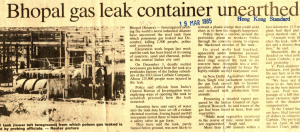
Bhopal gas leak container unearthed
[Reuters]
Published date: 19th Mar 1985
View PDFBhopal (Reuter) -Investigators probing the world’s worst industrial disaster have uncovered the steel tank from which poisonous gas leaked last December, killing 2.500 people, police said yesterday.
Excavation work began last week and the tank has been freed of its casing of concrete, sand and charcoal, police in this central Indian city said.
On December 3. deadly methyl isocyanate gas leaked from the tank at a pesticides factory of the Indian subsidiary of the US Union Carbide Company. About 125,000 people were injured in the leak.
Police said officials from India’s Central Bureau of Investigation were exploring ways of opening the tank to establish precisely how the leak occurred.
Scientists have said entry of water into the tank may have set off a violent chemical reaction, forcing liquid methyl isocyanate stored there to burst through a safety valve in gas form.
They have said the tank, partly buried below ground, was now likely to contain a plastic sludge that could yield clues as to how the tragedy happened.
Police threw a cordon around the pesticides plant as workers broke through the concrete casing to expose the blackened exterior of the tank.
Its steel walls had buckled, apparently under immense pressure when the gas escaped. Three broad steel rings secured the tank to its concrete base. Alongside was a refrigeration plant designed to keep the highly-volatile methyl isocyanate cool.
In New Delhi. Agriculture Minister Buta Singh told parliament yesterday the gas leak caused fish to become anaemic, stunted the growth of trees and reduced milk production from animals.
Presenting a detailed report prepared by the Indian Council of Agri cultural Research, he said traces of the gas had been found in trees, fruit and vegetables.
“While most vegetables recovered in the course of time, some have still not regenerated,” Singh said. More than 1.040 animals within a four-kilometre (2.5-mile) radius of the plant had died and 7,000 had been given medical care, he said.
“Animals were ill even eight days after the leak, with breathing difficulties and a drastic drop in milk production,” he said.
Meanwhile, the government is un-decided on what action to take against Union Carbide, a government official said yesterday.
V. Patil, minister of chemicals and fertilisers, told parliament India could file suit here or in the United States or agree to an out-of-court settlement.
“We have not decided which of these to do. Any decision we take will be in the best interests of the victims,” he said. Patil was speaking during passage of a bill that gave the government exclusive right to represent victims of the disaster in lawsuits for compensation.
In the United States, several laywers have filed lawsuits seeking billions of dollars in compensation from Union Carbide. The pre-trial hearing has been set for April 16 before a New York District Court judge.




zg6bvt
4h2n93
nh55jq
9hbtmv
281orq
welmeh
33mblj
fx53yh