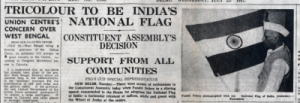
TRICOLOUR TO BE INDIA’S NATIONAL FLAG
[Reuters]
Published date: 6th Aug 1997
View PDFCONSTITUENT ASSEMBLY DECISION
_____________
SUPPORT FROM ALL COMMUNITIES
FROM OUR SPECIAL REPRESENTATIVE
New Delhi, Tuesday. —There were scenes of enthusiasm in the Constituent Assembly today when Pandit Nehru in a stirring speech commended to the House for adoption the National Flag of India—a horizontal tricolour of saffron, white and green with the Wheel of Asoka at the centre.
The flag, Pandit Nehru said, marked the triumphant conclusion of their struggle. It was not a flag of empire, imperialism or domination over anybody, but a flag of freedom.
“Wherever it goes,” he said—’’and I hope it will go far, not only where Indians live, but across the seas, where it may be carried by Indian ships—it will bring a message of freedom and comradeship, the message that India wants to be friendly and to help any people who may lack freedom”.
Pandit Nehru added that India’s foreign policy was not to join any power group; but to be a peace-maker and peace-bringer. When he had concluded his speech, Pandit Nehru unfurled two specimens of the flag, one on silk and the other on khaddar. Members stood in silence for half a minute. Pandit Nehru suggested that the two sample flags be preserved and sent to the National Museum, a suggestion with which the President concurred.
Chaudhury Kahliq-uz-Zaman, leader of the Muslim League group, amidst cheers, expressed the hope that at a moment when the new flag was being adopted all the bitter memories of the past would be forgotten. “Let us,” he said, “make a new history of India in which everybody is respected and has equal opportunity.”
Sir Radhakrishnan said that the wheel represented something which perpetually moved with the times.
This meant that such things as caste and untouchability must go. The orange colour meant renunciation. This indicated that the leaders of the people must be disinterested.
After 22 speakers had pledged allegiance to the flag, Mrs. Naidu was called upon to wind up the proceedings Speaking with her usual eloquence on the virtues for which the flag stood, she concluded with the words: “I bid you rise and salute the flag.”
Pandit Nehru’s proposal was supported with enthusiasm by members of all communities and was adopted by the House.