

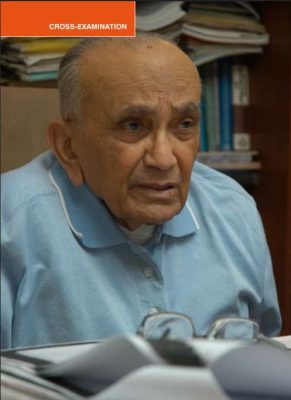
Justice PN Bhagwati – People are losing faith in arbitration
Published date: Halsbury's Law, May 2009
View PDFFormer Chief Justice of India, Justice PN Bhagwati, underlines the shortcomings in the arbitration system in India, in a discussion with Publishing Director Chaitanya Kalbag. He stresses the need to make arbitration cheap and speedy through the combined efforts of lawyers and arbitrators and moots legislation, if need be, in order to make it an effective tool, well within the reach of the common man.
Halsbury’s Law Monthly (HLM): What do you think about the general situation relating to arbitration in India right now?
Justice PN Bhagwati: There are arbitration proceedings going on at a higher level because there are many cases that are being referred by the courts for arbitration. Some of the retired Supreme Court and High Court judges are doing a lot of work in the area of arbitration and I think some of them are keeping busy all through the year. But that is only at a very high level, where higher stakes are involved, but so far as the disputes at a lower level are concerned, I don’t think there is a very effective system of arbitration in place.
HLM: Cases like causing hurt, wrongful restraint, assault, criminal intimidation and cheating are some offences that are now being settled in Lok Adalats. Do you feel that criminal cases should also be taken for arbitration before the litigation stage?
Justice Bhagwati: The Lok Adalats were started by me; I’m really the author of the Lok Adalats. What I felt was that a large number of small disputes, which people were not able to bring to court because it costs quite a bit of money to take litigation to court, and therefore they have to remain content with whatever they have got, and they can’t even do anything else about it. So I thought of this system of Lok Adalat, so that people who have grievances and problems can go there and file cases with them and the Lok Adalats can take them up and call the other side and try to bring about a settlement. When I started them and during the period when I was in-charge for them, we brought about a number of settlements, and those settlements. were enforceable by the courts. And. I personally feel that if the institution of Lok Adalat is set up on a systematic basis and given a legal shape, and there is a proper machinery to ensure its proper functioning, then it can do a lot of good to the people because there are a large number of cases that people are unable to carry to the court, and even if they carry them to the court, sometimes it takes months and years there, with the result that people are disillusioned.
The Lok Adalats were set up by me only for this purpose, to see that people should get justice at minimal cost. There, two or three respective persons who take up the case…try and bring about a settlement. They don’t have the authority to decide cases, but the parties can leave it to the authority to decide, depending upon their willingness. That is how it is different from arbitration. In an arbitration, what the arbitrator decides is binding upon the parties. But if we have a good system of arbitration, and particularly some respectable persons who can take up arbitration, they can do a lot of good.
Today’s arbitration system is working only because most of the arbitrators are retired judges of the High Courts and the Supreme Court, who charge a fairly large amount let me tell you. With the result that it is more of a substitution for the court, and sometimes arbitrations also take two-three years. Therefore, we’ve got to devise a system of arbitration through law. Today it is monetary, but if something can be done through a legal system by which two parties enter into an arbitration agreement, then it should be made enforceable, and I think it will then go a long way. Then arbitration will be a good substitute for a legal battle in court, there is no doubt. But provided it is cheap and it is speedy. At the moment, it is neither of the two.
HLM: In fact the allegation is that quite often it drags on longer than litigation.
Justice Bhagwati: Yes, sometimes it takes upto four years and what happens is that arbitrators, retired judges or lawyers, take up cases for two three days and then it is adjourned for a couple of months because in the meantime neither the lawyers nor the arbitrators are available, with the result that cases take many years to resolve.
I have got an arbitration which is now going on for the fourth year, but I can’t do anything because the lawyers are not willing. One side or the other is busy. Therefore, we must make some law to the effect that an arbitration must be disposed of within a certain specific period.
HLM: Also, is it possible to legislate on the sort of disputes that go for arbitration?
Justice Bhagwati: That may be difficult.
HLM: So who decides what goes for arbitration?
Justice Bhagwati: The parties or sometimes the judges before whom the case is pending, they sometimes persuade the parties to go for arbitration because it will be very difficult to make it compulsory.
HLM: In the 176th report of the Law Commission, Justice B.P. Jeevan Reddy has suggested that the principle of least court interference may be a fine principle for international arbitration awards but having regard to Indian conditions, such awards should not be as restricted as they are in the matter of international arbitrations. Do you agree with this?
Justice Bhagwati: Yes, I do agree that it can’t be made a rule that there should be no court interference, but whenever a case is brought before the court for the purpose of interfering with an award, the court should be very loath to interfere. Unfortunately, our courts are interfering too readily. Interference should be the last resort, and where it is found to be a clear injustice, only there interference should be made. Very often, two views are possible. Where only one view is possible, one should not interfere.
HLM: So we have a long way to go in improving the way in which arbitration is currently conducted and accepted in India by parties involved in an arbitration?
Justice Bhagwati: There is a lot to do. There are many improvements that are absolutely essential. But today, I think, people are losing faith in arbitration, as it goes on for two, three, four years, and costs quite a bit of money to the client.
What is happening in all big arbitrations before the Supreme Court and High Court judges is that a retired judge charges sometimes thirty-fifty thousand rupees per sitting and that is not the end of it because the arbitration goes on at times from day-to-day, sometimes from month-to-month and sometimes from year-to-year. Look at the amount of costs which are involved. My own view is that once an arbitration begins before an arbitrator, one side must be able to finish its evidence at a stretch and there should be no adjournment. Then there maybe a little break for the other side, but then again it may go on continuously, and then arguments may proceed.
HLM: Do you think mediation centers are a solution to this problem?
Justice Bhagwati: They can definitely help. With good mediators, it can go a long way.
HLM: The decision of one arbitration tribunal is not binding on other tribunals. This has also been seen as being problematic, as one clause can be the subject of arbitration in hundreds of disputes and in all hundred disputes the same clause cannot be interpreted in a hundred different ways.
Justice Bhagwati: This is because one arbitral council is not bound by the decision of another one.
I remember, in one case, an arbitral body decided a particular case on an interpretation that was totally incorrect. When the case came before me, how could I have accepted that? That is the whole difficulty. These instances though are not many.
HLM: In many cases there is a need for technical knowledge which the arbitrator may not possess because the case may be a complex and technical subject that he may be dealing with.
Justice Bhagwati: That happens sometimes, in building contracts, for example. The arbitrator or even a lawyer would not be able to understand the intricacies of the system. In such cases the arbitrator should be entitled to consult an expert.
HLM: Does that happen?
Justice Bhagwati: No it doesn’t happen, but in such cases the dispute should be referred to only those arbitrators who are familiar with that particular subject or branch of law.
Now if a building contract comes to me, I’m hardly competent to deal with it, but here my younger brother who is himself an engineer can deal with it within a very short time.
HLM: Do you support judicial intervention in arbitral awards on the ground of public policy, especially when courts find the award granted is unfair or unjust in terms of public policy or public good?
Justice Bhagwati: Today, the Supreme Court is interfering in all kinds of cases in arbitration. Only today some lawyers told me that at the slightest pretext the Supreme Court interferes, grants special leave for arbitral awards.
There is such a lot of time involved, as one is first required to go before an arbitration council, then there is an award, then it is challenged before a lower court, then the High Court and then it goes before the Supreme Court. Then after ten-twelve years you get a final decision, and then it may be that the award is set aside. It is a farce.
What is public good is debatable. One judge may feel that one thing is public good, another may feel that it is not. Unless it is patently against public interest, then only the court may interfere, but not otherwise. Not because it is against the judge’s conception of what is right and what is wrong.
HLM: The London Court of International Arbitration just opened an Indian branch. Do you think that more of such institutions will make the arbitration system more sophisticated and reduce the misuse of the system?
Justice Bhagwati: I don’t know whether it is going to prevent the misuse of the system, but it can make the arbitration a lot more expensive than what it is today.
HLM: It is really unfortunate that we force judges to retire at sixtyfive, when they are in a position to function effectively for another twenty years or so, forcing them into doing arbitration, which is not the best use of their intellectual power, in order to earn a decent livelihood.
Justice Bhagwati: I agree with you, but what happens is, it is human nature, that since they’ve not had money for such a long time, when they get the opportunity, they try to make the most of it with the result that they charge fantastic fees and they just go on and on with the arbitration. Some of them make twenty-thirty lakhs per year, with the result that arbitration is abused. One doesn’t need so much money; that is my view. I do very few arbitrations and most of my time is public time, but I do a few arbitrations to maintain myself, but that is not my sole interest.
HLM: So you’re very choosy about the arbitrations you take up, the ones that you think are important?
Justice Bhagwati: Important and those which I can deal with effectively. If I have six, eight or ten arbitrations, I can’t possibly do justice to them. Then I will not be able to hear them continuously. But there is one thing that I want to recommend and it is that judges must hear cases continuously. Today what is happening is a farce. I had got an arbitration today, which has been going on for over two and half to three years because none of the lawyers want to sit for longer than two and a half hours to three hours continuously, and the next hearing will take place after one month because the counsels are not available. Is it not farcical?
HLM: It is as bad as the worst of litigation.
Justice Bhagwati: It is worse than litigation because counsels have taken up so many cases. They have cases in court and before the arbitrators, with the result that they can’t find time, in spite of charging as high as fifty-thousand rupees for two and a half hours. To my mind it is criminal. I belong to the old school. I charge half of what others do, but lawyers prefer to go for them than for me because they feel that those people are better equipped and they’ll be able to devote more time than I can. I don’t care.
HLM: I think the theory must be that if the judge doesn’t charge much, the lawyer can’t charge more than him. So you’re pushing down the market rate!
Justice Bhagwati: That is also possible. I think it is crazy and criminal and I want to ask them what is it that they do with so much money?
Padma Vibhushan awardee, Hon’ble Justice P N Bhagwati, is one the most distinguished jurists of the country. He is a former Chief Justice of India. He is also former Chief Justice of the Gujarat High Court, during which term he was nominated twice as the Governor of Gujarat. He was responsible for making a large number of innovations with a view to provide access to justice to the poor and disadvantaged, such as the development of Public Interest Litigation and enlarging of the doctrine of locus standi before the Supreme Court and the High Courts for vindicating the individual and collective rights of those who were denied access to justice on account of social or economic disability. He is widely regarded as the originator of India’s legal aid programme. He has been nominated as an Honorary Member of the New York Bar Association, the first Asian to be conferred the honour. He has also been a member of the Permanent Court of Arbitration at the Hague for the last several years. He is closely connected with a large number of NGOs, both in India and outside and has been inspiring grassroots human rights and development NGOs. He has provided leadership to the NGO AWARE in making 6000 villages self-reliant. He has been elected for the fourth time to the UN Human Rights Committee. He is the Chairman of Eminent Persons Group for Study of questions relating to refugees. He was also a participant in the national freedom movement.



9kxjo0
9aaaoh
5fzieg
7a7tcb
0rlbyt
k4ez3b
75f63m