

The Needle’s Eye
Everything is hunky-dory, don’t you agree?
Published date: 26th Jan 2018, The Economic Times
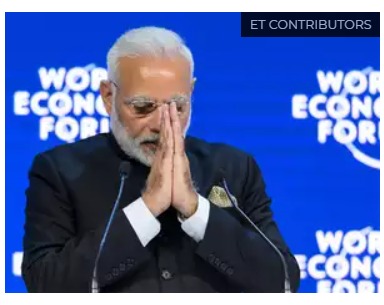
View PDFThe prime minister’s speech at the World Economic Forum was sweeping and aspirational (one observer said he was “preaching to the choir”). He presented India as the most attractive investment destination in the world, with its democracy, its young population, its diversity and the headroom it has in catching up with the West’s levels of consumption. He also defended globalisation, saying protectionism cannot be considered a lesser threat than terrorism or climate change.
I don’t know if he had watched former US President Barack Obama’s interview with David Letterman a few days earlier. Letterman, known for his irascibility during his Late Show years, lobbed softball questions at the former president. Yet, the conversation was thoughtful and engaging.
During the past week I watched three interviews on television. Besides the Letterman interview, two with Prime Minister Narendra Modi. All three were touchy-feely and velvet-gloved. There was something else in common: the interviewers had all sheathed their claws. Especially the Indian ones: they were literally purring.
Many of the questions to Modi, who has not held a press conference in his 44 months in power, had me clutching my head (this is the Fourth Estate we are talking about, remember?) Among other things, the prime minister was informed that there was a New World Order called PTM – Putin, Trump, Modi. No mention of China’s Xi Jinping, who has just tightened his grip on power for the next five years at the head of the world’s second-largest economy. Modi was told that the opposition was needlessly has made several attempts to finish Narendra Modi. I wish them all the best.” To which the journalist responded: “But they keep at it. It doesn’t end.”
Modi should have been pressed on why, despite his talk of inclusive growth and the good of the common citizen, he does not speak out strongly against caste and religious violence, or use his power to steer the national discourse towards the development theme he says is his lodestar.
You had to trudge through the treacle to find the odd policy statement or insight from the prime minister. For instance, he spoke persuasively about his wish for simultaneous elections to the Lok Sabha and state assemblies. Administrative machinery is frozen while officials are diverted to election duty, thousands of crores are spent on campaigns, and police and paramilitary forces are deployed to poll security, away from their real functions – all good arguments for one big election every five years. That is a huge ask and will need the cooperation of every state. Look at the Bharatiya Janata Party-ruled states that, sensitive to the Vidhan Sabha elections strung out through this year, would rather keep the voters and law and order on a slow burn with the faux rage over ‘Padmaavat’ in defiance of the Supreme Court’s order. On the day Modi spoke at Davos, mobs were attacking malls and burning cars in Ahmedabad.
Presaging Davos, Obama talked about the things that worried him. “You still have growing inequality,” he said. “The combination of technology and globalisation means that entire industries and categories of jobs are being eliminated … in that environment, if all the money is going to a handful of people at the top, and they are investing in all kinds of stuff because they want to maximise their return, that’s how you start getting bubbles, that’s how you start getting an overheated financial system. The challenge we still have to address is, how do we make an economy in this globalised, technological environment, that’s working for everybody?”
That question ought to preoccupy our policymakers as we head into an eventful year. Trade and development topped he agenda at Modi’s summit on Thursday with leaders of the Association of Southeast Asian Nations. ASEAN is dominated by authoritarian members who couldn’t have been too pleased with the violence and intimidation triggered by Padmaavat’s release, including the reprehensible attack on a schoolbus in Gurgaon not far from the airport where the VIPs were flying in.
Is the glass half-empty or half-full? The global economy is doing remarkably well. In 2017, there was an acceleration in the growth rates of three-quarters of the world. India was among those countries whose growth rate shrank. Global trade is also growing in value and volume. This trend is spreading to India’s exports; but oil prices are also rising, putting an end to more than three years of low import bills. At the same time, the oil price rise is benefiting India’s exports of oil products – take a look at Reliance Industries’ latest profit figures.



**mitolyn official**
Mitolyn is a carefully developed, plant-based formula created to help support metabolic efficiency and encourage healthy, lasting weight management.
i9shqh
ou5r9s
ge5qyo
7hajh5
74j0dv
tbtd3m
p4hlhf
rs09i2