

The Needle’s Eye
How PM Modi has run UPA’s legacy programmes better than his predecessors
Published date: 6th Jun 2018, The Economic Times
View PDFThey say the best way to persuade somebody is to plant an idea in their head and get them to start speaking about it as if it were their idea. Prime Minister Narendra Modi has shown he is a great persuader. Persuasion is one thing: what about implementation? Over the past four years, the Bharatiya Janata Party (BJP) government’s two main pillars of political consolidation have been ‘economic intervention’ and ‘social investment’. There is a lot of politics too, and that is aimed at maintaining and expanding the BJP’s hold on power.
The Modi government has received a lot of flak for the implementation of its biggest economic interventions, the 19-month-old demonetisation and the introduction of the Goods and Services Tax (GST), which will soon mark its first anniversary. Notebandi directly hit citizens’ personal autonomy, and GST, although it is touted as a sign of ‘cooperative federalism’, is also seen as diminishing states’ fiscal autonomy.
Demonetisation’s short- and medium-term economic palsy (which the dictionary defines as paralysis accompanied by involuntary tremors) has still not run its course, and may never be properly medicated, especially in regard to the devastation it has caused in the informal economy
Demonetisation was a ‘proprietary’ Modi step. Nearly all other programmes he has pushed – GST, Swachh Bharat, the Ujjwala free LPG connections, Awas low-cost housing, Mudra micro-loans, the Jan Dhan zero-balance bank accounts, and not forgetting Aadhaar – were all launched in one form or another by the UPA government. Modi adapted, re-branded, marketed and personally pushed them, focusing on execution. He is the Last=Mile Man.
Like his adroit use of social media, Modi has deployed technology as well as the growing spread of the Internet to push his messages. Immediately after his government entered the final year of its term in May, Modi held a series of video interactions with beneficiaries of the Ujjwala, Mudra and Awas across the country. As always with marketing, there was a bit of hype. Modi said under Ujjwala, more than 40 million free LPG was an upper middle class luxury for a long time.
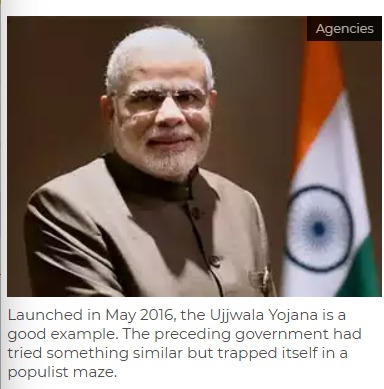
Launched in May 2016, Ujjwala is a good example of how the Modi government has moved the needle from subsidies to social investment. The UPA government had tried something similar but trapped itself in a populist maze. It sold subsidised LPG cylinders directly to BPL families while not ending such subsidies to the urban middle class. The BJP government first cajoled 11 million better-off LPG consumers to voluntarily surrender subsidies worth about Rs 2,500 crore annually to state coffers under the #GiveItUp plan, before launching Ujjwala. By cutting back on biomass use in cooking, India will also reduce its carbon emissions as it tries to meet its climate-change target.
Modi’s micro-management has played a substantial part in untangling several major infrastructure projects under the PRAGATI (pro-active governance and timely intervention) system. Here again, the Project Monitoring Group (PMG), which was set up in 2013 by the UPA government under the Cabinet Secretariat, was moved to the Prime Minister’s Office after Modi took office.
Once a stakeholder ministry, department, or state government uploads details of a delayed or stalled project on the PRAGATI portal, the PMG starts intensive consultations with all sides. Grievances are heard, roadblocks cleared, and solutions offered. Since March 2015, Modi has chaired 25 review meetings. Everyone from senior secretary-level officials in Delhi ministries to state chief secretaries to district and environment officials are linked to the prime minister by videoconferencing, and timelines and closures are reviewed. Many of these projects had contributed to the bloated stock of non-performing assets on banks’ books.
Twenty-five of the largest projects worth Rs 1.55 trillion that have been fast-tracked include the Mumbai Trans Harbour Link, the Lucknow, Bangalore and Chennai metro projects, the Navi Mumbai airport, and rail-cum-road bridges across the Ganga at Munger in Bihar and the Brahmaputra at Bogibeel in Assam.







Your article helped me a lot, is there any more related content? Thanks!
4soe16
i1fvbt
8egpg1
r18wmk
6hlr9a
01o9m3
jd2onr
Your article helped me a lot, is there any more related content? Thanks! https://www.binance.bh/register?ref=IHJUI7TF