

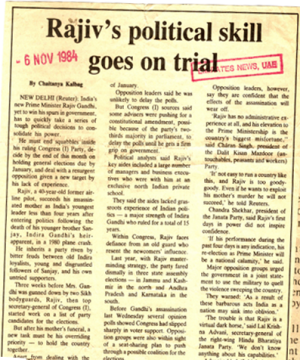
Rajiv’s political skill goes on trial
[Reuters]
Published date: 6th Nov 1984
View PDFBy Chaitanya Kalbag
NEW DELHI (Reuter): India’s new Prime Minister Rajiv Gandhi, yet to win his spurs in government, has to quickly take a series of tough political decisions to consolidate his power.
He must end squabbles inside his ruling Congress (I) Party, decide by the end of this month on holding general elections due by January, and deal with a resurgent opposition given a new target by his lack of experience.
Rajiv, a 40-year-old former airline pilot, succeeds his assassinated mother as India’s youngest leader less than four years after entering politics following the death of his younger brother Sanjay, Indira Gandhi’s heir apparent, in a 1980 plane crash.
He inherits a party riven by bitter feuds between old Indira loyalists, young and disgruntled followers of Sanjay, and his own untried supporters.
Three weeks before Mrs. Gandhi was gunned down by two Sikh bodyguards, Rajiv, then top secretary-general of Congress (I), started work on a list of party candidates for the elections.
But after his mother’s funeral, a new task must be his overriding priority — to hold the country together.
Apart from dealing with the communal crisis, a major decision he must take is whether to go ahead with what was believed to be his mother’s plan to hold national elections in the first week of January.
Opposition leaders said he was unlikely to delay the polls.
But Congress (I) sources said some advisers were pushing for a constitutional amendment, possibly because of the party’s two thirds majority in parliament, to delay the polls until he gets a firm grip on government.
Political analysts said Rajiv’s key aides included many managers and business executives who were with him at an exclusive north Indian private school.
They said the aides lacked grassroots experience of Indian politics — a major strength of Indira Gandhi who ruled for a total of 15 years.
Within Congress, Rajiv faces defiance from an old guard who resents the newcomers’ influence.
Last year, with Rajiv masterminding strategy, the party fared dismally in three state assembly elections — in Jammu and Kashmir in the north and Andhra Pradesh and Karnataka in the south.
Before Gandhi’s assassination last Wednesday several opinion polls showed Congress had slipped sharply in voter support. Opposition groups were also within sight of a seat-sharing plan to push through a possible coalition for the elections.
‘But Indira Gandhi’s killing may turn out to be the biggest boost the Congress (I) needed, an emotional issue to swing disenchanted voters back,” one analyst said.
Opposition leaders, however, say they are confident that the effects of the assassination will wear off.
“Rajiv has no administrative experience at all, and his elevation to the Prime Ministership is the country’s biggest misfortune,” said Charan Singh, president of the Dalit Kisan Mazdoor (untouchables, peasants and workers) Party.
“It’s not easy to run a country like this, and Rajiv is too goody-goody. Even if he wants to exploit his mother’s murder he will not succeed,” he told Reuters.
Chandra Shekhar, president of the Janata Party, said Rajiv’s first days in power did not inspire confidence.
“If his performance during the past four days is any indication, his re-election as Prime Minister will be a national calamity,” he said.
Major opposition groups urged the government in a joint statement to use the military to quell the violence sweeping the country.
They warned: “As a result of these barbarous acts India as a nation may sink into oblivion.”
“The trouble is that Rajiv is a virtual dark horse,” said Lal Krishna Advani, secretary-general of the right-wing Hindu Bharatiya Janata Party. “We don’t know anything about his capabilities.”
Advani added: “I think the sympathy factor is bound to fade, and without Mrs. Gandhi, can the Congress garner votes and can Rajiv inspire confidence? These are crucial questions.”







**mitolyn official**
Mitolyn is a carefully developed, plant-based formula created to help support metabolic efficiency and encourage healthy, lasting weight management.
8vq4e0
r0apex
19alyo
nrzjbe
83n3cc
e34fh8
Your point of view caught my eye and was very interesting. Thanks. I have a question for you.