

Indira Gandhi Assassination
[Reuters]
Published date: 1st Nov 1984
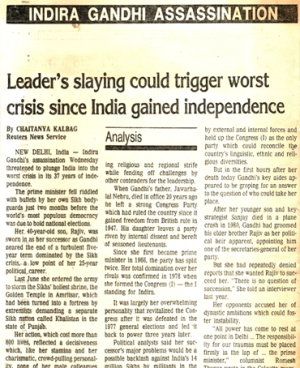
View PDFLeader’s slaying could trigger worst crisis since India gained independence
By CHAITANYA KALBAG
Reuters News Service
NEW DELHI, India – Indira Gandhi’s assassination Wednesday threatened to plunge India into the worst crisis in its 37 years of independence.
The prime minister fell riddled with bullets by her own Sikh bodyguards just two months before the world’s most populous democracy was due to hold national elections.
Her 40-year-old son, Rajiv, was sworn in as her successor as Gandhi neared the end of a turbulent five-year term dominated by the Sikh crisis, a low point of her 25-year political career.
Last June she ordered the army to storm the Sikhs’ holiest shrine, the Golden Temple in Amritsar, which had been turned into a fortress by extremists demanding a separate Sikh nation called Khalistan in the state of Punjab.
Her action, which cost more than 800 lives, reflected a decisiveness which, like her stamina and her charismatic, crowd-pulling personality, none of her male colleagues could match.
“India was teetering on the brink of a precipice and Gandhi’s sudden removal from the helm may well push it over the edge,” a senior official told Reuters.
“She made enemies because of her firm handling of crises and her refusal to bow to pressure, but there was nobody to match her in holding India together,” he added.
Political analysts said Rajiv Gandhi would have to tackle growing religious and regional strife while fending off challenges by other contenders for the leadership.
When Gandhi’s father, Jawaharlal Nehru, died in office 20 years ago, he left a strong Congress Party which had ruled the country since it gained freedom from British rule in 1947. His daughter leaves a party riven by internal dissent and bereft of seasoned lieutenants.
Since she first became prime minister in 1966, the party has split twice. Her total domination over her rivals was confirmed in 1978 when she formed the Congress (I) — the I standing for Indira.
It was largely her overwhelming personality that revitalized the Congress after it was defeated in the 1977 general elections and led it back to power three years later.
Political analysts said her successor’s major problems would be a possible backlash against India’s 14 million Sikhs by militants in the Hindu majority and a strong challenge to her philosophy of a strong central leadership.
Gandhi had successfully staved off calls for autonomy from opposition governments in Tamil Nadu State in the South and West Bengal in the East and more recently in the Northern border states of Jammu and Kashmir and Punjab.
In recent speeches she had repeated warnings that India was under growing threat of disruption by external and internal forces and held up the Congress (I) as the only party which could reconcile the country’s linguistic, ethnic and religious diversities.
But in the first hours after her death today Gandhi’s key aides appeared to be groping for an answer to the question of who could take her place.
After her younger son and key strategist Sanjay died in a plane crash in 1980, Gandhi had groomed his older brother Rajiv as her political heir apparent, appointing him one of the secretaries-general of her party.
But she had repeatedly denied reports that she wanted Rajiv to succeed her. “There is no question of succession,” she told an interviewer last year.
Her opponents accused her of dynastic ambitions which could foster instability.
“All power has come to rest at one point in Delhi…The responsibility for our traumas must be placed firmly in the lap of the prime minister,” columnist Romesh Thapar wrote in the Calcutta magazine Sunday last week.
But he added, echoing the dilemma recognized by both her friends and enemies: “Even those who seek to remove Indira Gandhi want to play Indira Gandhi.”
As the nation came to terms with the shock of her death, Gandhi’s followers felt she had died in defense of her beliefs symbolized by the Punjab crisis in which her decision to send in the army may have spelled her own death.




g9lvmb
07kqgo
dmdtoh
1jn8zw
5hd0nn
5sx8k0
n4haev