

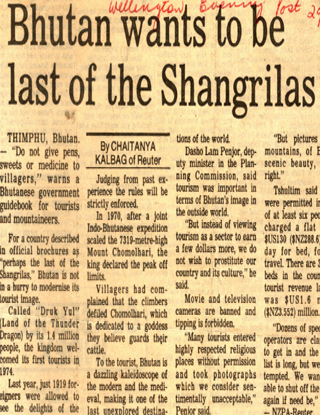
Bhutan wants to be last of the Shangrilas
Published date: Bhutan
View PDFBy CHAITANYA KALBAG of Reuter
THIMPHU, Bhutan.
—”Do not give pens, sweets or medicine to villagers,” warns a Bhutanese government guidebook for tourists and mountaineers.
For a country described in official brochures as “perhaps the last of the Shangrilas,” Bhutan is not in a hurry to modernize its tourist image.
Called “Druk Yul” (Land of the Thunder Dragon) by its 1.4 million people, the kingdom welcomed its first tourists in 1974.
Last year, just 1919 foreigners were allowed to see the delights of the mountainous nation sandwiched between China’s Tibet region and India.
They travelled on tightly controlled package tours that were priced high to discourage all but the five-star visitor.
There has been the same caution about mountaineering and a determination not to compete with Nepal, where climbers swarm over almost every peak.
Bhutan opened its first peak, 7015-metre-high Jitchudrake, to mountaineering teams two years ago.
Jigme Tshultim, general manager of the Bhutan Tourism Corporation, said one new peak would be opened to climbers every two years.
Tshultim said four expeditions had tried to scale Jitchudrake but each had failed. So far this year, 19 expeditions have applied, indicating the interest in Bhutan’s peaks.
Bhutan issued several rules when the first climbers were let in, saying they were imposed to preserve “ecological balance and cultural and traditional values.”
Judging from experience the rules will be strictly enforced.
In 1970, after a joint Indo-Bhutanese expedition scaled the 7319-metre-high Mount Chomolhari, the king declared the peak off limits.
Villagers had complained that the climbers defiled Chomolhari, which is dedicated to a goddess they believe guards their cattle.
To the tourist, Bhutan is a dazzling kaleidoscope of the modern and the mediaeval, making it one of the last unexplored destinations of the world.
Dasho Lam Penjor, deputy minister in the Planning Commission, said tourism was important in terms of Bhutan’s image in the outside world.
“But instead of viewing tourism as a sector to earn a few dollars more, we do not wish to prostitute our country and its culture,” he said.
Movie and television cameras are banned and tipping is forbidden.
“Many tourists entered highly respected religious places without permission and took photographs which we consider sentimentally unacceptable,” Penjor said.
“But pictures of our mountains, of Bhutan’s scenic beauty, are all right.”
Tshultim said tourists were permitted in groups of at least six people, and charged a flat rate of US$130 (NZ288.60) each a day, inclusive of food and travel. There are 368 hotel beds in the country and tourist revenue last year was $US1.6 million (NZ$3.552 million).
“Dozens of special tour operators are clamouring to get in and the waiting list is long, but we are not tempted. We want to be able to shut off the country again if need be,” he said
– NZPA-Reuter.


Your article helped me a lot, is there any more related content? Thanks!