

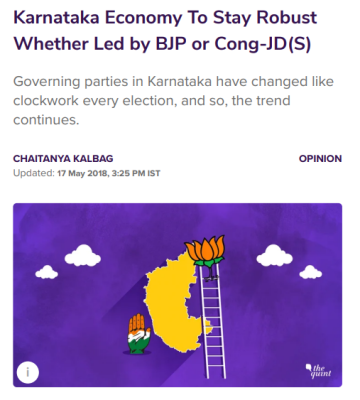
Karnataka Economy To Stay Robust Whether Led by BJP or Cong-JD(S)
Published date: 17th May 2018, The Quint
View PDFOne of the smartest things Prime Minister Narendra Modi did after coming to power four years ago was to appoint diehard loyalists as state governors. They were either beholden to him or to the Bharatiya Janata Party (BJP) or the Rashtriya Swayamsevak Sangh (RSS).
When the Congress was on top of the heap, it routinely shunted disgruntled and rebellious warhorses to Raj Bhavans across the country. In the BJP, if you are senior and disgruntled, you are simply placed in cryogenic care, not swaddled in gubernatorial warmth.
Those constitutional but unelected posts have been paying rich dividends as the BJP moves to a ‘Congress mukt Bharat’.
It doesn’t really matter how many seats the BJP ended up with in Karnataka’s hung assembly. The odds are that the BJP will form the next government even if it did not win an outright majority. What matters is that Karnataka Governor Vajubhai Vala is a Gujarat BJP politician.
The Science of Winning Elections
Under Modi and BJP President Amit Shah, the party has replaced the art of elections with the science of winning. It treats every state election like a key battle, down to the last panna, pramukh and booth karyakarta. It replenishes its war-chest and opens up with its big-calibre guns on its opponents.
Money is no object: A Centre for Media Studies survey said on Monday that Karnataka 2018 has been the most expensive state election, with between Rs 9,500 crore and Rs 10,500 crore spent. The state’s chief electoral officer said authorities had seized Rs 94 crore in cash, liquor worth Rs 24.78 crore, and other presumed voter inducements like clothes, vehicles and electronic gadgets worth Rs 66 crore.
A senior Karnataka bureaucrat I spoke with told me corruption in the state was huge and prevails across the board regardless of which party is in power. A lot of the corruption at the district level has been fed by poor land records. Karnataka politicians are among the country’s richest.
An Association for Democratic Reforms report said the average assets of 184 re-contesting MLAs had risen 64 percent between the 2013 and 2018 assembly elections to Rs 44.24 crore. The five richest politicians in the state all belong to the Congress party. The assets of the exiting Energy Minister, DK Shivakumar (who turned 56 on the day he won re-election from the Kanakapura constituency) rose 234 percent during the Siddaramaiah regime to Rs 840 crore.
The Economy Endures, Whoever Rules
The good news about the Karnataka election is that the state’s economy will continue to do reasonably well, whichever government takes power later this week. Karnataka’s gross state domestic product (GSDP) grew at a compounded annual growth rate (CAGR) of 12.8 percent between 2011 and 2018; GSDP is forecast to grow by 7.42 percent in 2018-19. The state has managed to keep its fiscal deficit below the FRBM target of three percent of GSDP since 2010-11.
There is serious farmer distress, although the state is more advanced than any other in linking its agricultural markets on an electronic platform that ensures better price discovery and access to markets for farmers. Kiran Mazumdar Shaw, chairperson of Biocon Limited, said earlier this month that Karnataka’s entrepreneurial ecosystem has sustained its economy.
“Government engaged very closely with first-generation entrepreneurs in policy-making,” she said. “That is why you have seen that Karnataka has always been ahead in terms of policy-making, whether it is IT policy, biotech policy, start-up policy, electric-vehicle policy — you name it.”
SM Krishna, Congress Chief Minister between 1999 and 2004, is credited with setting up the Vision Groups of entrepreneurs to help devise policy. The senior bureaucrat I spoke with said most of the other chief ministers have been dhotiwallahs, more rustic in their roots. But Mazumdar Shaw said even Siddaramaiah, who hails from the hard-scrabble Kuruba sheep-herding community, had put in a fair bit of infrastructure, including the Bangalore Metro and continued investing in science and technology — steps that would benefit the next government.
If the BJP forms the next Karnataka government, it will have to live down the chaos of three chief ministers in five years in its 2008-13 term in power. The 2018 campaign has seen new lows in abuse and brazen appeals to caste and religion. Whichever side Governor Vala picks, we will have to hold our noses and cheer our latest exhibition of democracy.





da4y6l
Your article helped me a lot, is there any more related content? Thanks!
fnz0x2
zr5ras
6r9qzn
baayfo
e68icp
0mj382
l690zf
zdghes