Life In Iran – Joyless and Hopeless
Published date: Feb 2nd to Feb 15th 1981, New Delhi
View PDFBut the people have their ways of making do
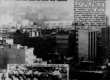
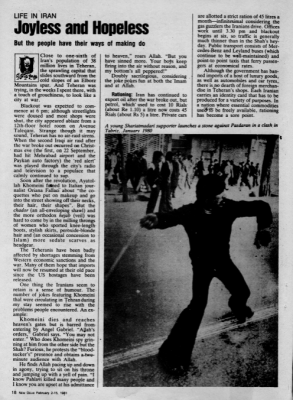
Close to one-sixth of Iran’s population of 38 million lives in Teheran, the sprawling capital that slides southward from the cold slopes of an Elborz Mountains spur. And Teheran was trying, in the weeks I spent there, with a touch of grouchiness, to look like a city at war.
Blackout was expected to commence at 6 pm; although streetlights were doused and most shops were shut, the city appeared ablaze from a 12th-floor hotel room on Avenue Taleqani. Strange though it may sound, Teheran has no air-raid sirens. When the second Iraqi air raid after the war broke out occurred on Christmas eve (the first, on 22 September, had hit Mehrabad airport and the Paykan auto factory) the ‘red alert’ was played through the city’s radio and television to a populace that calmly continued to sup.
Soon after the revolution, Ayatollah Khomeini fumed to Italian journalist Oriana Fallaci about “the coquettes who put on makeup and go into the street showing off their necks, their hair, their shapes”. But the chador (an all-enveloping shawl) and the more orthodox hejab (veil) was hard to come by in the milling throngs of women who sported knee-length-boots, stylish skirts, peroxide-blonde hair and (an occasional concession to Islam) more sedate scarves, as headgear.
The Teheranis have been badly affected by shortages stemming from Western economic sanctions and the war. Many of them hope that imports will now be resumed at their old pace since the US hostages have been released.
One thing the Iranians seem to retain is a sense of humour. The number of jokes featuring Khomeini that were circulating in Tehran during my stay seemed to rise with the problems people encountered.
Rationing: Iran has continued to export oil after the war broke out, but petrol, which used 4to cost 10 Rials (about Re 1.10) a litter now costs 45 Rials (about Rs 5) a litter. Private cars are allotted a strict ration of 45 litres a month-infinitesimal considering the gas guzzlers the Iranians drive. Offices work until 3.30 pm and blackout begins at six, so traffic is generally much thinner than in the Shah’s hey-day. Public transport consists of Mercedes-Benz and Leyland buses (which continue to be well-maintained) and point to point taxis that ferry passengers at economical rates.
Although the government has banned imports of a host of luxury goods, as well as automobiles and car tyres, there is no dearth of foreign merchandise in Teheran’s shops. Each Iranian carries an identity card that has to be produced for a variety of purposes. In a nation where essential commodities used to be freely available, rationing has become a sore point.
Each citizen is entitled (on the basis of ration coupons) to five kg of sugar a month (at Rs 2.60 per kg), 20 litres of kerosene per week (insufficient to keep giant room-heaters going), and heating oil for central- heating systems. Eggs are really scarce, sold in kilograms, and pounced upon at first sight (at Rs 25 a kg), rice (American, smuggled in through Dubai) costs about Rs 24 a kg, and meat is exorbitantly expensive-720 rials (about Rs 78.50 per kg). Chicken is cheaper, at Rs 24 a kg, while milk and bread are also very difficult to find.
Every morning, however, I saw people queueing outside shops that sold long noons-a nan by another name, which is a staple item in Iranian diets, along with green salad, dill pickle, and a rice-and-meat combination called chelo kabab.
Snuffed out: Teheran’s nightlife, which used to be legendary, has been snuffed out. Liquor is strictly taboo, although many Iranians brew a potent drink, misnamed vodka, in their homes from locally available grapes. Weaned on colour television the Iranians complain about the deadening fare of revolutionary films (many of them Algerian) in the cinema halls, and the dull propaganda on TV. Iranians are great talkers, and one was astonished to see heavily sedated Pasdaran (wounded on the battlefront) holding forth at length, in TV interviews, on Khomeini’s leadership and the inevitable victory of Islam.
Still, groups of people huddled in hotel lobbies on Friday evenings (Fridays are weekly holidays) drinking in illegally imported videotapes of Western films. The Iranians are acknowledged masters at the art of film dubbing, and it was strange watching a Bud Spencer Western on video or Zoltan Fabri’s ‘The Hungarians’ on TV with the characters spouting fluent Farsi.
The huge Kourosh departmental store in central Tehran had on display a variety of imported foodstuff-mayonnaise from Holland, American rice, Danish and Australian meat, Swiss coffee, Brazilian sugar, and British cocoa.
Dubai has become Iran’s lifeline after the trade sanctions: Dhows carrying anything from essential food items to electrical goods, cigarettes and alcohol berth regularly at the numerous ports that surround Bandar Abbas, the southern port on the Persian Gulf. There have been friends despite the sanctions: the Soviet Union pitched in with huge sugar shipments, and New Zealand reduced lamb exports to the UK by 30,000 tonnes in order to meet commitments in Iran.
The lifestyle that proximity to the Americans induced has not changed much since the revolution. Pepsi and Coke are still bottled locally; American newsmagazines still hit Tehran newsstands ahead of their issue dates (with zealous censors painting black ink over ‘filth’ such as pictures of bikini-clad girls); plug-in phones, fried chicken and hamburgers pervade Iranian lives as much as locally manufactured Kleenex tissues and Tampons do.
Automobiles: On the streets, aside from the Paykans (locally assembled cars, using imported British Hillman parts) and some American cars, German Mercedes-Benzes and BMWs (the latter are coveted status symbols) one sees a huge Japanese presence. Almost every brand of Japanese auto- mobile and two-wheeler is represented, with traffic policemen preferring. Yamaha 350s and Pasdaran favouring Hondas. There are huge numbers of shoppers crowding major streets on any morning (leading visitors to wonder who mans Iran’s offices) and a common sight is young couples walking, hands clasped, past shop windows.
Iran is, an incredibly young nation-45 per cent of its population is under 15 years of age. It is also a country where there are more women than men. The voting age was reduced to 16 after the revolution, and a man is now allowed to wed four wives if he can afford to look after them. The marriage age for girls has been reduced to 13. The result: a stunning increase in the number of teenaged mothers.
As one travels south to Tehran, the shortages become less visible, for Bandar Abbas lies in the deep south and Tehran is far away from it. In Esfahan, a city a-brim with stunning mosques, Bani-Sadr’s face looked out with benevolent eyes from almost every shop window (Esfahan is a Bani-Sadr stronghold). In Shiraz, further south, surrounded as it is by hills, the war has scarcely intruded, and the Shirazis continue to live up to their reputation of being insular people, not easily moved into action or anger. Shiraz is the nation’s cultural centre (the Asian Cultural Festival used to be held there before the revolution) and aside from the tombs of Persian poets Hafez and Saadi, it has hosted Firdausi and Omar Khayyam.
In Shiraz, a prominent Jewish minority has been silently harassed. In Esfahan, a large community of American Christians, who played a major role in trade and ran a good mission hospital, have similarly suffered. The pastor of the local diocese is in prison. This, despite the fact that the Iranian Constitution grants recognition to Jews, Christians and Zoroastrians.
As Iran’s few factories reel under the maladministration of ‘managers’ whose only qualification is Islam, dis- content often surfaces in noisy Tehran demonstrations demanding undisbursed pay or benefits. Large-scale purges have taken place in many ministries (which were major employers). Islamic commissars routinely ruin sensitive factory equipment by driving them beyond capacity.
Pathetic: Only three categories of people are allowed to leave Iran today-with letters from the Prime Minister’s office that are next to impossible to obtain: the very ill, businessmen, and students in the midst of courses abroad. N, a young Iranian shopkeeper from London, had a pathetic story to tell in this connection.
Just before the war began, N came to Tehran with his six-year-old daughter to visit an ailing mother. He succeeded in sending his mother to Germany for treatment. But to his horror, he was told his daughter could not accompany him back to London since she did not fall in any of the allowable categories. As a result, N has been staying in an expensive Tehran hotel for close to four months, and journeys every day with little hope to the emigration office where two teenaged boys decide who will or will not leave Iran. They have told N that he can take his daughter away if he pays them a bribe of one million rials.
A rumour that bank accounts would be confiscated by the government when the war broke out sparked off a run on the banks. Today, most Iranians prefer to hoard all their cash savings at home-and so there is a desperate shortage of currency notes in the market. Maimed and mutilated notes that would otherwise not pass muster are accepted without demur, and Bank Markazi, the central bank, has had to print ‘cheques’ worth 10,000 rials each to meet the shortage.
Gradually, the hardships that the revolution brought with it are eating into the Iranians’ hearts and they have affected even the poor Iranians who form the mullahs’ major constituency. If a poll were taken of Iranian sentiments today, it would show: that the hostage capture was perceived to be a mistake by a majority; that, though the Iraqis need to be ejected from Iranian territory, the war had been “asked for” by the clergy; and finally, that Bani-Sadr is the only man left who can “set things right”.
INDIANS IN IRAN – ‘Not Like Europe Anymore’
But, despite the war, they have a fairly decent time
Officially, there are at least 5,300 Indians in Iran today. Not many left the country after the war began, in contrast to the considerable exodus from Iraq. No Indian has so far been killed or injured as a result of the war. The only time Indians were in physical danger was on 22 September, the day the war broke out, when eight Indians manning the Indian consulate in Khorramshahr had to hastily evacuate in one automobile, leaving almost all their belongings behind.
Once-weekly flights from Bombay to Teheran, which were resumed on 19 December, have seen many Indian doctors returning to Iran with their families. The doctors began migrating to Iran around six years ago when the recruitment of Indian professionals by foreign governments was regularised and routed through the Ministry of External Affairs. Doctors from Andhra Pradesh and Kerala outnumber those from other states.
More than doctors are in great demand in Iran. Engineers and architects are willing to work in remote; rural areas at half the wages they used to be paid in pre-revolutionary times. They are sponsored by the employers of the Health Ministry and the Education Ministry to enter private practice, but may be on contract.
As of now, they earn a average monthly salary of 40,000 rials (about Rs 4,540), 80,000 rials a month (about Rs 9,000) if one also maintains an all-consultancy hospital. Generally, Indians have been paid fairly well. And most of them still work in small cities rather than the capital — mainly because of the natural (and clandestine) anti-American sentiment that persists in the capital. Only about 1,500 Indians are believed to be still in Esfahan, a city which saw many Indian doctors fleeing after the war broke out. Others are slowly returning to the interior.
Another optimistic story: a senior surgeon who had reportedly earned only 15,000 rials during his six-week stay in Teheran way back in 1974, and who had faced up then with more than 200,000 rials a month. During his last week in Teheran he could easily have stayed in a plush hotel. Instead, he chose to have as host, a chauffeur at the Indian embassy.
But Indians are liked by Jewish and Christian landlords, who, fearful of sudden invasion by local komitehs prefer not to rent their places out to Muslims. Real estate values crashed after the revolution, but now they are on the rise again, and it is common for a two-bedroom apartment, whether it be in Teheran or Shiraz, to cost upwards of 20,000 rials a month.
Demand: The demand for doctors is not surprising: in a country with a population of 39 million, there were only 13,000 native doctors, of whom more than 5,000 fled the country after the revolution. Stark poverty stalks provinces like Kurdistan, Khuzestan, and Sistan-Baluchistan, where peasants try to eke out a sparse livelihood from saline soil. And no Iranian doctor is willing to serve in areas like Kurdistan, where civil war has made life quite dangerous.
There are quite a few illegal Indian residents in Iran, most of them have slipped across the border from Afghanistan, and work as truck drivers and construction workers. But construction work has come to a standstill after the war, and so the Indian embassy on Avenue Saba in Teheran is every day issuing ‘emergency certificates’, which enable the holder to travel back to India.
The shortages the Western sanctions and the war brought about have affected Indians more than most. Milk, sugar, and rice are staple items in their diets; as are vegetables. One frequently hears complaints about wives being forced to stand in long queues for rations. As a result, most Indians, who have lived in pre and post-revolution Iran, tend to speak nostalgically about the Shah’s days. “Life was so good, it was almost like Europe” they say.
Indian embassy officials in Teheran have not been spared their share of problems. Food (and liquor) stores are vastly depleted since supplies used to come in from London and Delhi. Petrol is rationed for diplomats too, although their allowance is more generous than the ‘Iranian’. When the diplomatic bag goes once a week from Teheran, a special petrol allowance has to be obtained through the Foreign Ministry for the long car ride to Bandar Anzali on the Caspian Sea, where a courier from the Indian embassy in Moscow comes with the bag from Delhi. The Teheran-Bandar Anzali-Moscow-Delhi route takes as many as ten days. Strangely, although the Teheran embassy could have been housed in a good building bought during the land price crash, it is still housed in a rented building and presents a seedy appearance. The only advantages of the location: the proximity of the local Pasdaran Hq and the Palestinian embassy.
One Indian who has reason to be fed up with Iran is the AIR correspondent in Teheran, C.V. Raman. Raman has been there since October 1978 and was witness to the final stages of the revolution. His post-revolution reportage has not, as far as one can make out, been objectionable. But Raman (who stays in Teheran with his wife) has to go through a nerve-wracking run-around every so often with the Foreign Ministry, the Ministry of Guidance (a symbolic name for the Ministry of Information) and the national police (who refuse to recognise the authority of the other ministries). Raman is granted two-week visas and is frequently threatened with non-renewal, although he holds an official passport and has embassy personnel helping him. In contrast, the Voice and Vision of Iran correspondent in Delhi is granted one-year accreditation by our magnanimous government.
The situation is summed up by a senior Indian embassy official who was in China at the height of the cultural revolution there. “Life was pretty dangerous then,” he recalls, “but compared to Beijing, Teheran is a hardship post five times over.”