

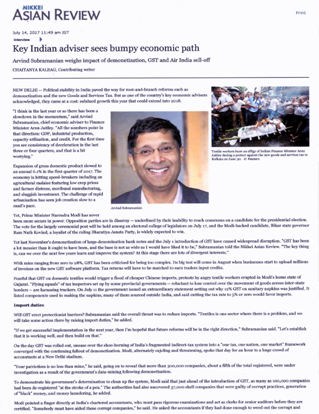
Key Indian adviser sees bumpy economic path
Published date: 14th Jul 2017, Nikkei Asian Review
View PDFArvind Subramanian weighs impact of demonetization, GST and Air India sell-off
Chaitanya Kalbag, Contributing writer
NEW DELHI — Political stability in India paved the way for root-and-branch reforms such as demonetization and the new Goods and Services Tax. But as one of the country’s key economic advisers acknowledged, they came at a cost: subdued growth this year that could extend into 2018.
“I think in the last year or so there has been a slowdown in the momentum,” said Arvind Subramanian, chief economic adviser to Finance Minister Arun Jaitley. “All the numbers point in that direction: GDP, industrial production, capacity utilization, and credit. For the first time you see consistency of deceleration in the last three or four quarters, and that is a bit worrying.”
Expansion of gross domestic product slowed to an annual 6.1% in the first quarter of 2017. The economy is hitting speed-breakers including an agricultural malaise featuring low crop prices and farmer distress, moribund manufacturing, and sluggish investment. The challenge of rapid urbanization has seen job creation slow to a snail’s pace.
Yet, Prime Minister Narendra Modi has never been more secure in power. Opposition parties are in disarray — underlined by their inability to reach consensus on a candidate for the presidential election. The vote for the largely ceremonial post will be held among an electoral college of legislators on July 17, and the Modi-backed candidate, Bihar state governor Ram Nath Kovind, a loyalist of the ruling Bhartiya Janata Party, is widely expected to win.
Yet last November’s demonetization of large-denomination bank notes and the July 1 introduction of GST have caused widespread disruption. “GST has been a lot messier than it ought to have been, and the base is not as wide as I would have liked it to be,” Subramanian told the Nikkei Asian Review. “The key thing is, can we over the next few years learn and improve the system? At this stage there are lots of divergent interests.”
With rates ranging from zero to 28%, GST has been criticized for being too complex. Its big test will come in August when businesses start to upload millions of invoices on the new GST software platform. Tax returns will have to be matched to earn traders input credits.
Fearful that GST on domestic textiles would trigger a flood of cheaper Chinese imports, protests by angry textile workers erupted in Modi’s home state of Gujarat. “Flying squads” of tax inspectors set up by some provincial governments — reluctant to lose control over the movement of goods across inter-state borders — are harassing truckers. On July 11, the government issued an extraordinary statement setting out why 12% GST on sanitary napkins was justified. It listed components used in making the napkins, many of them sourced outside India, and said cutting the tax rate to 5% or zero would favor imports.
Import duties
Will GST erect protectionist barriers? Subramanian said the overall thrust was to reduce imports. “Textiles is one sector where there is a problem, and we will take some action there by raising import duties,” he added.
“If we get successful implementation in the next year, then I’m hopeful that future reforms will be in the right direction,” Subramanian said. “Let’s establish that it is working well, and then build on that.”
On the day GST was rolled out, unease over the shoehorning of India’s fragmented indirect-tax system into a “one tax, one nation, one market” framework converged with the continuing fallout of demonetization. Modi, alternately cajoling and threatening, spoke that day for an hour to a huge crowd of accountants at a New Delhi stadium.
“Your patriotism is no less than mine,” he said, going on to reveal that more than 300,000 companies, about a fifth of the total registered, were under investigation because of the government’s data mining following demonetization.
To demonstrate his government’s determination to clean up the system, Modi said that just ahead of the introduction of GST, as many as 100,000 companies had been de-registered “at the stroke of a pen.” The authorities had also uncovered 37,000 shell companies that were guilty of corrupt practices, generation of “black” money, and money laundering, he added.
Modi pointed a finger directly at India’s chartered accountants, who must pass rigorous examinations and act as clerks for senior auditors before they are certified. “Somebody must have aided these corrupt companies,” he said. He asked the accountants if they had done enough to weed out the corrupt and dishonest among themselves. The self-regulating Institute of Chartered Accounts of India had acted against a mere 25 errant accounting firms over the past 11 years, Modi noted.
The prime minister then switched from attack mode to an appeal to the auditors to make GST a success. “I invite you to join in this celebration of honesty,” he urged them.
Tax experts agree that over the long term, the GST will pull more Indian businesses into the formal economy, expand both indirect and direct tax bases, and force compliance through technology. “But it is not going to boost demand over the short term,” Subramanian admitted.
With agricultural productivity falling, can India inject dynamism into its non-agricultural sectors? As processes improve, so should productivity, but that will not happen soon either, Subramanian said, predicting it would take at least a year.
As for the current fiscal year to March 31, 2018, he said inflation had changed for the better structurally. On July 12, after data was released showing June Consumer Price Index inflation had fallen to a five-year low of 1.54% on an annualized basis, Subramanian issued a strong statement arguing there had been a “paradigm shift in the inflationary process to low levels” and urging the RBI to cut interest rates.
Nonperforming assets
The economic boost from lower oil prices has tapered off, and although exports are starting to recover after a long downturn, the economy has been hit by demonetization as well as the huge overhang of nonperforming assets in the banking system.
The Reserve Bank of India, the central bank, has been given the mandate to force banks to push the most heavily indebted companies into insolvency proceedings. “The ball is with the RBI,” Subramanian noted. “We need to see some successful resolutions in the next few months that are not bogged down in bankruptcy proceedings or litigation.”
The next big challenge for Modi, in Subramanian’s view, will be the privatization of Air India, the national airline. The planned sale of the ailing carrier and the spin-off of five subsidiaries was announced on June 28.
Air India is drowning in debt amounting to more than 500 billion rupees ($7.7 billion). A 2012 plan by the previous Congress government to inject over 300 billion rupees of capital until 2021 is underway but has so far failed to rescue the airline. Air India now has only about 13% of the market, compared with 36% for the nimbler private budget airline IndiGo, despite the national carrier’s larger fleet of 118 aircraft.
Modi has named a committee of five senior ministers led by Jaitley to plot the privatization. Subramanian said a successful sale could unleash more such divestments.
He saw Air India as an indicator of the political will for reform. “To do it they will have to overcome a lot of political opposition, [and] the trade unions,” he said. “But if you can do that, it paves the way for more things to come.”
Subramanian said he did not see evidence that economic policymaking would turn more populist as the 2019 general election neared. “If [populism] had been the perspective, then GST and Air India would not have happened,” he said.
Of the border tensions with China which followed India’s cold-shouldering of Beijing’s Belt and Road Initiative to link South Asian countries with land and maritime connectivity, Subramanian quoted economist Vijay Kelkar as saying the best foreign policy was 10% annual economic growth. “We need to get to that. The short-term is a bit challenging,” he said.







Your point of view caught my eye and was very interesting. Thanks. I have a question for you.
8wnem5
c7p2w9
7cjfqy
znn7ot
4bjn32
Your article helped me a lot, is there any more related content? Thanks! https://www.binance.bh/register?ref=JW3W4Y3A
fz3f8k
i3d6le
aawmma
dubt5v