

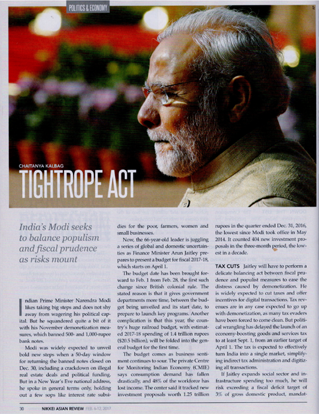
Tightrope Act – India’s Modi seeks to balance populism and fiscal prudence as risks mount
Published date: 6th-12th Feb 2017, Nikkei Asian Review
View PDFChaitanya Kalbag, Contributing writer
Indian Prime Minister Narendra Modi likes taking big steps and does not shy away from wagering his political capital. But he squandered quite a bit of it with his November demonetization measures, which banned 500 and 1,000 rupee bank notes.
Modi was widely expected to unveil bold new steps when a 50-day window for returning the banned notes closed on Dec. 30, including a crackdown on illegal real estate deals and political funding. But in a New Year’s Eve national address, he spoke in general terms only, holding out a few sops like interest rate subsidies for the poor, farmers, women and small businesses.
Now, the 66-year-old leader is juggling a series of global and domestic uncertainties as Finance Minister Arun Jaitley prepares to present a budget for fiscal 2017-18, which starts on April 1.
The budget date has been brought forward to Feb. 1 from Feb. 28, the first such change since British colonial rule. The stated reason is that it gives government departments more time, between the budget being unveiled and its start date, to prepare to launch key programs. Another complication is that this year, the country’s huge railroad budget, with estimated 2017-18 spending of 1.4 trillion rupees ($20.5 billion), will be folded into the general budget for the first time.
The budget comes as business sentiment continues to sour. The private Centre for Monitoring Indian Economy (CMIE) says consumption demand has fallen drastically, and 48% of the workforce has lost income. The center said it tracked new investment proposals worth 1.25 trillion rupees in the quarter ended Dec. 31, 2016, the lowest since Modi took office in May 2014. It counted 404 new investment proposals in the three-month period, the lowest in a decade.
TAX CUTS Jaitley will have to perform a delicate balancing act between fiscal prudence and populist measures to ease the distress caused by demonetization. He is widely expected to cut taxes and offer incentives for digital transactions. Tax revenues are in any case expected to go up with demonetization, as many tax evaders have been forced to come clean. But political wrangling has delayed the launch of an economy-boosting goods and services tax to at least Sept. 1, from an earlier target of April 1. The tax is expected to effectively turn India into a single market, simplifying indirect tax administration and digitizing all transactions.
If Jaitley expands social sector and infrastructure spending too much, he will risk exceeding a fiscal deficit target of 3% of gross domestic product, mandated for 2017-18 by the country’s Fiscal Responsibility and Budget Management Act. He has pledged to stick to a 3.5% target for the year, but the comptroller and auditor general have already estimated that the deficit will come in at 4.3%. Just days ago, a blue-ribbon committee created by Jaitley to recommend changes in the FRBM Act submitted its report.
Although the report has not been made public, leaks indicate it has recommended creating some “wiggle room” to allow the government to maintain the deficit at 3.5%. This will not be popular with investors. Standard & Poor’s, which rates India BBB—its lowest investment-grade rating, has warned that Jaitley must stick to fiscal consolidation and work to bring down India’s debt-to-GDP ratio to below 60% from the current 66%.
To complicate matters, Jaitley has been cautioned by the Election Commission not to announce any steps that could be construed as illegal blandishments for voters, who will elect new governments in five Indian states starting Feb. 4. Modi’s Bhartiya Janata Party is especially keen on seizing power in the huge northern state of Uttar Pradesh, where farmers were hit hard by demonetization.
External risks are mounting. A steepening U.S. yield curve and a resurgent dollar have combined with rising global oil prices in ways that could end a toward-a-half-year windfall that began with Modi’s election in mid-2014 and gave him and Jaitley plenty of fiscal elbow room. Instead of slashing gasoline and diesel prices for consumers as market prices fell, the government jacked up excise duties, boosting its indirect tax revenues. That bonanza may end soon as the Organization of the Petroleum Exporting Countries cuts output.
However, Modi has moved adroitly to plan for a new oil price crunch. On Jan. 25, he signed a pact with the United Arab Emirates to store 6 million barrels of crude in strategic underground tanks in southern India. His government has put away another 13.5 million barrels from Iran and Iraq and aims at total reserves of about 37 million barrels, which is 10 days’ supply for the world’s third-biggest oil consumer.
Modi will need such nimble footwork when dealing with U.S. President Donald Trump. He was the fifth world leader to get a call from Trump, but he knows he must balance friendship with Washington with Trump’s populist and protectionist “Buy American, hire American” policies, which could hurt everything from India’s software companies to already struggling exports.
Three days before Trump’s inauguration, Modi said at a conference in New Delhi that the assembled international audience would be debating “black swans and [the] new normal.” Sluggish growth and volatility were coming, he said, along with “walls within nations, a sentiment against trade and migration, and rising parochial and protectionist attitudes across the globe…Globalization gains are at risk, and economic gains are no longer easy to come by.” As if he were responding to Modi, Trump painted an apocalyptic picture in his Jan. 20 inaugural speech of a gutted American economy that needed to be rescued, although the numbers say otherwise. “Protection will lead to great prosperity and strength,” Trump proclaimed.
FALLING BEHIND CHINA
Domestically, the effects of demonetization have not become fully apparent. India had nosed ahead of China to claim the title of the world’s fastest-growing economy but is now projected by the International Monetary Fund to grow at 6.6% in 2016-17. This is a full percentage point below its October 2016 forecast. It means India will slip behind China and grow at a slower-than-predicted 7.2% in 2017-18, before bouncing back to 7.7% the following year. The government’s own Central Statistical Organization trimmed its 2016-17 growth forecast to 7.1% from 7.6%, making plain that the number did not factor in the effects of demonetization.
Modi’s stated goals for demonetization have not been met, despite the disruption and slowdown that he urged Indians to take in stride. The Reserve Bank of India was reported to have replied to a request for information by saying it had no data on counterfeit currency notes surrendered to banks. Replacement of the 15.4 trillion rupees worth of banknotes rendered useless on Nov. 8 has been slower than promised by Jaitley. RBI Governor Urjit Patel was reported to have told a parliamentary panel that 6.8 trillion rupees worth of new notes had been injected into the economy between Nov. 9 and Jan. 13.
Given the government’s massive push for more digital transactions, and the conversion of hoarded cash into bank deposits, Nomura Securities estimated that the economy would now require a cash-to-GDP ratio of about 9%, compared with a pre-demonetization high of 12%, and cash levels would reach that ratio by around the end of March.
Modi has told Indians that demonetization is just one of his moves against endemic corruption. But he received a poor report card on Jan. 25, on the eve of Republic Day celebrations, when Transparency International announced its Corruption Perceptions Index for 2016. India slipped to 79th among 176 countries and regions, from 76 among 168 in 2015 (the lower the ranking, the more corrupt the country). TI said this year’s rankings highlighted the connections between corruption, inequality and populism.
In words that seemed addressed directly to Modi, who has yet to move strongly against political corruption, TI said: “India’s ongoing poor performance … reiterates the states inability to effectively deal with petty corruption as well as large scale corruption scandals. The impact of corruption on poverty, illiteracy and police brutality shows that not only the economy is growing—but also inequality.”





bwpg24
6ykmib
dt4dh5
lwfruf
r8y1o4
1788ek
geky60
nhuuzf
mqjajs