

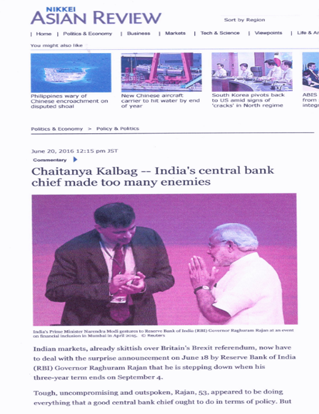
India’s central bank chief made too many enemies
Published date: 20th Jun 2016, Nikkei Asian Review
View PDFChaitanya Kalbag, Contributing writer
Indian markets, already skittish over Britain’s Brexit referendum, now must deal with the surprise announcement on June 18 by Reserve Bank of India (RBI) Governor Raghuram Rajan that he is stepping down when his three-year term ends on September 4.
Tough, uncompromising and outspoken, Rajan, 53, appeared to be doing budget signs everything that a good central bank chief ought to do in terms of policy. But he was too independent for India’s politicians and stepped on some very big toes.
Rajan served notice of what to expect on his very first day in office at the RBI, when he said: “The governorship of the Central Bank is not meant to win one votes or Facebook ‘likes’. But I hope to do the right thing, no matter what the criticism.”
Two weeks after he took over, Rajan stunned markets by raising interest rates, and did so twice more until early 2014, taking the repo rate to a high of 8% from 7.25%. Under constant pressure from the government and businessmen, he has since trimmed interest rates to a five-year low of 6.5% since January 2015, but critics wanted more.
Nonetheless, Rajan’s efforts to restore investor confidence in India, arrest a sharp fall in the rupees value and attack double-digit inflation have paid off.
Foreign direct investment rose from $36 billion in 2013/14, the year before Modi took power, to $55.45 billion in 2015/16. Foreign exchange reserves have increased sharply, and the rupee ended last week trading close to 67 to the dollar, the same level the central bank chief inherited.
Despite those results, Modi’s government had turned frosty, and some of its leaders distinctly hostile towards the RBI chief over the past couple of months. The government was celebrating two years in power, helped by growth of 7.6% in 2015-16 and the prospect of India being the world’s fastest growing economy this year.
But inflation, which Rajan targeted at 5% in fiscal 2016/17 ending March, rose sharply to 5.76% in May on the back of high food prices. Rajan responded by holding rates steady, ignoring business and political pressure to trim further.
In his farewell message to RBI staff on Saturday, Rajan made clear he would have liked to stay on but was being pushed. “While I was open to seeing these developments through, on due reflection, and after consultation with the government, I want to share with you that I will be returning to academia when my term as Governor ends,” he wrote. He also referred to two pieces of unfinished business on which he and the government have not seen eye to eye.
The first was a Monetary Policy Committee, recommended by a panel set up by Rajan himself. An MPC would dilute Rajan’s singular power to decide on interest rates, but differences erupted over the membership and the RBI’s remit. A six-member committee will now be set up only by September, nearly 18 months after it was mooted, with the governor holding the casting vote.
Separately, an Asset Quality Review ordered by Rajan to attack crisis levels of bad loans made by state-owned banks and an accompanying crackdown on ‘willful defaulters’ among oligarchs in the infrastructure sector who have borrowed recklessly for stalled projects may have earned Rajan too many powerful and politically connected enemies.
Businessmen opposed to the independent-minded central bank governor gained more ruling party allies when Rajan said in a mid-April interview in the U.S. that although India had been described by the IMF as the one bright spot in a weakening world economy, “…I think we’ve still to get to a place where we feel satisfied. We have this saying, ‘in the land of the blind, the one-eyed man is king.” We’re a little bit that way.”
That remark invited blistering retorts from some of Modi’s colleagues. Although Rajan tried to back-pedal some days later, the damage had been done. The most vituperative attacks came from Subramaniam Swamy, a lawmaker from Modi’s Bhartiya Janata Party (BJP). Swamy alleged that Rajan was not Indian (he holds an Indian passport and has a U.S. green card), and that his interest-rate policies had destroyed small businesses.
For Modi, who keeps his ministers on a tight leash, the last straw must have been a chorus of support for Rajan from international economists, polls of Indian CEOs, as well as an online petition signed by thousands. Luigi Zingales, a fellow professor of finance from the University of Chicago’s Booth School of Business, wrote last week that Rajan was being targeted because he had attacked crony capitalism, and called for a second term for the governor so he could complete his task.
N.R. Narayana Murthy, the billionaire technocrat who co-founded software giant Infosys, believes that the effects of Rajan’s exit will pass off because India’s economic fundamentals are strong.
“But what is more critical is: Will any other non-resident Indian come to India and take up an important responsibility if we start questioning their Indianness?” Murthy told the Nikkei Asian Review.
“We are in 2016. We cannot behave like we are in East India Company times. This is a time when we must solve our poverty; we must create ten million jobs every year; this is the time when the economy must grow at 10%. For that to happen we require intelligent people of Indian origin from all over the world. If you want to attract them, you have to make this country a hospitable place for them.”







Thanks for sharing. I read many of your blog posts, cool, your blog is very good.
Thanks for sharing. I read many of your blog posts, cool, your blog is very good.
sjlrlh
6dn93n
41pypx
2cvtzv
x44a7h
iunq8n
tsc2vd
ugrxvs