

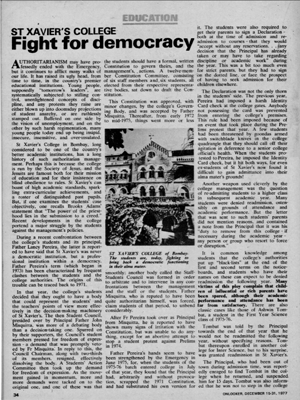
St Xavier’s College – Fight For Democracy
Published date: 15th-31st Dec 1977, Onlooker
View PDFAuthoritarianism may have professedly ended with the Emergency, but it continues to afflict many walks of our life. It has raised its ugly head, from time to time, in the country’s premier educational institutions. Young people, supposedly “tomorrow’s leaders”, are systematically subjected to stifling control, unenlightened concepts of discipline, and any protests they raise are either blown up into doomsday projections of student anarchy, or, are ruthlessly stamped out. Buffeted on one side by the vision of unemployment, and on the other by such harsh regimentation, many young people today end up being insipid, insecure, insensitive, and over-insulated.
St Xavier’s College in Bombay, long considered to be one of the country’s better academic institutions, has a long history of such authoritarian management. Perhaps this is because the college is run by the Society of Jesus, and the Jesuits are famous both for their mission of education and for their insistence on blind obedience to rules. St Xavier’s can boast of high academic standards, sparkling extra-curricular achievements, and a roster of distinguished past pupils. But, if one examines the students’ case objectively, one recalls Brooks Adams’ statement that “The power of the priesthood lies in the submission to a creed.” Recent developments in the college portend a major struggle by the students against the management’s policies.
During a recent confrontation between the college’s students and its principal, Father Lancy Pereira, the latter is reported to have said that St Xavier’s was never a democratic institution, but a professional institution within a democracy. Father Pereira’s term (which began in 1973) has been characterized by frequent clashes between the students and the college authorities. The origins of this trouble can be traced back to 1971.
In that year, the college’s students decided that they ought to have a body that could represent the students’ and the teachers’ points of view more effectively in the decision-making machinery of St Xavier’s. The then Student Council, presided over by Principal Father John Misquitta, was more of a debating body than a decision-taking one. Spurred on by their supporters, the Council’s student members pressed for freedom of expression – a demand that was promptly vetoed by Fr Misquitta. In reply to this, the Council Chairman, along with two-thirds of its members, resigned, effectively dissolving the body. A Students’ Action Committee then took up the demand for freedom of expression. As the movement gained in momentum, more and more demands were tacked on to the original ne, and one of these was that the students should have a formal, written Constitution to govern theirs, and the management’s, actions. A twelve-member Constitution Committee, consisting of six staff members and six students, all elected from their respective representative bodies, sat down to draft the Constitution.
This Constitution was approved, with minor changes, by the college’s Governing Body, and was accepted by Father Misquitta. Thereafter, from early 1972 to mid-1975, things went more or less smoothly; another body called the Staff-Students Council was formed in order to arbitrate and to intervene in any confrontations between the management and the staff or the students. Father Misquitta, who is reputed to have been quite authoritarian himself, was forced, claim students of that period, to unbend considerably.
After Fr Pereira took over as Principal from Misquitta, he is reported to have shown many signs of irritation with the Constitution, but was unable to do anything, except for an abortive attempt to stop a student protest against Prelims in 1974.
Father Pereira’s hands seem to have been strengthened by the Emergency in June 1975, for, when the students of the 1975-76 batch entered college in July of that year, they found that the Principal had, arbitrarily and without provocation, scrapped the 1971 Constitution, and had substituted his own version for it.The students were also required to get their parents to sign a Declaration – both at the time of admission and readmission to courses – that they would “accept without any reservations. . . any decision that the Principal has already taken or may have to take regarding discipline or academic work” during the year. This was a bit too much even for strict parents, but they had to sign on the dotted line, or face the prospect of having to seek admission for their children elsewhere.
The Declaration was not the only thorn in the students’ side. The previous year, Pereira had imposed a harsh Identity Card check at the college gates. Anybody not possessing the card was prevented from entering the college’s premises. This rule had been imposed because of an event that took place during the Prelims protest that year. A few students had been threatened by goondas armed with switchblade knives in the college quadrangle that they should call off their agitation in deference to a senior college official’s health. When the students protested to Pereira, he imposed the Identity Card check, but it hit both ways, for even ex-students of St Xavier’s now found it difficult to gain admittance into their alma mater’s grounds!
Another weapon used cleverly by the college management was the question of re-admitting students to a higher class in subsequent academic year. Many students were denied readmission, ostensibly on grounds of attendance and academic performance. But the letter that was sent to such students’ parents did not mention reasons, and contained a note from the Principal that it was his “duty to remove from this college – if necessary during the academic year-any person or group who resort to force or disruption.”
It is common knowledge among students that the college’s authorities put up “black-lists” at the end of the first and second terms on the notice-boards, and students who have their names on these can expect to be denied readmission the following year. Many victims of this ploy complain that children of influential or rich parents have been spared, although their academic performance and attendance has been far from satisfactory. There are also classic cases like those of Ashwin Tombat, a student in the First Year Science class of 1975-76.
Tombat was told by the Principal towards the end of that year that he would not be readmitted the following year, without specifying reasons. Tombat thereupon enrolled in another college for Inter Science, but to his surprise, was granted readmission in St Xavier’s.
The Principal, who had been out of town during admission time, was reportedly enraged to find Tombat in the college when he returned, and suspended him for 15 days. Tombat was also informed that he was not to step in the college canteen and that he could not join any association or participate in any college activities. Tombat’s parents were abroad, and his grandmother was informed that he would not be admitted into college in the second term. The Principal, evidently, was angry that Tombat should have secured admission against his wishes “behind my back.” Tombat’s mother flew down from Dubai, but to no avail, and her son had to seek admission in another college for the remainder of that year.
Three students who were denied readmission in the year 1977-78 decided to sue the college management, and the case is reportedly delayed because the college’s lawyer is abroad. The issue of readmission is therefore used mainly to put down any signs of dissent among the students.
Encouraged by the termination of the Emergency early this year, the students of the 1977-78 batch in St Xavier’s decided to do something about this harsh situation. Things began to move this academic year with the distribution of six issues of Xavierright, a clandestine pamphlet that, behind a wall of anonymity, sought to expose the college authorities’ “dictatorial methods.” On the 27th of September, a meeting was organized at the college’s gates by the Committee for the Protection of Democratic Rights (CPDR). and many Xavierites, past and present, described the management’s harsh methods. The students demanded an open question-and-answer debate with Principal Pereira, the list of questions to be submitted to him in advance.
The debate was, according to students present then, nothing more than a monologue from the Principal which brushed off all allegations of authoritarianism and all attempts to present evidence on the part of the students, and defended the dissolution of the Staff-Students Council and the scrapping of the 1971 Constitution. The Principal reportedly told the students that he had deleted the words “free” and “freedom” from the Constitution because they were liable to different interpretations in different set-ups, and had been done away with in order to save the students from confusion.
When the students produced statements from people supporting each allegation, the Principal warned them about making libelous statements. The following Monday, he circulated a letter asking the students who made the charges to hand him proof, or face consequences, “including legal action”, within 15 days. The students decided to fight the issue out in court rather than submit written evidence to the Principal, and secured the services of a leading lawyer. There was no response at all from the principal.
On October 18th, the students who were leading the struggle formed, with the active cooperation of ex-students, staff members, and ex-staff members, the Xaverian Union, an “independent. organisation consisting of Xavierites who have come together in the best interests of their alma mater. The Union has been, since then, fighting on various fronts to have democratic policies reintroduce into the college’s administration. Last week, on December 5th. the ion brought out its first bulletin, Think. Union in which all the issues it is fighting for were decided.
One development, however, seems to show that the college authorities are alarmed at this upsurge of student consciousness. Principal Father Pereira abruptly left for New Delhi during the Diwali holidays in November to take up a consultative post on the University Grants Commission. He is due to return only in mid-February, when the College will be in the last weeks of its current year. Pereira’s place has been taken by Acting Principal Father Emil D’Cruz, who evidently has no authority to take important decisions in Pereira’s absence.
But the Xavierites seem determined to press on with their, demands. The Xaverian Union, they point out, will enjoy one feature that all Students Councils lacked – continuity. Composed as it is of both present and past students and staff members, the Union can represent the students’ and the staff members’ cases more effectively, with only its Executive Committee (composed of press students) changing every year. Inform. talks with many students and staff members show that there is a lot of simmering discontent within the college campus. Only a fraction of the college’s total student body has joined the Union so far, but more and more students are overcoming their fear of reprisal from the authorities, and the Union leaders expect a dramatic increase in membership during the Second Term.
The Xaverian Union has come into conflict with the official Students’ Union Council, which allegedly is a rubber-stamp body. The increase in support for the Union is evident in the fact that its Executive Committee members were elected last week to key positions on the editorial board of Xavierite, the official college magazine, and have won elections to the Staff-Students Constitution Committee, which was formed early this month to look into the 1975 Constitution. To cap it all, one of the Union’s Executive Committee members, Amita Kagal, was elected recently, as the college’s University representative.
The Xaverian Union’s activities so far have exhibited a surprising organization, and a lot of careful planning. The Union members point out that this is the first time in Bombay that a college has such a representative body, and that they are fighting for democratisation and for liberalisation of the college’s draconian rules, and not for traditional demands that have sparked off widespread student unrest in the past. Pereira’s absence from the scene will no doubt make a difference, but the Union members have put their careers in the college on the line, and are determined to win their struggle during this academic year.
In recent weeks, many walls in the downtown area sported slogans against the Principal and the Vice-Principal, Professor T Aguiar (who is reported to be equally authoritarian). The Union Members disclaim any connection with the slogans, but the incident proves that the St Xavier’s issue is spreading beyond the college campus to the world beyond; from the “professional institution” to the “democracy” beyond.




997nsm
71s114
61aphq
lz32sr
1ipxhd
59yqcp
b9p6sc
x0b3bd
1ohhoc
On the website, you can find a lot of valuable content.
This resource includes comprehensive materials on numerous subjects.
Whether a beginner or experienced, you’ll discover something useful.
All content is easy to navigate, making it easy to access what you’re looking for.
https://noeliaromero.com/product/tejiendo-alas/
The proxy server acts as an type of gateway between an end user and web servers.
When someone connects through the proxy, your traffic are sent through the server first, and subsequently the service passes the requests to the destination on your behalf.
/vpn/category/android-tv.txt
Such a setup allows you to mask your location, overcome location-based limits, and increase anonymity.
However, some proxies are insecure, so it is crucial select a reliable proxy provider.
На нашем ресурсе удастся отыскать много познавательных публикаций.
На этой платформе представлены самые разные руководства на животрепещущие направления.
Всякий читатель сможет изучить много интересного и пополнить свой кругозор.
Публикации регулярно обновляются, чтобы посетители неизменно имели доступ к наиболее актуальной информации.
https://sakhaday.ru/news/psihologicheskiy-test-kakoe-slovo-vy-uvideli-pervym
На нашем сайте вы сможете обнаружить огромное количество увлекательных данных.
Тут доступны разнообразные обзоры на животрепещущие вопросы.
Любой гость имеет возможность найти что-то полезного и обогатить свой понимание.
Материалы регулярно обновляются, чтобы посетители всегда располагали возможность к наиболее актуальной информации.
https://sakhaday.ru/categories/interesnoe
Теплоизоляционные материалы выполняет ключевую задачу в удержании комфортной температуры внутри дома.
Надёжная теплоизоляция даёт возможность существенно сократить затраты на обогрев и охлаждение зданий.
https://abarmakov.ru/facts/948-vliyanie-mbo-na-zvukoizolyatsiyu-pomeshcheniy-prakticheskie-rezultaty/
Помимо этого, теплоизоляция предотвращает образование влаги, плесени и промерзания конструкций.
В итоге, правильная изоляция создаёт экономию ресурсов и комфортный климат в помещении.
Утепление несёт важнейшую функцию в удержании комфортной температуры внутри здания.
Качественная защита помогает значительно сократить затраты на обогрев и кондиционирование помещений.
https://mnfq.ru/secret-docs/105-primenenie-kauchukovoy-izolyatsii-v-morskoy-otrasli-zashchita-ot-korrozii-i-mekhanicheskikh-povrezhdeniy.htm
Помимо этого, изоляция предотвращает появление конденсата, плесени и промерзания конструкций.
Таким образом, правильная теплоизоляция обеспечивает энергоэффективность и уютный микроклимат в здании.
Свадьба считается главным моментом в жизни людей.
Данный праздник означает создание общей истории.
Этот день соединяет двух любящих возлюбленных перед близкими и гостями.
https://metaphysican.com/chto-podarit-shvejczarskie-chasy/
Празднование даёт молодым публично признаться в своих чувствах и принести обеты.
Это событие становится памятью на долгие годы, поддерживая любовь партнёров.
На этом сайте вы сможете отыскать важную информацию.
https://studiogp.ru/pub/111-sekrety-sluchaynykh-chisel-kak-tekhnologii-generatsii-simvolov-v-igrovykh-slotakh-vliyayut-na-spravedlivost-igry.html
На этом же портале удастся отыскать огромное количество полезных ресурсов.
https://wolgograd.ru/column/2694-the-history-and-evolution-of-beepbeep-casino-from-startup-to-global-brand/
На данном портале можно обнаружить массу интересных материалов.
https://labdiz.ru/full/541-trendy-ulichnogo-stilya-v-krupnykh-megapolisakh-2024-goda.htm
На нашем онлайн-ресурсе можно получить много полезной информации.
https://relax-spb.ru/read-info/3385-evolyutsiya-muzhskogo-kostyuma-ot-klassiki-k-kezhualu.html
На данном портале вы сможете обнаружить огромное количество актуальных знаний.
https://labdiz.ru/full/547-19-letnyaya-zhitelnitsa-krasnoyarskogo-kraya-poluchit-chetyre-goda-kolonii-za-razliv-piva-nesovershennoletnim.htm
На представленном интернет-портале легко отыскать много интересных материалов.
https://z3.sochidaily.ru/QkVFFJMDCoqD/