

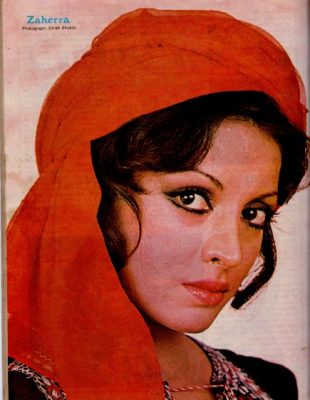
Zaherra Que Sera Sera…
Published date: Feb 1976, Stardust
View PDFZaherra is one of those unfortunates who are jinxed from the word ‘go’. Sometime back she said, “What’s not in a name?” and changed the ‘I’ in Zahirra to an ‘e’. But Zaherra is still lost in the wilderness. She does not even have a Russian fiancé like Katy (Cypher) Mirza, to console herself with, nor is she acting in vague movies with titles like ‘Sunrise Over the Volga’.
Zaherra’s also one of those people who are labelled early on in their careers as “nomos”. After she appeared in ‘Call Girl’ people began calling her up with all sorts of insinuations. And soon after she played the role of (hold your breath) a schoolgirl in ‘Anjaan Rahen’, all the schoolteachers in town rang her up with offers of free lessons. Trouble was, they were all men.
All this would have been enough to make any gypsy fortune-teller smash her crystal in disgust. But Zaherra has come back from London with two things to her credit—a small role in a James Bond movie, and lots of the pluck for which the British are famous. She refuses to say “die”. She looks at the world with a brave smile, even though it scowls at her, day in and day out.
When Zaherra was new in the Hindi film industry, she did not know how one tackled the countless problems a Hindi film star must face. One of her directors tried to get fresh with her on the sets of a film which shall remain unnamed. Zaherra, according to eye-witnesses, gave it back to the director, with a lot of ‘propah’ offended language. The director was not used to that sort of rebuff, and so he took great care to make Zaherra’s life miserable through the remainder of the film’s shooting. This incident is generally supposed to have been Zaherra’s baptism by fire in the Hindi film scene. She never liked the politics of it all, though, and it looks as though her senses, which had been considerably sophisticated by her foreign sojourn, will take quite some time to accept the crudities of the ways in which people operate over here.
But there is one thing about Zaherra that strikes most observers (and a lot of people, let me say, are observing her closely) is the fact that, like other “foreign-returned” film stars, or film-star-aspirants, she expects a comfortable deal in good old Bharat Hamara. Katy Mirza, Persis Khambhat, and Zaherra all fall into this pattern. All three were badly shaken by the realities they met here. Which goes to prove that “foreign” upbringing can broaden one’s outlook so much, that narrowing them to suit Indian conditions can be painful.
And then there was the magic promise of a role with that superstar, Rajesh Khanna, in ‘Naukri’. And in this film Zaherra was going to have two big blessings — a chance to co-star with Rajesh, and a chance to be directed by Hrishikesh Mukherjee. Things looked chirpy once again for the Bond girl, and she found her cornflakes crunchier at breakfast. But even this idyll was doomed to be broken. For, tempestuous Rajesh reportedly held up shooting for the film, and Zaherra’s old friend (enemy), the eager director of the pawing fame, decided to insert his ‘haddi’ into the ‘kabab’. He went around spreading stories about Zaherra and taught her yet another lesson—that discretion isn’t the better part of valour in Bombay’s Hindi-wood.
Later, of course, Zaherra bagged a role in ‘Sangeet Sajni’, Raj Khosla’s film, and opposite Sanjeev Kumar, who she has repeatedly stressed is her favorite actor. Even this deal has not been very rosy, because Zaherra is not the only lead female star in the film—there’s Moushumi Chatterjee too. Not that Zaherra’s the type of girl to crib about the disadvantage of a ‘parallel’ role.
All of which is quite sad. Because Zaherra (or Zahirra, which most people think is nicer) has got everything that it takes for success in filmdom—very good looks, poise, a nice nature, and she is extremely photogenic to shoot. And sometimes, looking at herself in her mirror, she must be asking: “Mirror, mirror, on the wall, who is the unluckiest of them all?”
Recently, Zaherra appeared in a textile advertising film, which said proudly at the beginning that Zaherra starred in it. And for five minutes, and for one reel, Zaherra wafted through outfit after heavenly outfit, looking like a page from VOGUE, smiling away to glory, selling the textiles she was modelling. Which again made many people say “tch tch”. Because so many promising young film people must make do by appearing in sleazy little advertising films, selling toothpaste, saris, and instant coffee. It is not the sort of thing one would expect a James Bond girl to have to do. It is not the sort of thing that ought to follow Fleming’s espionage intrigue. But then, how many Bharavis have heard of lan Fleming?
And this is the sort of deal our females can offer to a talented girl like Zaherra, in a country that wails about its brain drain every day. This is the sort of deal we offer to a very unusual film star(let) who is very, very careful about how she steps, and where she steps. Who does not have a ‘Godfather’ in the film industry-and who would not want one, either. And Zaherra has scrupulously avoided controversy—she has not been linked, romantically or otherwise, to any other name. She is pretty much a loner, preferring to attend parties on her lonesome own. But she never allows her despondency to show-midst the profusion of self-pitying interviews doled out by unlucky stars, she has remained consistently silent on her misfortunes. She never backbites about anyone, and nobody does about her (except for that director of lore). She is, in short, a dream girl for talent scouts, an answer to many producers’ prayers. Yet, she continues to trundle along in her well-worn, discouraged rut, wondering what she has done to deserve all this. Sometimes she thinks aloud, wondering whether she ever did the right thing by coming back to her motherland. No one can answer her.
But there’s hope. There is the thought that every grey cloud must have a silver lining. There are all the fans who have taken to Zaherra in a big way, and who would agree that she shouldn’t lose hope, that “Que Sera, Whatever Will Be Will Be”. But when Zaherra was a little girl, and asked her mother what she would be one day-whether she would be pretty, whether she would be rich, her mother must have replied : “Que Sera, my child, the future’s not ours to see.” The future’s not ours to see, either. Perhaps it holds a lot for Zaherra.



86v7e2
8al5hz
2qh1h2
o1znfa
ng7s21
3sju1c
g70aul